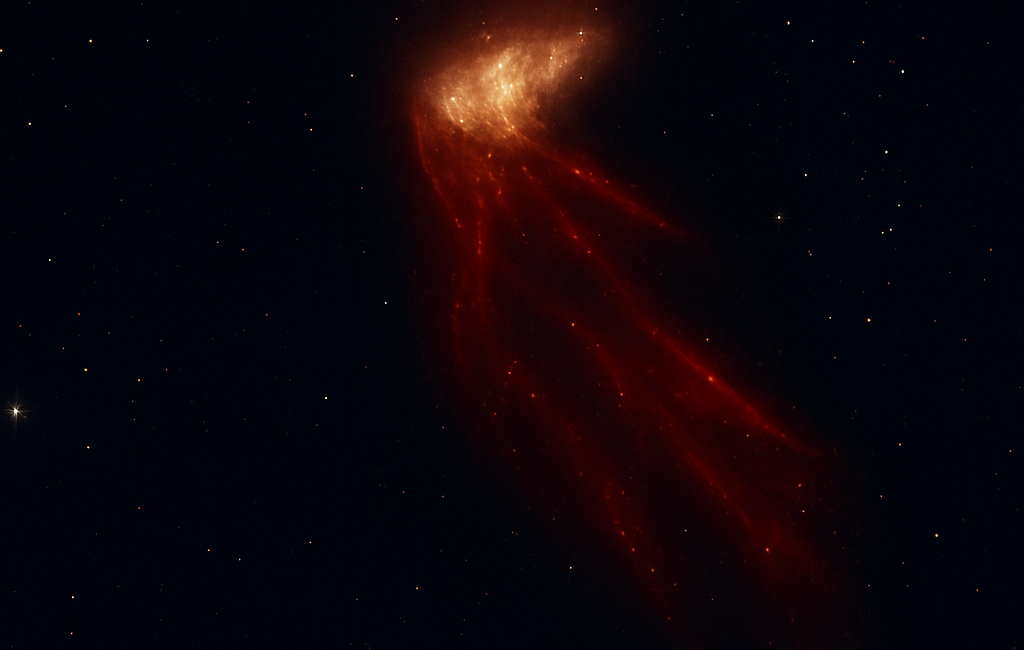
Jellyfish Galaxy Revealed — A Cosmic Predator in Deep Space
Daily Cosmic Update – March 3, 2026 | Cosmic A2Z

Introduction
The universe never fails to surprise us. Today marks the second Daily Cosmic Update on Cosmic A2Z, and it’s a discovery that blends drama with science: astronomers using the James Webb Space Telescope have revealed the most distant Jellyfish Galaxy ever recorded. This cosmic predator galaxy, streaming glowing tentacles of gas and newborn stars, offers a rare glimpse into the violent creativity of the early universe.
What Is a Jellyfish Galaxy?
Jellyfish galaxies are named for their striking appearance. Their bright central cores resemble the body of a jellyfish, while long, trailing streams of gas and dust stretch outward like tentacles. These streams are not just beautiful—they are sites of intense star formation in tentacles. As galaxies move through dense cosmic environments, gravitational forces and intergalactic winds strip away their gas, creating these spectacular trails.
The newly observed galaxy is the most distant jellyfish galaxy ever seen, dating back 8.5 billion years. That means the light reaching us today began its journey when the universe was less than half its current age.
The James Webb Breakthrough
The James Webb Space Telescope (JWST) continues to revolutionize astronomy. Its infrared vision allows scientists to peer deeper into the cosmos than ever before, capturing faint galaxies that older telescopes could not detect.
In this case, JWST revealed a galaxy being torn apart by cosmic forces. As its gas was stripped away, the galaxy responded by igniting new stars within its tentacle-like streams. This dual process—destruction and creation—makes jellyfish galaxies powerful laboratories for understanding how galaxy evolution unfolds.
Why This Discovery Matters
- Galactic Evolution: Jellyfish galaxies show how environments shape galaxies. By studying them, astronomers learn how galaxies lose gas, form stars, and change over billions of years.
- Cosmic History: Observing a jellyfish galaxy from 8.5 billion years ago provides direct evidence of how violent the early universe was.
- Star Formation: The tentacles are star nurseries. Understanding their dynamics helps explain how stars form under extreme conditions.
This discovery is not just about one galaxy—it’s about unlocking the story of how galaxies live, die, and transform.
The Drama of a Cosmic Predator
Astronomers often describe jellyfish galaxies as “predators” because they appear to devour themselves. Their tentacles stretch across space, glowing with the birth of new stars even as the galaxy’s core is stripped of its resources.
This duality—creation and destruction—makes them some of the most dramatic objects in the universe. They remind us that cosmic beauty often comes from violent processes.
Public Fascination and Viral Appeal
The term Jellyfish Galaxy itself sparks curiosity. It combines something familiar (a jellyfish) with something vast and mysterious (a galaxy). This makes it perfect for viral science communication.
For Cosmic A2Z, this discovery is a chance to connect audiences with both wonder and knowledge. A galaxy tearing itself apart while creating stars is a story that resonates emotionally and scientifically.
Watch the Shorts
To make this update even more engaging, Cosmic A2Z has prepared a YouTube Shorts video highlighting the Jellyfish Galaxy discovery.
Conclusion
The cosmos is alive with wonders. Today’s second Daily Cosmic Update reminds us that galaxies are not always peaceful—they can be predators, tearing themselves apart while giving birth to new stars.
The Jellyfish Galaxy, revealed by the James Webb Space Telescope, is more than a discovery. It’s a story of galaxy evolution, destruction, and rebirth. Stay tuned to Cosmic A2Z for tomorrow’s Daily Cosmic Update.