Introduction
On March 12, 2026, astronomers announced a breakthrough that redefines our understanding of planetary magnetism. For the first time, the James Webb Space Telescope (JWST) has captured Uranus’s near‑complete spin. Unlike any other planet in our solar system, Uranus rotates on its side — a cosmic oddity that has baffled scientists for decades. Over a 15‑hour observation, JWST collected more than 1,000 spectra, exposing how Uranus’s tilted magnetic field interacts with its atmosphere. This discovery doesn’t just explain Uranus’s strange tilt — it reshapes our understanding of planetary magnetism across the universe.
Uranus: The Sideways Planet
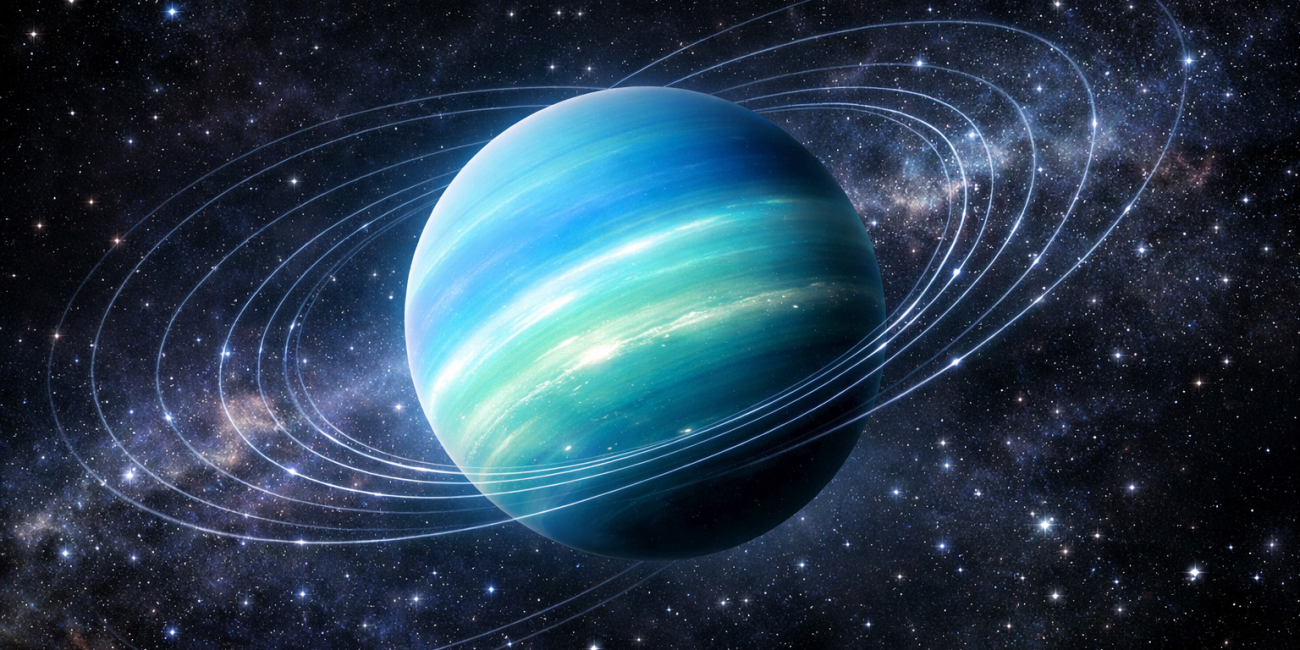
Uranus is often called the “sideways planet.” With a tilt of nearly 98 degrees, it rolls around the Sun rather than spinning upright like Earth or Jupiter. This extreme tilt creates bizarre seasonal effects: each pole experiences 42 years of continuous daylight followed by 42 years of darkness. For decades, scientists debated how Uranus ended up this way. Was it struck by a massive proto‑planet billions of years ago? Or could its tilt be linked to deeper magnetic and atmospheric processes? JWST’s new observations provide the clearest evidence yet that Uranus’s magnetic field plays a central role in shaping its unusual behavior.
JWST’s Breakthrough Observations
The James Webb Space Telescope, launched in 2021, has already revolutionized astronomy with its infrared vision. For Uranus, JWST tracked the planet’s rotation continuously for 15 hours, gathering over 1,000 spectra. Each spectrum revealed how light interacts with Uranus’s atmosphere and magnetic field. These observations showed that Uranus’s magnetic field is not only tilted but also offset from the planet’s center. This creates a dynamic interaction between the atmosphere and magnetosphere, producing strange auroras and energy flows unlike anything seen on Earth or Jupiter.
Uranus’s Auroras: A Magnetic Light Show
One of the most fascinating outcomes of JWST’s observations was the detection of auroral activity on Uranus. Unlike Earth’s auroras, which are concentrated near the poles, Uranus’s auroras appear in unpredictable locations due to its tilted and offset magnetic field. These auroras are created when charged particles from the solar wind collide with Uranus’s atmosphere, releasing bursts of light. JWST’s infrared spectra allowed astronomers to map these auroras in detail, offering clues about how energy flows through the planet’s magnetosphere.
Why This Matters
This breakthrough is more than just a curiosity about Uranus. It provides a template for understanding planetary magnetism across the universe. Many exoplanets discovered in recent years show unusual tilts, rotations, and magnetic fields. By studying Uranus, astronomers can better interpret these distant worlds. Magnetic fields are critical for planetary habitability. On Earth, our magnetic field shields us from harmful solar radiation. On Uranus, the tilted field creates chaotic interactions with the solar wind. Understanding these dynamics helps scientists predict how magnetic fields protect — or fail to protect — planets elsewhere in the cosmos.
Exoplanet Parallels
Uranus’s sideways spin is not just a local curiosity — it may be a key to understanding distant exoplanets. Many exoplanets discovered by missions like Kepler and TESS show extreme tilts or unusual orbital behaviors. Some “hot Jupiters” orbit so close to their stars that their magnetic fields are constantly bombarded by stellar winds. By comparing Uranus’s tilted magnetism with these exoplanets, astronomers can build models that explain how planetary magnetism evolves under different cosmic conditions. This connection strengthens Uranus’s role as a natural laboratory for exoplanet science.
The Role of JWST
JWST continues to prove its value as humanity’s most powerful space observatory. Its ability to capture Uranus’s full rotation demonstrates the telescope’s precision and endurance. By collecting over 1,000 spectra in a single observation, JWST provided a dataset that will fuel planetary science for years to come. Astronomers plan to use JWST to study Neptune next, hoping to compare its magnetic field with Uranus’s. Together, these ice giants may reveal a broader pattern of magnetism in the outer solar system.
Future Research
The Uranus breakthrough is only the beginning. Future JWST campaigns will focus on Neptune, exoplanets with tilted axes, and even brown dwarfs with magnetic fields. Ground‑based observatories will complement JWST’s findings, creating a multi‑layered picture of how magnetism shapes planetary atmospheres. Scientists also hope to simulate Uranus’s magnetic field in supercomputers, testing theories about how such tilts arise and persist over billions of years. These efforts will deepen our understanding of planetary evolution and cosmic magnetism.
Public Engagement: Cosmic Wonder
For the public, Uranus’s sideways spin is a reminder of the universe’s strangeness. Planets are not uniform spheres behaving predictably — they are dynamic worlds with unique histories. JWST’s discovery invites us to imagine what other oddities await in distant star systems. This is why Cosmic A2Z’s Daily Cosmic Update highlights such breakthroughs. By sharing them in accessible language, we connect audiences worldwide to the wonder of cosmic science and inspire curiosity about the cosmos.
YouTube Shorts Integration
To maximize engagement, this discovery is featured in a YouTube Shorts video. Watch the clip below to see Uranus’s sideways spin explained in under 30 seconds:
Conclusion
The James Webb Space Telescope’s capture of Uranus’s sideways spin marks a turning point in planetary science. By revealing how Uranus’s tilted magnetic field interacts with its atmosphere, astronomers have opened a new chapter in our understanding of cosmic magnetism. This discovery is not just about Uranus — it’s about the universe. It shows that planetary magnetism is diverse, dynamic, and essential to understanding worlds near and far. As JWST continues to explore, we can expect more breakthroughs that challenge our assumptions and expand our cosmic imagination.