Introduction
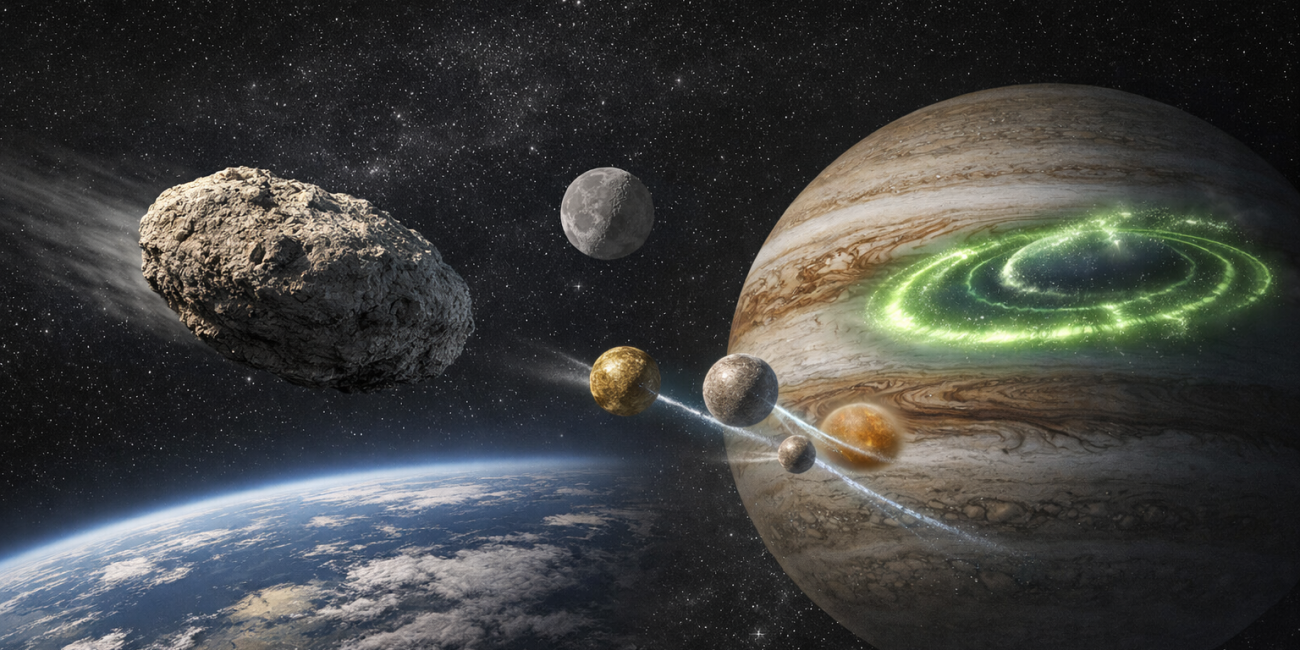
On March 11, 2026, two extraordinary cosmic events captured the attention of astronomers and space enthusiasts worldwide. A near‑Earth asteroid, 2026 CC3, roughly the size of a bus, made a safe but close pass by our planet. At the same time, the James Webb Space Telescope (JWST) unveiled a breathtaking discovery: Jupiter’s moons leave icy “footprints” in its glowing auroras, reshaping the giant planet’s atmosphere in ways scientists never imagined.
Together, these events highlight both the dangers and the wonders of our cosmic neighborhood, reminding us of Earth’s vulnerability while inspiring awe at the beauty of planetary systems.
Asteroid 2026 CC3: A Close Encounter
Asteroid 2026 CC3 is classified as a near‑Earth object (NEO). Measuring about 30 feet across—comparable to a city bus—it passed Earth at a distance of nearly one million miles. While this distance is safe, it is close enough to emphasize the importance of asteroid monitoring.
Why It Matters
- Planetary Defense: Even small asteroids can cause significant damage if they enter Earth’s atmosphere. Tracking flybys ensures early‑warning systems remain accurate.
- Scientific Opportunity: Each close approach allows astronomers to refine orbital predictions and study asteroid composition.
- Public Awareness: Events like CC3’s flyby remind us that Earth is part of a dynamic system where cosmic debris constantly moves through space.
NASA and other space agencies maintain databases of thousands of NEOs. While CC3 posed no threat, its flyby is a reminder that vigilance is essential.
How Scientists Track Asteroids
Near‑Earth objects like asteroid 2026 CC3 are monitored by NASA’s Planetary Defense Coordination Office and international observatories. Using radar imaging and orbital calculations, scientists can predict future flybys decades in advance. This ensures that even small asteroids, which may only measure a few dozen feet across, are catalogued and tracked. The importance of this work was highlighted by the DART mission in 2022, which successfully altered the orbit of a small asteroid to test planetary defense strategies. These efforts prove that humanity is developing tools to protect Earth from potential impacts.
Jupiter’s Auroras: Footprints of Its Moons
While Earth watched an asteroid pass, the James Webb Space Telescope turned its gaze toward Jupiter. What it found was stunning: Jupiter’s auroras are not only shaped by solar winds but also by its moons.
The Discovery
JWST revealed that Io, Europa, and Ganymede leave icy “footprints” in Jupiter’s auroras. These trails are created when charged particles from the moons interact with Jupiter’s magnetic field, reshaping the planet’s upper atmosphere.
Why It’s Stunning
- Io’s Volcanic Influence: Io’s volcanic activity releases sulfur and oxygen, fueling auroral patterns.
- Europa’s Icy Trail: Europa’s frozen surface contributes water molecules that spark unique auroral signatures.
- Ganymede’s Magnetic Field: As the only moon with its own magnetic field, Ganymede adds complexity to Jupiter’s auroral dance.
This discovery shows how moons can directly reshape a planet’s atmosphere, a phenomenon scientists never expected before JWST’s advanced instruments.
Comparing Auroras: Earth vs Jupiter
On Earth, auroras are created when solar wind particles collide with our magnetic field, producing shimmering lights near the poles. Jupiter’s auroras, however, are far more powerful. The planet’s immense magnetic field and its interaction with moons like Io and Europa create auroral emissions that are hundreds of times stronger than those on Earth. The James Webb Space Telescope is uniquely equipped to study these phenomena in infrared wavelengths, revealing details invisible to previous missions.
The Bigger Picture
Together, these events illustrate two sides of our cosmic reality:
- Threats: Asteroids remind us of Earth’s vulnerability.
- Wonders: Moons sculpting auroras reveal the beauty of planetary systems.
Astronomy is not just about survival—it’s about awe, curiosity, and the drive to understand our place in the universe.
Future Outlook
Looking ahead, missions such as Europa Clipper will explore Jupiter’s icy moon in detail, searching for signs of habitability beneath its frozen crust. Meanwhile, asteroid monitoring programs continue to refine detection methods, ensuring Earth remains prepared for future encounters. JWST will keep observing distant worlds, expanding our knowledge of planetary atmospheres and cosmic phenomena. Each discovery adds to humanity’s growing understanding of the universe and strengthens our ability to protect our planet.
Watch the Cosmic Update on YouTube
For a quick visual breakdown, watch our YouTube Shorts covering both events:
👉 Watch on YouTube: Asteroid Flyby & Jupiter’s Footprints – March 11, 2026 | Cosmic Update
Experience the asteroid’s close pass and Jupiter’s glowing auroras in under 60 seconds.
SEO‑Optimized Key Points
- Asteroid 2026 CC3 flyby near Earth (March 11, 2026).
- James Webb Space Telescope discovers icy footprints in Jupiter’s auroras.
- Importance of planetary defense and asteroid monitoring.
- Moons Io, Europa, and Ganymede reshaping Jupiter’s atmosphere.
- Cosmic neighborhood dangers and wonders.
- Comparing Earth’s auroras with Jupiter’s powerful emissions.
- Future missions: Europa Clipper and continued JWST observations.
Conclusion
The safe passage of asteroid 2026 CC3 and the breathtaking discovery of Jupiter’s auroral footprints remind us that space is both a realm of potential hazards and endless beauty. As technology advances, we continue to uncover secrets that reshape our understanding of the universe.
These discoveries are not isolated—they are part of a larger narrative of exploration, vigilance, and wonder. Earth may be fragile, but our curiosity and scientific progress ensure that we remain prepared while continuing to marvel at the cosmos.