Comet 46P/Wirtanen Returns in March 2026: A Cosmic Visitor Brightens Our Skies
Introduction: A Messenger From the Outer Solar System
As the excitement from the recent Blood Moon eclipse fades, the cosmos offers yet another gift: the return of Comet 46P/Wirtanen. This small but active comet, often nicknamed the “Christmas Comet” due to its bright 2018 appearance, is once again gracing Earth’s skies in March 2026. While not as dazzling as Halley’s Comet, Wirtanen’s close approach makes it a fascinating target for astronomers and skywatchers alike.
What Is Comet 46P/Wirtanen?
Discovered in 1948 by Carl Wirtanen, this comet belongs to the Jupiter-family comets, meaning its orbit is strongly influenced by Jupiter’s gravity.
- Orbital period: Roughly 5.4 years.
- Size: About 1.2 kilometers across — relatively small compared to giants like Halley’s Comet.
- Composition: A mix of ice, dust, and rocky material, shedding gas and particles as it nears the Sun.
Visibility in March 2026
During its current approach, Comet Wirtanen is visible with binoculars and small telescopes, especially under dark skies.
- Best regions: Southern Hemisphere observers have the clearest view, though Northern Hemisphere stargazers can also spot it.
- Timing: Look toward the southwestern horizon after sunset.
- Brightness: Estimated magnitude around +6, making it faint but detectable with optical aid.
Why This Appearance Matters
While comets are relatively common, Wirtanen’s return is special for several reasons:
- Close approach: At just over 50 million kilometers from Earth, it’s one of the nearer cometary visits this decade.
- Scientific interest: NASA and ESA astronomers continue to study its composition to understand the building blocks of our solar system.
- Public fascination: Comets have long been seen as cosmic messengers, inspiring awe and sometimes superstition.
The Science of Comets
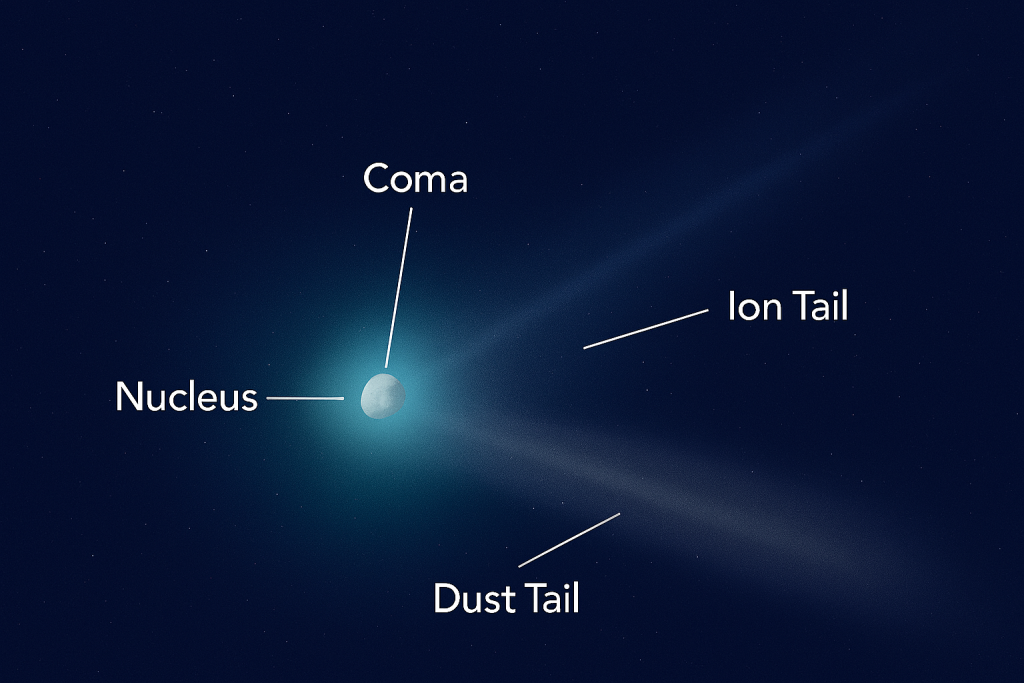
Comets are often described as “dirty snowballs” — frozen remnants from the early solar system. As they approach the Sun, heat causes sublimation, releasing gas and dust that form:
- Coma: A glowing cloud surrounding the nucleus.
- Ion tail: A bluish stream pushed away by solar wind.
- Dust tail: A golden trail reflecting sunlight.
Wirtanen, though small, displays these features beautifully through telescopes.
Observing Tips
If you want to catch Comet Wirtanen this month:
- Use binoculars or a telescope: Naked-eye visibility is limited, but optical aid reveals its fuzzy glow.
- Dark skies are essential: Rural areas far from city lights provide the best chance.
- Astrophotography: Long-exposure shots can capture the comet’s faint tail.
- Patience: Comets are subtle compared to eclipses or conjunctions — slow observation pays off.
Cultural Resonance of Comets
Conclusion: A Cosmic Visitor Worth Watching
The return of Comet 46P/Wirtanen in March 2026 may not dominate headlines like a Blood Moon, but it offers something equally profound: a chance to glimpse a fragment of our solar system’s origins. Whether through binoculars, telescopes, or astrophotography, this comet reminds us that the universe is alive with