Introduction
Dark matter remains one of the greatest mysteries in modern astrophysics. While it makes up about 85% of the universe’s matter, it does not interact with light, making it invisible to telescopes. Recently, physicists have uncovered new evidence that a special form of dark matter—known as self‑interacting dark matter—may dramatically reshape galaxies from within. This discovery could revolutionize our understanding of cosmic evolution and the hidden forces that govern the universe.
For decades, scientists have tried to explain why galaxies behave the way they do. Some galaxies rotate faster than expected, while others show unusual heating in their cores. Traditional models of cold dark matter cannot fully explain these anomalies. That is why the idea of self‑interacting dark matter has gained attention—it offers a new way to understand the invisible scaffolding of the cosmos.
What Is Self‑Interacting Dark Matter?
Most theories describe dark matter as “cold” and non‑interacting, meaning it passes through itself and normal matter without collisions. However, self‑interacting dark matter (SIDM) behaves differently. It collides with itself, redistributing energy inside dark matter halos—the invisible structures that surround galaxies. These collisions can trigger collapses, heating galaxies internally and altering how stars form and evolve.
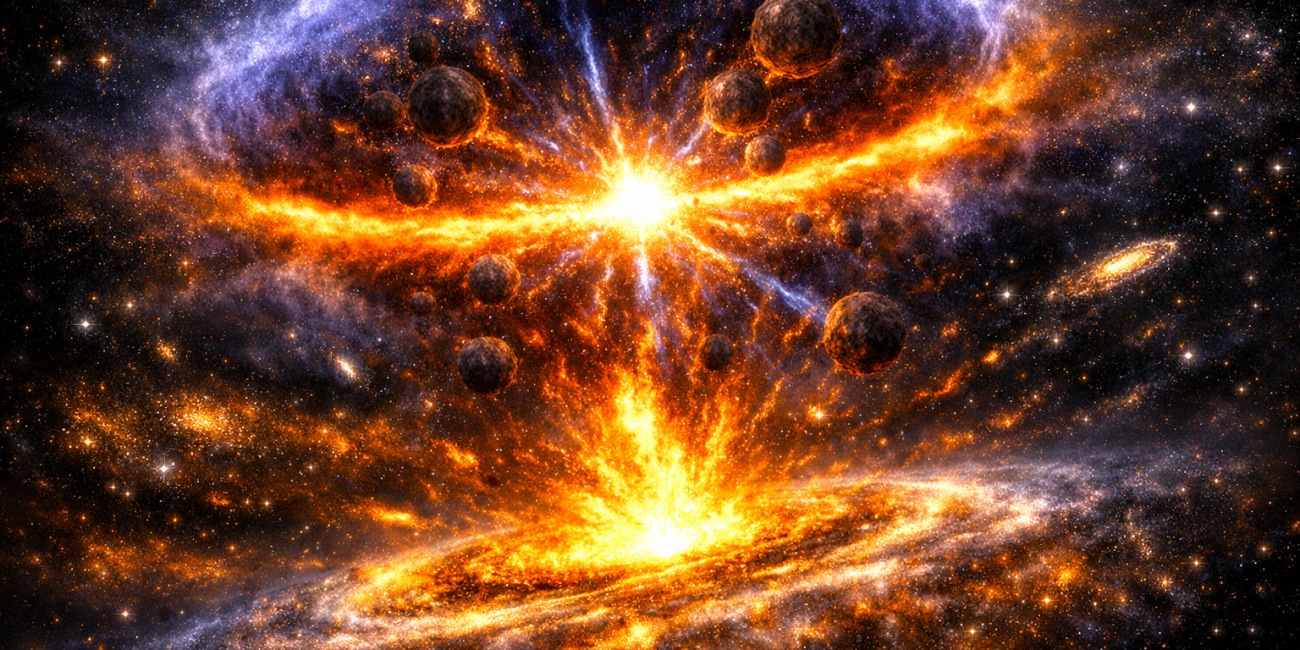
Think of dark matter halos as invisible cocoons around galaxies. In the cold dark matter model, these cocoons remain stable. But in the SIDM model, the cocoons can collapse inward, releasing energy like a hidden furnace. This process could explain why some galaxies appear hotter than expected, even when no external forces are acting on them.
The Collapse of Dark Matter Halos
Physicists have discovered that SIDM can cause dark matter halos to undergo dramatic collapses. Instead of remaining stable, the halos contract inward, releasing energy that heats the galaxy’s core. This process may explain puzzling observations where galaxies appear hotter or more turbulent than expected.
- Star formation rates – heating may suppress or accelerate star birth.
- Galaxy morphology – spiral arms and cores could evolve differently.
- Cosmic balance – the interplay between dark matter and baryonic matter may be more dynamic than previously thought.
Computer simulations of SIDM collapses show galaxies evolving in unexpected ways. Some galaxies may develop denser cores, while others may experience bursts of star formation triggered by internal heating. These simulations provide a new lens through which astronomers can interpret puzzling data collected from telescopes.
Why This Matters for Cosmic Evolution
The discovery of SIDM collapses challenges long‑standing models of galaxy formation. If dark matter can heat galaxies from within, it adds a hidden layer of complexity to cosmic history. This could help explain:
- Why some galaxies glow hotter than expected.
- Why certain galactic cores appear unusually dense.
- How cosmic structures evolve differently across time and space.
Cosmic evolution is not just about stars and gas—it is also about the invisible forces shaping them. SIDM introduces a new mechanism that could alter the timeline of galaxy growth. Instead of galaxies evolving only through external mergers and collisions, they may also be reshaped internally by dark matter collapses.
Observational Evidence
Astronomers are now searching for signatures of SIDM collapses in real galaxies. Clues may include:
- Unexpected heating in galactic centers.
- Distorted halo shapes compared to predictions.
- Star formation anomalies linked to internal heating.
Future telescopes, such as the James Webb Space Telescope, gravitational lensing surveys, and X‑ray observatories, may provide direct evidence of these collapses. By comparing galaxies across different ages and distances, scientists hope to identify patterns that match SIDM predictions. If confirmed, this would be one of the most significant breakthroughs in astrophysics in decades.
The Bigger Picture
Dark matter has always been the “invisible architect” of the universe, shaping galaxies through gravity. With SIDM, it may also act as an internal engine, heating and reshaping galaxies from within. This dual role makes dark matter even more central to cosmic evolution than previously imagined.
On a larger scale, SIDM could influence galaxy clusters and the cosmic web itself. If collapses occur across vast structures, they may affect how matter is distributed throughout the universe. This could reshape our understanding of cosmology, from the birth of galaxies to the fate of the universe.
Watch the Cosmic Update
For a quick breakdown of this discovery, check out our YouTube Short:
Conclusion
The discovery of self‑interacting dark matter collapses marks a turning point in astrophysics. By colliding with itself, dark matter may heat galaxies internally, reshaping stars and cosmic structures. As scientists continue to investigate, we may be on the verge of unlocking one of the universe’s deepest secrets.
For readers and viewers, this is more than just science—it is a reminder of how much remains hidden in the cosmos. Every new discovery about dark matter brings us closer to understanding the grand design of the universe. Stay tuned with Cosmic A2Z for daily updates on cosmic mysteries, astrophysics breakthroughs, and the wonders of the universe.