Introduction
Astronomers have achieved a groundbreaking discovery: a hydroxyl gigamaser, often called a “cosmic laser,” detected more than 8 billion light-years away. Using the MeerKAT radio telescope in South Africa, scientists identified this powerful radio signal from a galaxy merger. This record-setting find not only expands our knowledge of the universe but also demonstrates the incredible capabilities of modern radio astronomy. Alongside this, ESA’s Mars Express orbiter has released new images of Mars’ cratered surface, reminding us that cosmic drama unfolds both near and far.
What Is a Cosmic Laser?
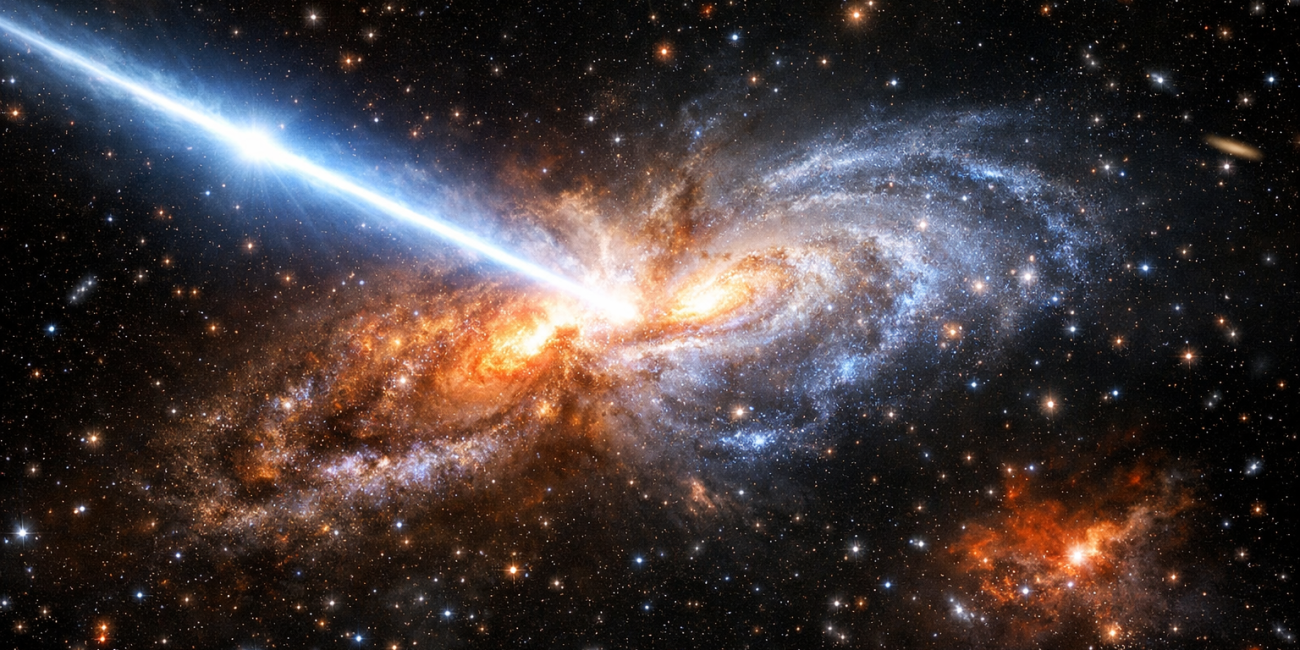
A cosmic laser, or hydroxyl megamaser, is a naturally occurring amplified radio signal. It forms when molecules such as hydroxyl (OH) are excited in dense, turbulent environments. Galaxy collisions compress gas clouds, stimulating hydroxyl molecules to emit intense radio waves. These emissions are so powerful they can be detected across billions of light-years. The newly discovered signal is classified as a gigamaser, far brighter than typical megamasers, making it a beacon from the distant universe.
The Discovery
The signal originated from a galaxy merger more than 8 billion light-years away. MeerKAT’s 62 antennas worked together to capture the razor-thin spike of radio light at a wavelength of 18 cm. Gravitational lensing, where a foreground galaxy magnifies the background source, boosted the signal, making it visible to Earth-based instruments. This detection sets a new record for the most distant hydroxyl maser ever observed, pushing the boundaries of what astronomers can study.
Why It Matters
This discovery is significant for several reasons:
- Record-Breaking Distance: At over 8 billion light-years, this is the most distant hydroxyl maser ever detected.
- Galaxy Evolution: Gigamasers reveal how merging galaxies ignite star formation and fuel extreme cosmic activity.
- Radio Astronomy Frontier: The discovery demonstrates MeerKAT’s ability to probe the early universe, when galaxies were more chaotic and collisions more frequent.
- Cosmic Timeline: We are seeing this event as it happened when the universe was less than half its current age.
Mars Express Update
While astronomers celebrated the gigamaser discovery, ESA’s Mars Express orbiter delivered new high-resolution images of Mars. These snapshots highlight the planet’s violent past, marked by asteroid impacts and geological upheavals. The cratered terrain offers clues about Mars’ history and evolution. Together, these updates remind us that cosmic drama is not limited to distant galaxies but also plays out within our solar system.
Embedded Video
Watch the relevant YouTube Shorts update here:
Conclusion
The detection of a cosmic gigamaser 8 billion light-years away is more than a record-setting achievement—it is a window into the turbulent processes that shaped galaxies and stars across cosmic history. As telescopes like MeerKAT continue to scan the skies, we can expect more revelations that challenge our understanding of the universe. Meanwhile, Mars Express continues to remind us of the dynamic history of our neighboring planet. From galactic collisions to Martian scars, the cosmos never stops surprising us. For daily insights into cosmic wonders, stay tuned to Cosmic A2Z—where science meets curiosity.
SEO Keywords and Hashtags
Keywords: Cosmic Laser, Gigamaser, Galaxy Collision, MeerKAT Telescope, Mars Express, Astronomy News, Daily Cosmic Update, Space Science.
Hashtags: #CosmicUpdate #SpaceNews #Astronomy #CosmicLaser #GalaxyCollision #Mars #DailyCosmicUpdate #Cosmos #ScienceNews #Universe