Introduction: Is Mars Under Attack from the Sun?
Mars, the Red Planet, has long fascinated scientists and dreamers alike. But beneath its dusty surface lies a cosmic mystery: why did Mars lose its protective atmosphere while Earth continues to thrive? On March 7, 2026, NASA’s upcoming ESCAPADE mission takes center stage in answering this question. With twin satellites set to orbit Mars, scientists hope to uncover how solar storms and solar wind strip away gases from the planet’s fragile atmosphere.
The Cosmic Battle: Sun vs. Mars
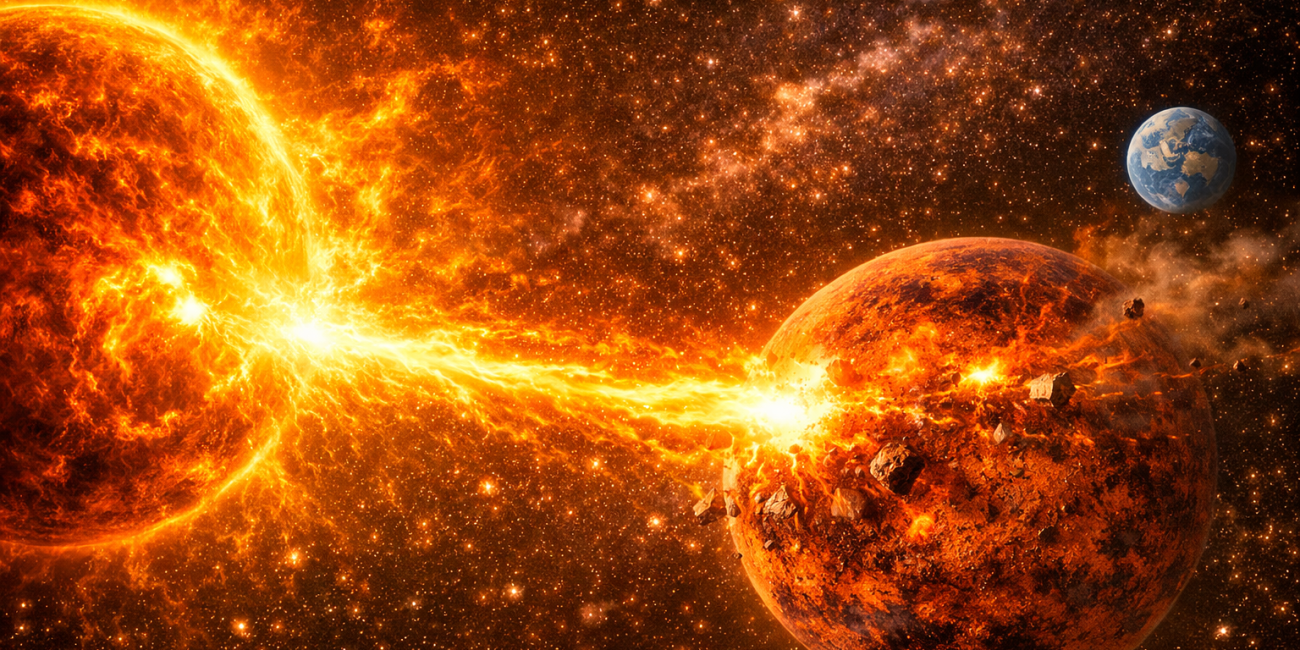
The Sun is both a giver of life and a destroyer. Its solar wind—a stream of charged particles—constantly blasts through the solar system. Earth survives thanks to its magnetic field, which deflects most of this radiation. Mars, however, lost its magnetic shield billions of years ago. Without protection, Mars’ atmosphere has been steadily eroded. Solar storms accelerate this process, stripping away more gases and leaving the planet exposed and barren.
This cosmic battle raises a haunting question: could Mars ever sustain human life if its atmosphere continues to vanish? Understanding this process is vital not only for planetary science but also for humanity’s long-term ambitions of colonizing Mars.
NASA’s ESCAPADE Mission: Twin Satellites to the Rescue
Scheduled for launch in 2026, ESCAPADE (Escape and Plasma Acceleration and Dynamics Explorers) is a groundbreaking mission. Two identical satellites will orbit Mars, working together to track how solar storms interact with the planet’s atmosphere.
- Measure solar wind impact on Mars’ upper atmosphere
- Track plasma flows and how gases escape into space
- Compare Mars’ atmospheric loss with Earth’s resilience
By studying these interactions, scientists hope to reconstruct Mars’ atmospheric history and predict its future. ESCAPADE could also provide vital data for future human missions to Mars, ensuring astronauts are prepared for solar radiation hazards.
Why Earth Survived While Mars Did Not
Earth’s magnetic field acts like a cosmic shield, generated by its molten iron core. Mars, however, cooled too quickly, shutting down its magnetic field. Over billions of years, solar storms stripped away its atmosphere, leaving behind a thin layer of carbon dioxide. This explains why Mars is cold, dry, and inhospitable compared to Earth’s lush biosphere.
Understanding this difference is not just scientific curiosity—it’s essential for protecting Earth and planning human colonization of Mars. Without a magnetic shield, any future Martian settlers will face extreme radiation risks.
The Sun’s Fury: A Threat to All Planets
Solar storms don’t just affect Mars. On Earth, they can disrupt satellites, power grids, and communication systems. Studying Mars’ vulnerability helps scientists better understand how solar activity impacts planetary environments across the solar system.
If humanity hopes to expand beyond Earth, we must learn how to shield ourselves from the Sun’s fury. ESCAPADE is a step toward that knowledge, offering insights into both planetary science and space weather forecasting.
Cosmic Storytelling: Why This Matters for You
Space exploration isn’t just about science—it’s about perspective. Mars’ struggle against solar storms reminds us of Earth’s fragility. Our planet thrives because of its magnetic shield, but that protection is not guaranteed forever. Following missions like ESCAPADE helps us understand cosmic forces that shape planetary destinies.
By connecting science with storytelling, platforms like Cosmic A2Z bring these discoveries to life, blending cinematic visuals with daily cosmic updates.
Watch the YouTube Short: Mars Under Solar Attack
Experience this cosmic clash in motion. Watch the short video update here:
Conclusion: Mars’ Destiny Lies with the Sun
Mars’ fate is tied to solar storms. Without a magnetic shield, the planet continues to lose its atmosphere, making colonization a daunting challenge. NASA’s ESCAPADE mission offers hope by unraveling the mysteries of solar wind and planetary survival. As humanity looks to the stars, understanding the Sun’s fury is essential. Will Mars remain barren, or could future technology help restore its shield? The answers may shape the future of space exploration.