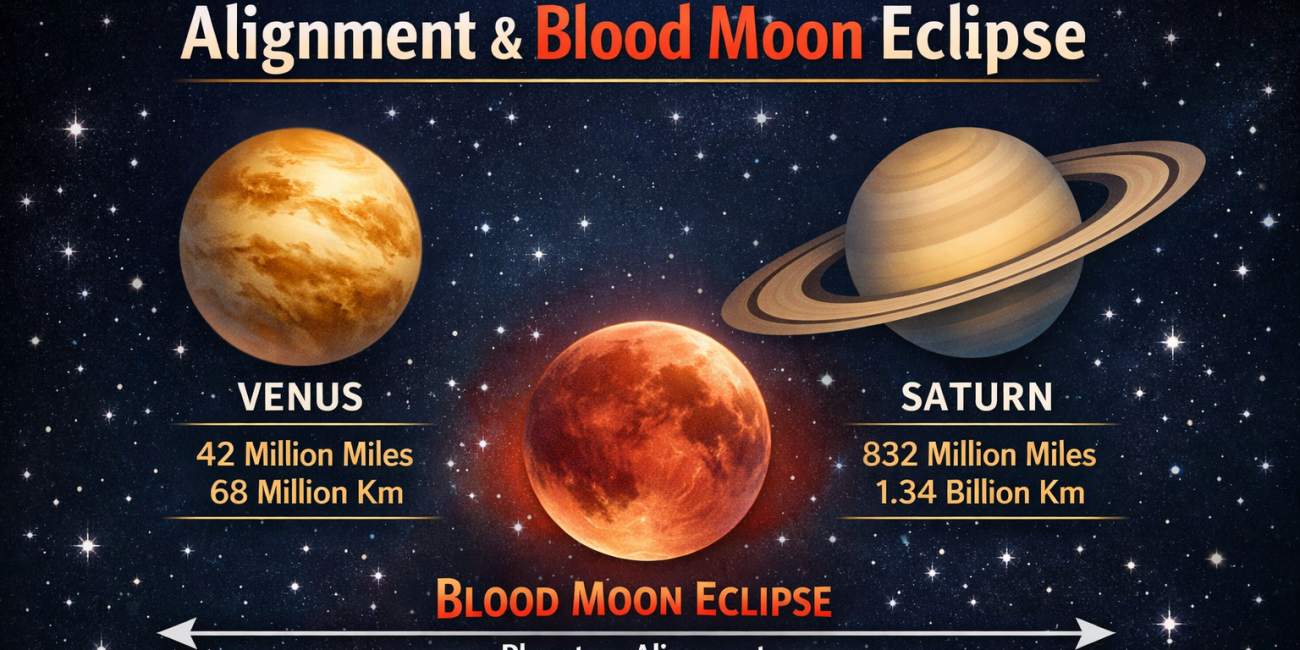
On March 8, 2026, the twilight sky offers a rare spectacle: Venus and Saturn appear side by side, separated by just one degree. This fleeting cosmic embrace is visible in the western sky after sunset, blending scientific wonder with poetic beauty. For astronomers, casual stargazers, and anyone who pauses to look up, tonight’s conjunction is a reminder of how vast and interconnected our universe truly is.
What Is Happening Tonight?
Venus, often called the “Evening Star,” shines brilliantly at magnitude –3.9, dominating the twilight sky. Saturn, though fainter at magnitude 0.9, appears close enough to Venus that the two planets seem like neighbors. In reality, Saturn is nearly 900 million miles farther away, but orbital mechanics align them in our line of sight. This illusion is what astronomers call a conjunction, and it is one of the most visually striking events of the year.
To witness this event, look west shortly after sunset. Venus will be unmistakable, glowing brightly above the horizon. Saturn will appear just to its side, a subtle golden point of light. Binoculars may enhance the view, though the naked eye is enough to appreciate the beauty of this cosmic pairing. Telescopes may reveal Saturn’s rings, but the planets will be too far apart to fit neatly in the same field of view.
Other Cosmic News
Tonight’s conjunction is just one highlight in a year filled with celestial wonders. Astronomy enthusiasts can look forward to several major events in 2026:
- Six‑Planet Parade: Later this year, Mercury, Venus, Mars, Jupiter, Saturn, and Neptune will align across the sky. Such alignments are rare and often spark cultural fascination, blending science with myth. Skywatchers will have the chance to see multiple planets stretched across the horizon in a single evening.
- Blood Moon Eclipse: A total lunar eclipse will paint the Moon in deep red hues, visible across Asia and Africa. Known as a “Blood Moon,” this event occurs when Earth’s shadow completely covers the Moon, filtering sunlight through our atmosphere and casting a crimson glow.
- Space Exploration Updates: NASA’s Artemis program continues preparations for crewed lunar missions, aiming to return humans to the Moon. SpaceX’s Starship is undergoing new test flights, pushing the boundaries of reusable rocket technology. Meanwhile, the James Webb Space Telescope has released breathtaking images of galaxies formed just a few hundred million years after the Big Bang, expanding our understanding of cosmic history.
Cultural and Emotional Resonance
Throughout history, planetary conjunctions have been seen as omens, inspirations, and cosmic milestones. Ancient civilizations often interpreted such alignments as messages from the heavens. In modern times, they serve as reminders of our place in the universe. Tonight’s Venus–Saturn meeting can be seen as a cosmic embrace, two travelers crossing paths briefly before continuing their journeys. It is also a reminder of impermanence—Saturn will soon drift into the morning skies, leaving Venus alone as the evening star.
For many, these events spark wonder and reflection. They encourage us to pause, look up, and feel connected to something larger than ourselves. Whether you are an astronomer with a telescope or simply someone enjoying the night sky, tonight’s conjunction offers a chance to experience awe and humility.
The symbolism of Venus and Saturn together is powerful. Venus represents love, beauty, and passion, while Saturn symbolizes discipline, patience, and structure. Their meeting in the sky can be interpreted as a balance between desire and responsibility, a cosmic reminder that harmony often comes from opposites. This poetic resonance adds depth to the scientific wonder of the event.
Conclusion
The Venus–Saturn conjunction of March 8, 2026, is more than just an astronomical event—it is a reminder of cosmic impermanence and beauty. Combined with upcoming spectacles like the six‑planet parade and Blood Moon eclipse, 2026 is shaping up to be a landmark year for skywatchers. Tonight, pause to look west at dusk and witness two cosmic travelers meeting at the edge of the horizon. In their brief alignment, we are reminded of the vast distances that separate worlds, and yet the shared perspective that unites us all under one sky.
As you watch Venus blaze and Saturn whisper faintly beside her, consider the scale of the universe and the fleeting nature of cosmic alignments. These moments remind us that even across millions of miles, the universe finds ways to bring worlds together. And for us here on Earth, they offer a chance to feel wonder, curiosity, and connection to the cosmos.
Looking ahead, the six‑planet parade and Blood Moon eclipse promise more opportunities to marvel at the sky. Each event is unique, but together they form a cosmic calendar that keeps us engaged with the rhythms of the universe. Tonight’s conjunction is a chapter in that ongoing story, one that blends science, culture, and emotion into a single breathtaking view.