Introduction
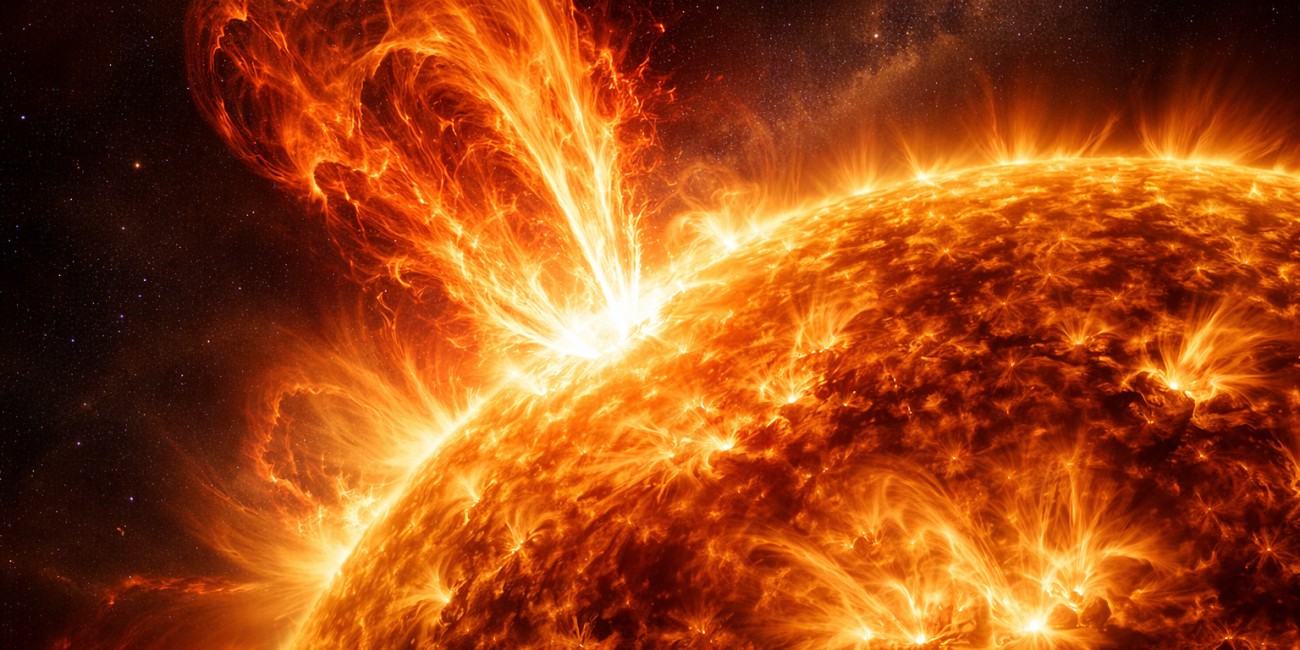
On March 9, 2026, the Sun unleashed a powerful solar flare that sent charged particles racing toward Earth. As these particles collided with our planet’s magnetic field, they produced breathtaking auroras visible far beyond the polar regions. This cosmic event is both a visual wonder and a scientific reminder of how deeply connected we are to the universe. In this article, we explore the science behind solar storms, their impact on Earth, and why they matter for our future in space exploration.
What Happened Today?
NASA and global observatories reported a solar storm triggered by a coronal mass ejection (CME). These eruptions release plasma and magnetic fields into space. When directed toward Earth, they interact with our magnetosphere, producing geomagnetic storms. Today’s event was moderate but significant enough to create auroras visible in regions that rarely experience them.
- Auroras: Green, red, and purple lights danced across the skies, visible farther south than usual.
- Technology Impact: Solar storms can disrupt satellites, GPS systems, and power grids. Today’s event was closely monitored to prevent disruptions.
- Scientific Importance: Studying these storms helps us understand space weather and protect modern technology.
The Science Behind Auroras
Auroras occur when charged particles from the Sun collide with atoms in Earth’s atmosphere. Oxygen produces green and red lights, while nitrogen creates blue and purple hues. This natural light show is a direct result of cosmic energy interacting with our planet’s protective shield. Scientists study auroras not only for their beauty but also to learn more about how Earth’s magnetic field protects us from harmful solar radiation.
Why Solar Storms Matter
Solar storms are not just beautiful—they carry real consequences:
- Communication Systems: Radio signals can be disrupted, affecting aviation and maritime communication.
- Navigation: GPS accuracy may decline, impacting transportation and logistics.
- Power Grids: Strong storms can overload electrical systems, leading to blackouts.
- Space Exploration: Astronauts and spacecraft face increased radiation risks, making monitoring essential.
Understanding solar storms is crucial for building resilience in our technology-dependent world. As humanity prepares for deeper space missions, protecting astronauts from solar radiation will be one of the greatest challenges.
Historical Context
Solar storms have impacted Earth throughout history. The most famous example is the Carrington Event of 1859, when a massive solar storm disrupted telegraph systems worldwide. If a storm of similar magnitude occurred today, it could cause widespread damage to satellites, internet infrastructure, and power grids. This is why modern monitoring systems are vital for predicting and mitigating the effects of solar activity.
Cosmic Perspective
Events like today’s solar storm remind us of the delicate balance between Earth and the cosmos. The Sun provides life-giving energy, yet its storms can challenge our modern world. This duality inspires awe and respect for the universe’s power. For scientists, each solar storm is an opportunity to learn more about the Sun’s behavior and its influence on Earth.
Future of Space Weather Research
Space agencies are investing heavily in space weather research. Satellites such as the Solar and Heliospheric Observatory (SOHO) and the Parker Solar Probe provide real-time data on solar activity. These missions help scientists predict solar storms and develop strategies to protect technology and human life. In the future, improved forecasting models may allow us to anticipate solar storms days in advance, giving industries time to prepare.
Global Impact
Solar storms are a global phenomenon. While auroras are most visible near the poles, the effects of solar storms can be felt worldwide. Airlines reroute flights to avoid radiation exposure, power companies adjust grid operations, and communication networks prepare for potential disruptions. This interconnected response highlights the importance of international cooperation in space weather monitoring.
Conclusion
The solar storm of March 9, 2026 is a reminder that cosmic events are not distant—they affect our daily lives. From auroras that inspire wonder to the challenges posed to technology, the universe continues to shape our existence. Cosmic A2Z will keep bringing you daily science updates, ensuring you stay connected to the cosmos. By understanding and respecting the power of the Sun, we can prepare for a future where humanity ventures deeper into space while staying safe here on Earth.