Introduction
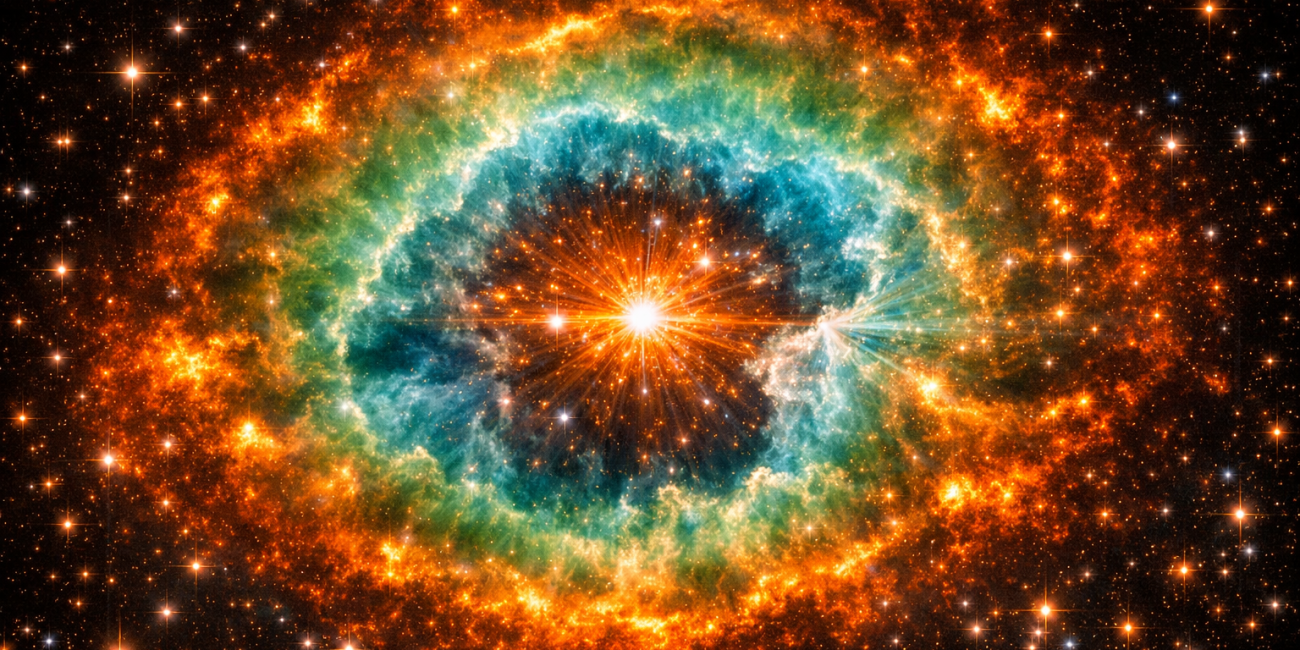
Ever wondered how a star dies? On March 10, 2026, astronomers unveiled a breathtaking new image of the Cat’s Eye Nebula (NGC 6543), captured by the Hubble Space Telescope and the Euclid mission. This cosmic spectacle reveals the dramatic final moments of a dying star, offering both scientists and stargazers a glimpse into the universe’s most beautiful farewell.
The Cat’s Eye Nebula is not just a scientific curiosity—it is a cosmic masterpiece. Its intricate rings, glowing filaments, and radiant colors make it one of the most visually stunning planetary nebulae ever observed. For astronomers, it is a laboratory of stellar death. For the public, it is a reminder of the universe’s endless cycles of creation and transformation. Images like these inspire curiosity, fuel scientific outreach, and remind us of our place in the cosmos.
What Is the Cat’s Eye Nebula?
The Cat’s Eye Nebula lies about 3,000 light‑years away in the constellation Draco. First discovered in 1786 by astronomer William Herschel, it was named for its resemblance to a feline eye staring back from the depths of space. Its layered shells and glowing filaments make it one of the most complex planetary nebulae ever observed.
Unlike supernova remnants, which are violent explosions, the Cat’s Eye is a planetary nebula—a gentler but equally dramatic end to a star’s life. When a star similar to our Sun exhausts its nuclear fuel, it sheds its outer layers into space. These layers form glowing shells of gas, illuminated by ultraviolet radiation from the hot stellar core.
What makes the Cat’s Eye unique is its complexity. Most planetary nebulae appear as simple rings or spheres. The Cat’s Eye, however, displays multiple overlapping shells, intricate filaments, and symmetrical patterns. Astronomers believe these structures were shaped by stellar winds, magnetic fields, and possibly even the gravitational influence of a companion star. Compared with the Helix Nebula or the Ring Nebula, the Cat’s Eye stands out as a cosmic jewel of symmetry and chaos combined.
The Science of Stellar Death
Stars are cosmic engines, fusing hydrogen into helium for billions of years. When hydrogen runs out, the core contracts and heats up, igniting heavier elements. This process destabilizes the star, causing it to pulsate and eject its outer layers.
The Cat’s Eye Nebula is a textbook example of this process:
- Core Contraction: The star’s core shrinks, becoming extremely hot and dense.
- Gas Ejection: Pulsations push outer layers into space, forming concentric shells.
- Radiation Glow: Ultraviolet light from the exposed core ionizes the gas, making it glow.
- White Dwarf Formation: The core eventually stabilizes as a white dwarf, a dense remnant that slowly cools over billions of years.
Astronomers often describe this process as a “cosmic recycling program.” The material expelled by dying stars enriches the interstellar medium with heavier elements, which later form new stars, planets, and even life. In a sense, the Cat’s Eye Nebula is both an ending and a beginning. It is the death of one star, but the birth of countless possibilities for the galaxy.
A Cosmic Collaboration: Hubble and Euclid
The latest image of the Cat’s Eye Nebula is the result of a collaboration between two powerful observatories:
- Hubble Space Telescope: Famous for its high‑resolution images of deep space.
- Euclid Mission: Launched in 2023 to study dark matter and dark energy.
By combining Hubble’s precision with Euclid’s wide‑field capabilities, astronomers produced a composite image that reveals new layers of detail. The swirling filaments, glowing rings, and central star are now visible with unprecedented clarity. This collaboration demonstrates how modern astronomy thrives on teamwork, blending instruments to unlock cosmic secrets. Hubble’s legacy of deep‑space imaging and Euclid’s mission to map the dark universe together provide a richer, more complete view of stellar death.
Why This Discovery Matters
The Cat’s Eye Nebula is more than a beautiful picture—it is a scientific treasure. Studying planetary nebulae helps astronomers:
- Understand how stars evolve and die.
- Predict the future of our Sun, which will undergo a similar transformation in about 5 billion years.
- Explore how stellar death enriches the galaxy with elements essential for life.
For the public, images like the Cat’s Eye inspire curiosity and wonder. They remind us that the universe is vast, dynamic, and full of beauty—even in endings. The nebula’s intricate design also sparks artistic inspiration, appearing in books, films, and even cultural motifs. Science and art meet in the Cat’s Eye, bridging knowledge and imagination.
Recent Sky Events (March 2026)
This cosmic update coincides with several notable sky events:
- Total Lunar Eclipse (March 2–3): The Moon turned blood‑red, the last total eclipse until 2029. Observers across Asia and Europe witnessed a dramatic celestial show.
- Planetary Highlights: Jupiter resumed direct motion today, Venus shines brilliantly after sunset, and Uranus sits near the Pleiades cluster, offering a rare alignment for stargazers.
- March Equinox (March 20): A seasonal shift often linked to enhanced auroral activity. Cultures worldwide celebrate the equinox as a symbol of balance and renewal.
Together, these events make March 2026 a month of cosmic spectacle, both near and far. From eclipses to nebulae, the skies remind us of the universe’s rhythm and beauty.
Conclusion
The Cat’s Eye Nebula reminds us that even in death, stars create beauty that lights up the universe. This cosmic farewell is not just a scientific discovery—it is a reminder of the cycles of creation and transformation that shape the cosmos.
As we gaze at the Cat’s Eye, we are witnessing the future of our own Sun, billions of years from now. It is a humbling thought: the same process that creates nebulae will one day shape the destiny of our solar system.
For now, we can marvel at the Cat’s Eye Nebula as both a scientific wonder and a cosmic work of art. Its story is one of endings and beginnings, of death and rebirth, and of the eternal dance of the stars.