


How one of history’s greatest astronomers unknowingly observed Neptune more than 200 years before its official discovery.
Introduction
History is full of remarkable discoveries, but few are as fascinating as the story of Neptune and Galileo Galilei.
Imagine being the first human in recorded history to observe a new planet through a telescope—yet never realizing what you had found.
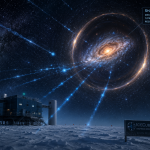
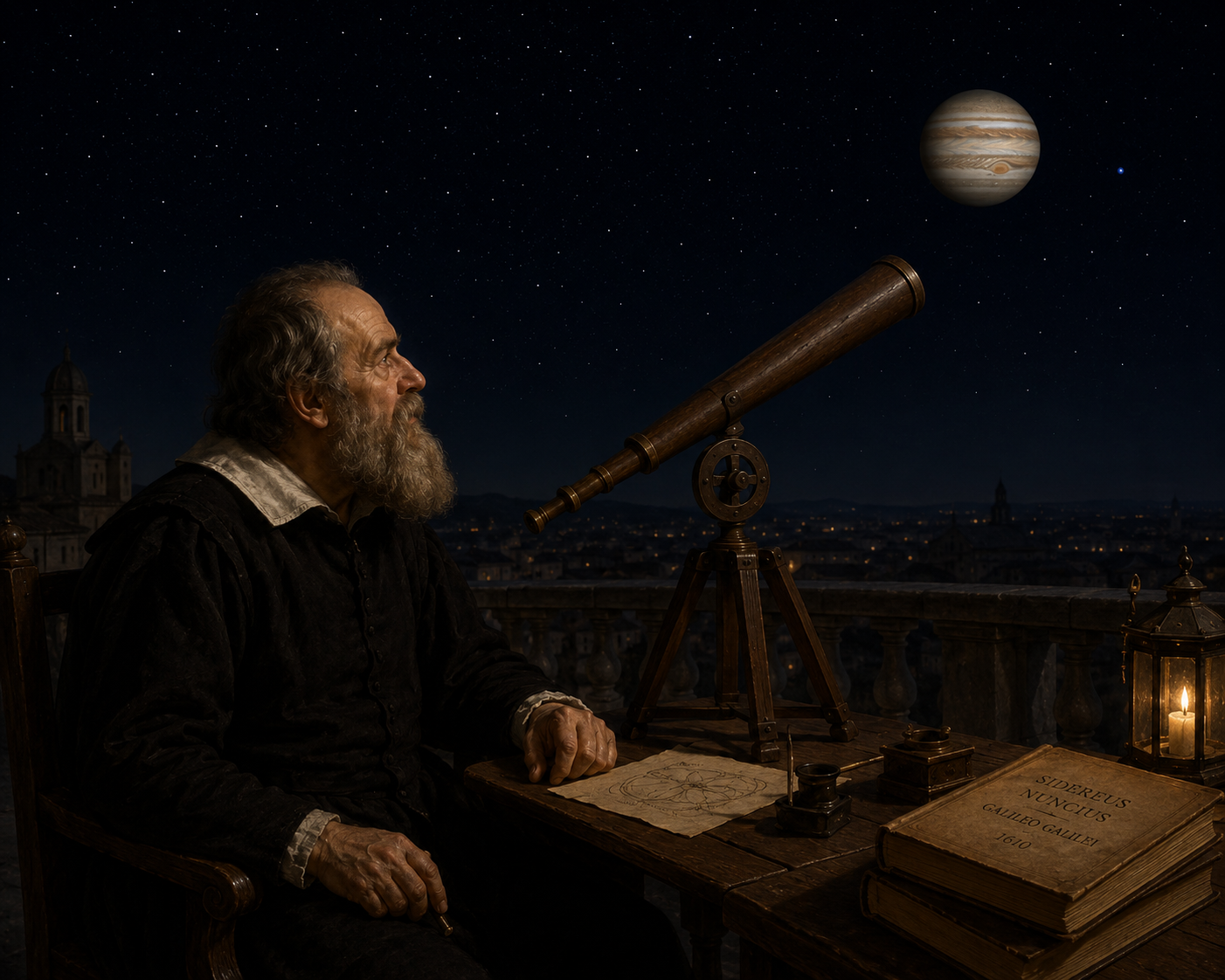
That is exactly what happened in 1612 when Galileo, already famous for his revolutionary observations of the heavens, pointed his telescope toward Jupiter. While studying the giant planet and its moons, he recorded a tiny point of light nearby. To Galileo, it appeared to be an ordinary star.
It wasn't.
That faint object was Neptune, the eighth planet from the Sun.
More than two centuries would pass before astronomers officially recognized Neptune as a planet. Today, Galileo's forgotten observation stands as one of the most intriguing "almost discoveries" in the history of science.
This story is not merely about a missed opportunity. It reveals how scientific discoveries depend not only on observation but also on technology, mathematical understanding, and the willingness to challenge assumptions.
Galileo's Revolutionary View of the Universe
To understand why Galileo missed Neptune, we first need to understand the world he lived in.
In the early 1600s, astronomy was undergoing a revolution. For centuries, many Europeans accepted the geocentric model, which placed Earth at the center of the universe. Although Nicolaus Copernicus had proposed a Sun-centered system in 1543, the idea remained controversial.
Then came Galileo Galilei.
Using one of the most advanced telescopes of his time, Galileo transformed humanity's understanding of the cosmos. His observations included:
- Mountains and craters on the Moon
- Countless previously unseen stars
- Sunspots moving across the Sun
- The phases of Venus
- Four large moons orbiting Jupiter
These discoveries provided powerful evidence that not everything revolved around Earth.
By 1612, Galileo was carefully observing Jupiter night after night, tracking the movements of what we now call the Galilean moons: Io, Europa, Ganymede, and Callisto.
While making these observations, he unknowingly captured something extraordinary.
The Night Galileo Observed Neptune
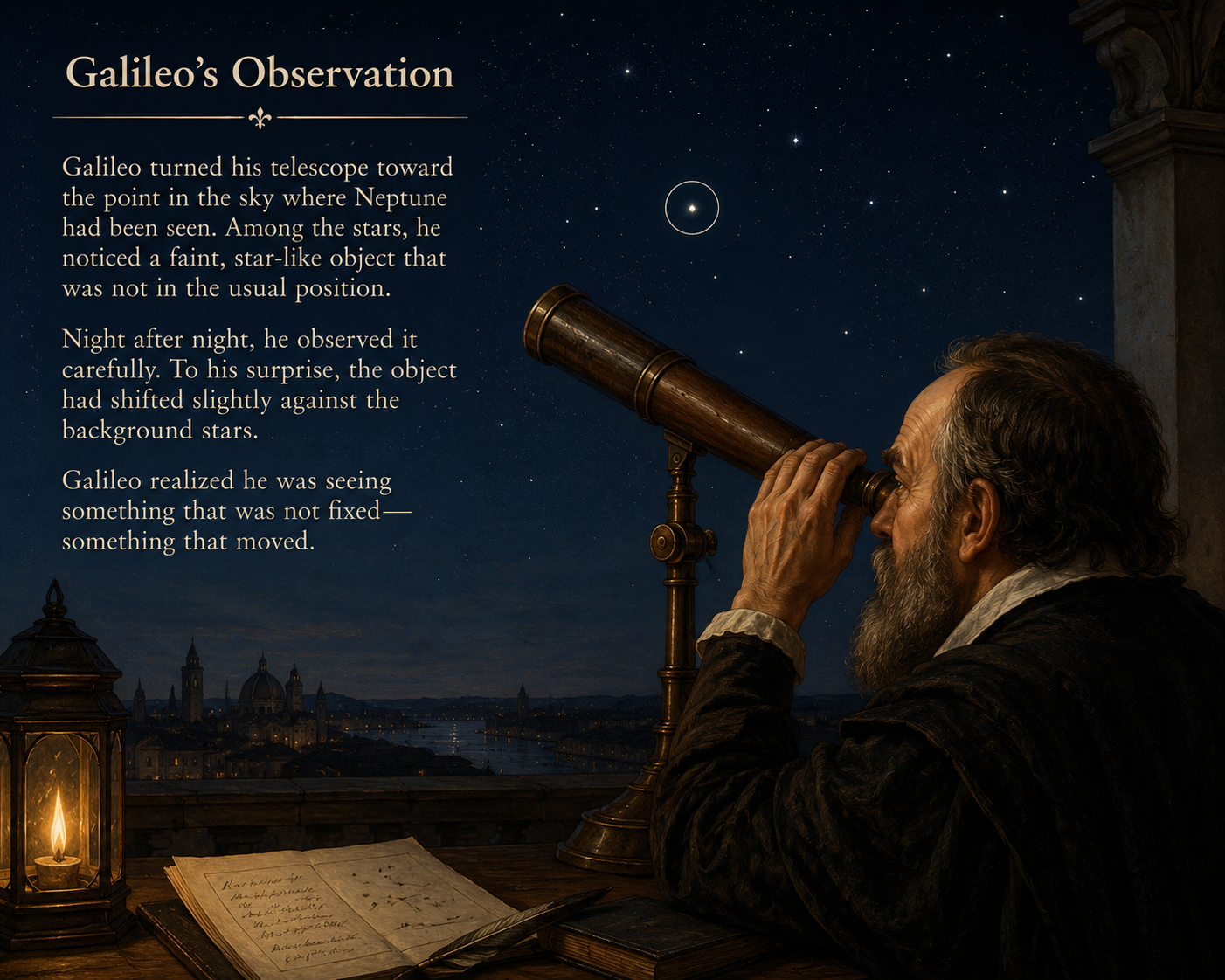
On December 28, 1612, Galileo recorded Jupiter and the surrounding stars in his observation notes.
Near Jupiter appeared a faint point of light.
At the time, Neptune was positioned in the sky close to Jupiter from Earth's perspective. Since Neptune is extremely distant, it appears star-like even through a telescope.
Galileo marked the object as a fixed star.
A few weeks later, on January 27, 1613, he observed the region again.
What makes this second observation remarkable is that Galileo noticed something unusual. The "star" seemed to have shifted slightly compared to nearby stars.
Unknown to him, he was witnessing Neptune's slow motion against the stellar background.
However, the movement was so subtle that he could not confidently determine whether the object was moving or whether observational errors were responsible.
As a result, the mystery remained unsolved.
Why Neptune Was So Difficult to Identify
Today it might seem surprising that Galileo could observe Neptune but fail to recognize it as a planet.
The explanation lies in Neptune's enormous distance from Earth.
Neptune Is Incredibly Far Away
Neptune orbits the Sun at an average distance of about 4.5 billion kilometers (2.8 billion miles).
Because of this vast distance:
- Neptune appears very faint.
- Its motion across the sky is extremely slow.
- It resembles a dim star when viewed through small telescopes.
Unlike planets such as Mars, Jupiter, or Venus, Neptune does not immediately reveal itself through obvious movement.
Galileo's Telescope Had Limitations
Galileo's telescope was revolutionary for its era, but by modern standards it was primitive.
His instruments suffered from:
- Low magnification
- Narrow fields of view
- Optical distortions
- Limited light-gathering ability
Although Galileo possessed extraordinary observational skill, the technology available to him simply was not capable of clearly revealing Neptune as a planetary disk.
To his eyes, Neptune looked almost indistinguishable from a star.
Did Galileo Suspect Something Was Strange?
One of the most fascinating aspects of this story is that Galileo may have suspected that the object was unusual.
Modern analyses of his notebooks indicate that he carefully marked the position of the mysterious object and even noted slight positional changes.
Some historians argue that Galileo recognized that the object might not be a fixed star.
However, he lacked enough evidence to draw a definitive conclusion.
Science often advances through confidence built on repeated observations. Galileo observed Neptune during a period when its apparent motion was exceptionally slow due to its position relative to Earth.
This unfortunate timing worked against him.
Had Neptune been moving more noticeably across the sky, history might have recorded Galileo as the discoverer of an entirely new planet.
The Long Road to Neptune's Official Discovery
After Galileo's observations, Neptune remained hidden in plain sight for more than 200 years.
Astronomers continued studying the solar system, gradually improving telescopes and mathematical techniques.
The key breakthrough came through the study of Uranus.
Something Was Pulling Uranus
After Uranus was discovered in 1781 by astronomer William Herschel, scientists carefully tracked its orbit.
Over time, they noticed something strange.
Uranus was not moving exactly as predicted by Newton's laws.
Its orbit showed small but persistent irregularities.
Astronomers suspected that another unseen object was exerting a gravitational pull on Uranus.
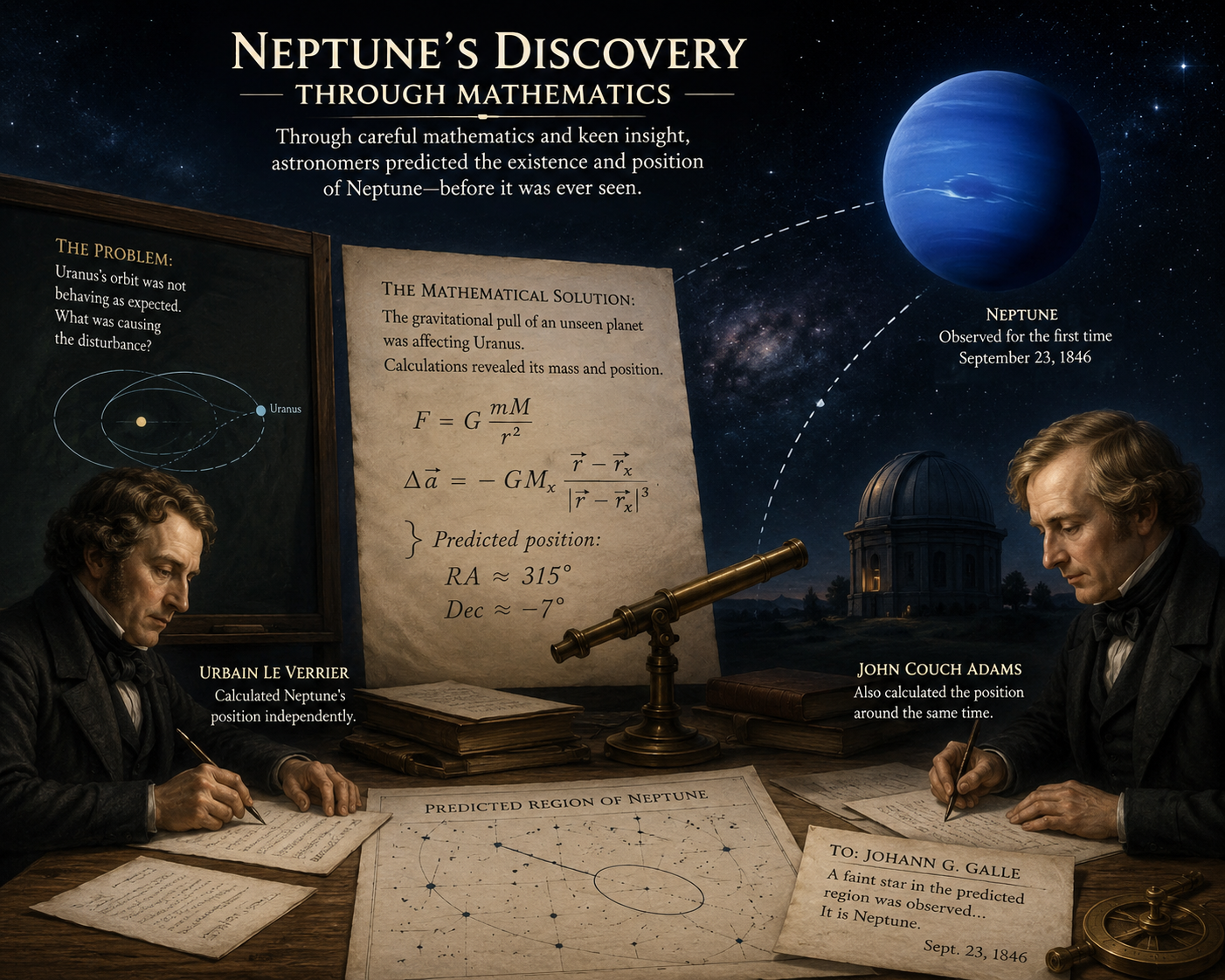
Rather than searching blindly across the sky, mathematicians attempted something unprecedented: calculating the location of an unknown planet using mathematics alone.
The Mathematical Hunt for an Invisible Planet
Two scientists independently tackled the problem.
Urbain Le Verrier
French mathematician Urbain Le Verrier analyzed the orbital deviations of Uranus and predicted the position of a hidden planet.
John Couch Adams
At nearly the same time, English mathematician John Couch Adams performed similar calculations.
Both researchers concluded that another giant planet likely existed beyond Uranus.
This represented one of the greatest triumphs of theoretical science.
Instead of discovering a planet first and studying it later, astronomers predicted its existence before seeing it.
Neptune Is Finally Found
On September 23, 1846, German astronomer Johann Gottfried Galle received Le Verrier's predicted coordinates.
That very night, Galle searched the indicated region of the sky.
The result was astonishing.
Neptune was located less than one degree from the predicted position.
The new planet had finally been identified.
Its discovery became one of the greatest successes in the history of astronomy and demonstrated the extraordinary predictive power of Newtonian physics.
Only later would historians realize that Galileo had actually observed Neptune over 230 years earlier.
How Historians Rediscovered Galileo's Observation
The connection between Galileo and Neptune was not recognized immediately.
Centuries later, scholars reexamined Galileo's notebooks using modern astronomical software and orbital calculations.
Researchers reconstructed the night sky exactly as it appeared during Galileo's observations.
The results were unmistakable.
The faint "star" Galileo recorded in December 1612 and January 1613 matched Neptune's position precisely.
His sketches aligned remarkably well with where Neptune actually appeared.
In other words, Galileo truly had seen Neptune.
He simply lacked the evidence needed to understand what he was looking at.
What This Story Teaches About Scientific Discovery
The Neptune story illustrates an important lesson about science.
Discovery is not just about seeing something.
It is about understanding what you see.
Many people assume that scientific breakthroughs occur the moment an object is observed. In reality, observation is only the first step.
A discovery often requires:
- Accurate measurements
- Repeated observations
- Theoretical understanding
- Technological capability
- Scientific confidence
Galileo possessed the observation.
Nineteenth-century astronomers possessed the tools and mathematical framework necessary to interpret it.
Together, these elements transformed a tiny point of light into a recognized world.
Neptune Today
Modern spacecraft and telescopes have revealed Neptune as one of the most fascinating planets in the Solar System.
Key facts include:
- Neptune is the eighth planet from the Sun.
- It is approximately 17 times more massive than Earth.
- Winds on Neptune can exceed 2,000 km/h, making them among the fastest in the Solar System.
- The planet has at least 14 known moons.
- Its largest moon, Triton, likely originated as a captured object from the Kuiper Belt.
- Neptune completes one orbit around the Sun every 165 Earth years.
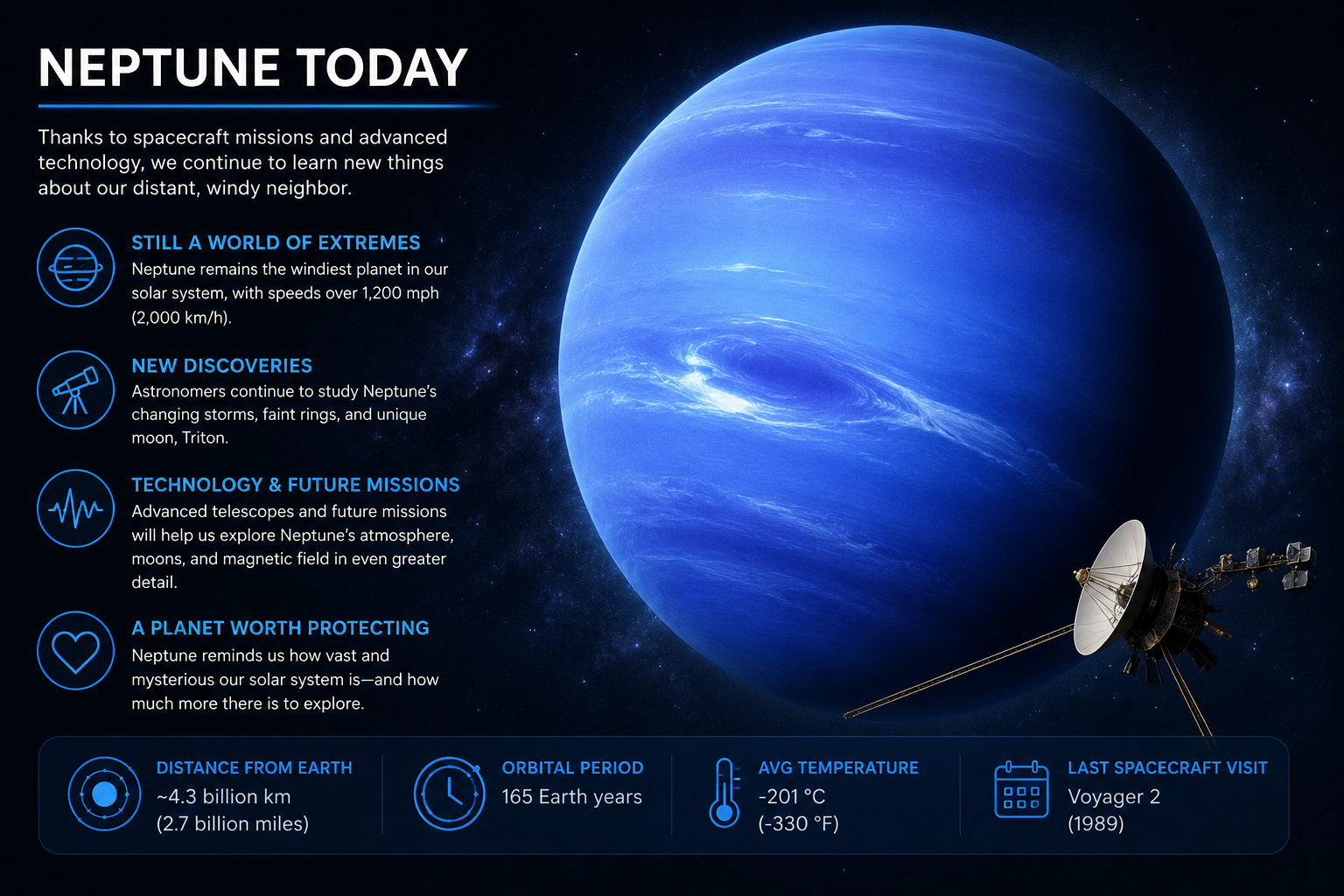
The world that appeared as a tiny star to Galileo is now known as a dynamic ice giant with storms, rings, and an active atmosphere.
Watch the Short Version
Conclusion
Galileo Galilei is remembered for changing humanity's view of the universe. Yet one of his most remarkable observations remained unrecognized during his lifetime.
In 1612, while studying Jupiter, he unknowingly recorded Neptune—the very planet that would not be officially discovered until 1846.
His story reminds us that science is not merely about looking at the cosmos. It is about asking the right questions, interpreting evidence correctly, and building knowledge step by step.
Sometimes a world can be hiding in plain sight.
And sometimes even the greatest scientists can look directly at a new planet and mistake it for a distant star.
More than four centuries later, Galileo's forgotten observation remains one of astronomy's most fascinating "what if?" moments—a powerful reminder that the universe still holds surprises for those willing to look closely.
Sources
- Galileo Galilei notebooks and historical observation records.
- Johann Gottfried Galle discovery observations (1846).
- Urbain Le Verrier orbital calculations.
- John Couch Adams independent predictions.
- Neptune historical and astronomical data.
- NASA Solar System Exploration – Neptune
- ESA Neptune Science Overview