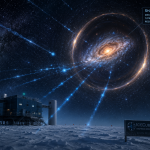
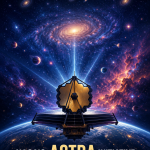
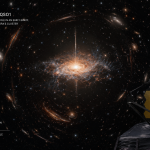
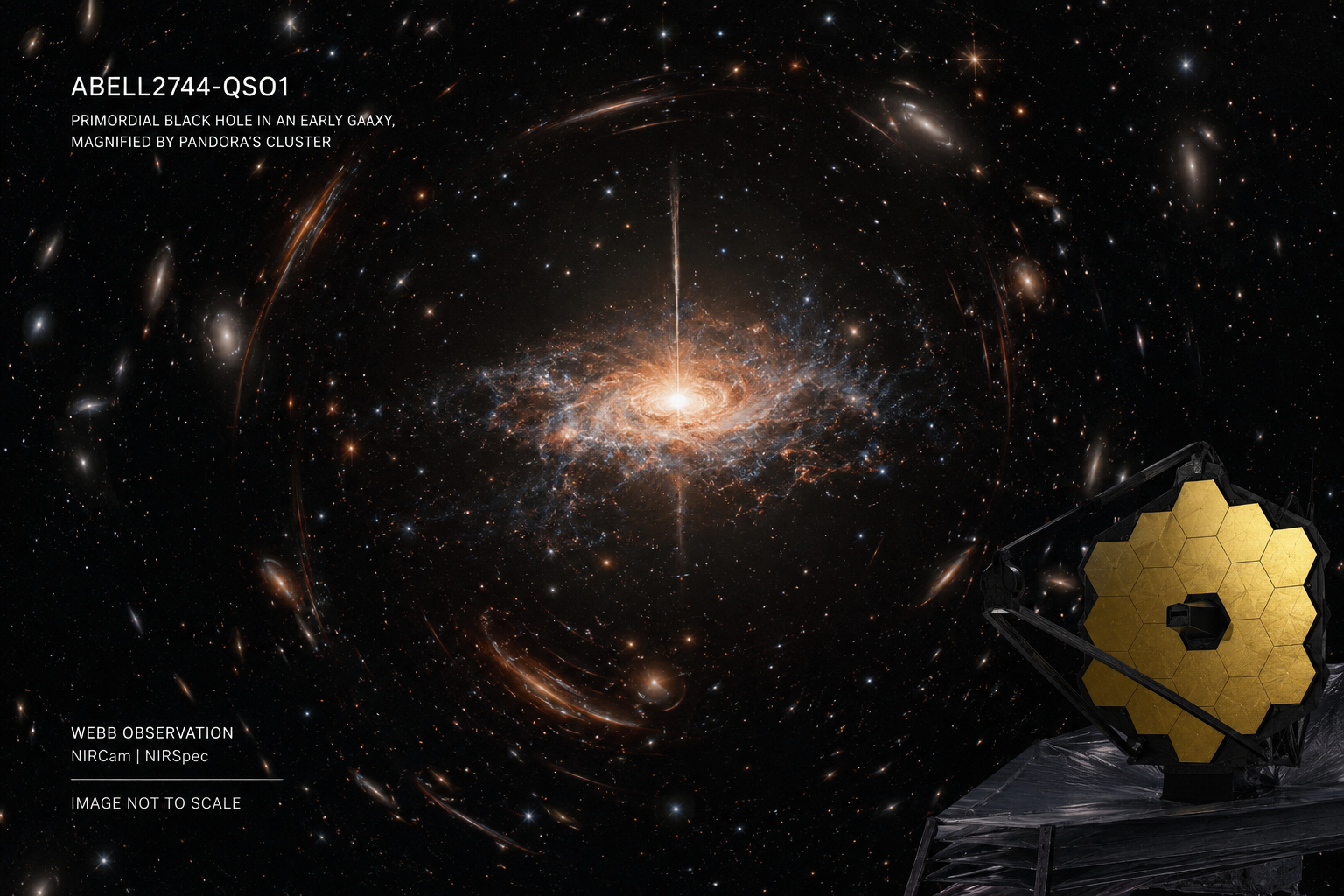
The James Webb Space Telescope (JWST) has uncovered a cosmic enigma: Abell2744-QSO1, a supermassive black hole about 50 million times the Sun’s mass, existing just 700 million years after the Big Bang. Even more astonishing, this black hole accounts for nearly two-thirds of its host galaxy’s mass, a ratio thousands of times larger than what we see in galaxies today. This discovery challenges long-held theories of cosmic evolution and suggests black holes may have formed in ways far more radical than previously imagined.
🔭 The Discovery in Context
JWST’s infrared sensitivity allowed astronomers to peer deep into the Pandora’s Cluster (Abell 2744), a gravitational lens magnifying faint, distant galaxies. Among these faint “Little Red Dots,” scientists identified Abell2744-QSO1. Using JWST’s NIRSpec instrument, they measured the velocity of gas swirling around the black hole, enabling a direct calculation of its mass.
This measurement revealed something extraordinary: the black hole’s mass was not just large, but disproportionately dominant compared to its galaxy. In modern galaxies like the Milky Way, the central black hole (Sagittarius A*) is only about 0.1% of the galaxy’s mass. Abell2744-QSO1, however, is nearly 66% of its galaxy’s total mass.
🌌 Why This Matters
1. Early Universe Puzzle
The universe was only 700 million years old when this black hole existed. Standard models suggest galaxies form first, then black holes grow slowly inside them. But QSO1 flips this narrative — it appears the black hole came first, or at least grew much faster than its galaxy.
2. Born Big Hypothesis
Astrophysicists now suspect some black holes may have formed directly from primordial gas clouds, collapsing under gravity without passing through the usual star-formation stage. This “direct collapse” model could explain how such massive black holes appeared so early.
3. Cosmic Evolution Rewritten
If black holes like QSO1 were common, galaxies may not have been the architects of cosmic structure. Instead, black holes could have seeded galaxies, reversing decades of assumptions about cosmic evolution.
📊 Comparative Analysis
| Object | Black Hole Mass | Fraction of Galaxy Mass | Age (after Big Bang) |
|---|---|---|---|
| Abell2744-QSO1 | ~50 million Suns | ~66% | 700 million years |
| Milky Way (Sagittarius A*) | ~4 million Suns | <0.1% | 13.6 billion years |
| Typical Early Galaxies | 1–10 million Suns | <1% | 1–2 billion years |
🧩 Scientific Reactions
Researchers worldwide are grappling with the implications. Some argue this discovery supports direct collapse black holes, while others suggest runaway accretion — where black holes consume gas at extreme rates — could explain the rapid growth.
Dr. Roberto Maiolino of Cambridge University noted that QSO1 “forces us to rethink the timeline of cosmic evolution,” while NASA emphasized that JWST is only beginning to uncover the population of these mysterious “Little Red Dots.”
🌠 Broader Implications
- Galaxy Formation Models: If black holes formed first, galaxies may have grown around them, not the other way around.
- Dark Matter Connection: Some theorists speculate that early black holes could interact with dark matter, influencing galaxy clustering.
- Future Observations: JWST will continue surveying faint galaxies to determine whether QSO1 is unique or part of a larger population.
🎯 Conclusion
The discovery of Abell2744-QSO1 is not just another milestone in astronomy — it is a paradigm shift. By revealing a black hole that outweighs its galaxy, JWST has challenged the very foundations of cosmic evolution. Whether through direct collapse, runaway growth, or some yet-unknown mechanism, QSO1 proves that the early universe was far stranger and more dynamic than we imagined.
As JWST continues its mission, we may soon learn that galaxies were not the first architects of the cosmos — black holes were.
📚 References
- Maiolino, R. et al. (2024). A supermassive black hole in Abell2744-QSO1 outweighing its galaxy. Nature Astronomy.
- NASA Science Mission Directorate (2024). Webb Reveals Black Hole That Formed Before Its Galaxy.
- European Space Agency (ESA/Webb) (2024). Webb reveals black hole that formed before its galaxy.
- Cambridge University Press Release (2024). Roberto Maiolino comments on JWST’s discovery of Abell2744-QSO1.