


Published: June 27, 2026
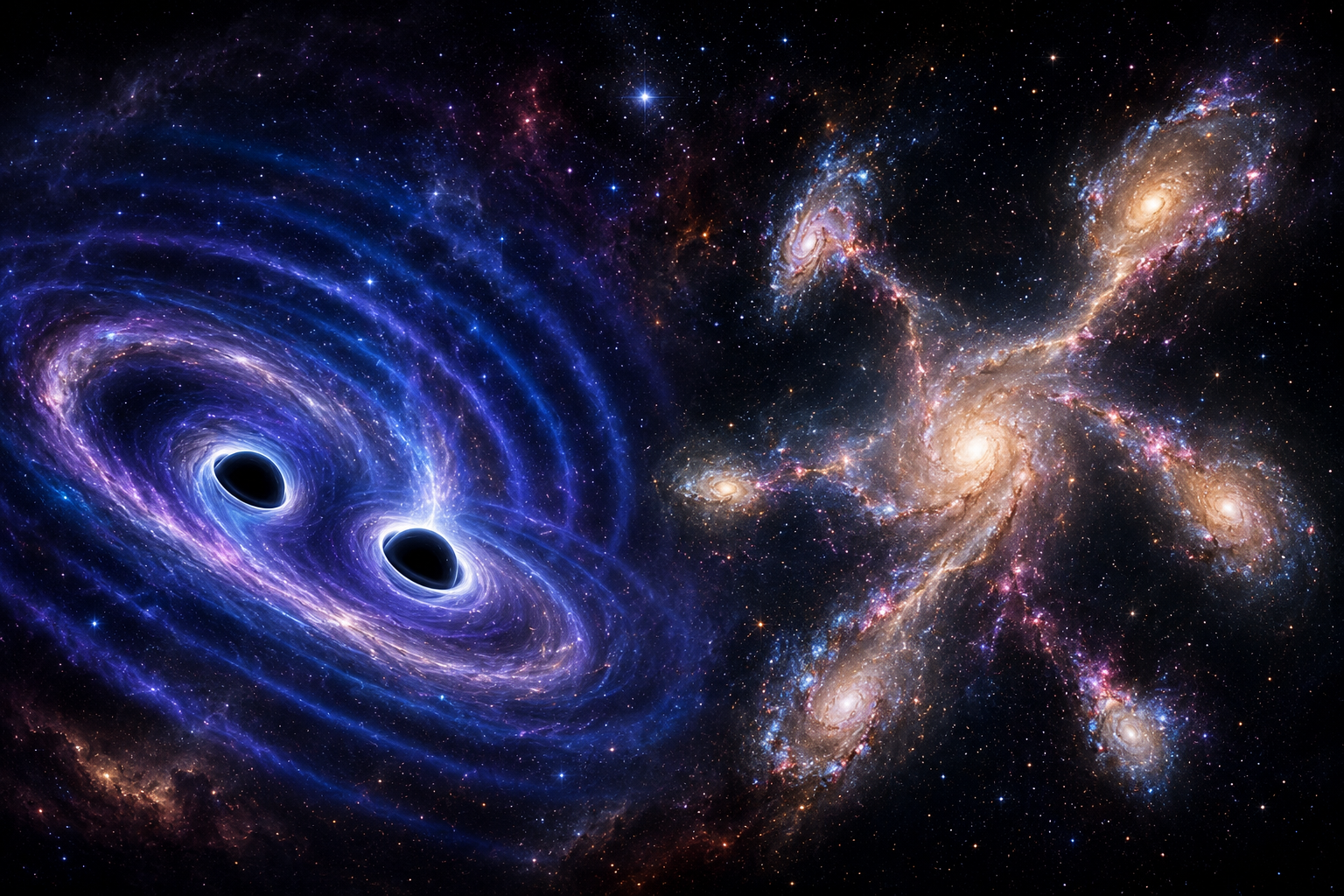
The universe has a way of reminding us that even after centuries of scientific discovery, it still holds extraordinary surprises. This week, astronomers announced two remarkable breakthroughs that reveal the power of gravity on completely different scales. One came from Earth, where scientists detected the strongest gravitational-wave signal ever recorded. The other came from deep space, where the James Webb Space Telescope captured an extraordinary system of six galaxies slowly merging into what could become one of the largest galaxies ever observed.
Although these discoveries involve different instruments and different regions of the universe, they tell a similar story. Gravity is not simply a force that keeps planets in orbit. It is the engine that shapes stars, black holes, galaxies, and ultimately the large-scale structure of the cosmos itself.
Together, these findings represent another step forward in humanity's effort to understand how the universe has evolved over billions of years.
The Strongest Signal Ever Recorded
Gravitational waves are often described as ripples in space-time. More than one hundred years ago, Albert Einstein predicted their existence through his theory of General Relativity, suggesting that massive accelerating objects should create tiny distortions that travel across the universe at the speed of light.
For decades, these waves remained purely theoretical because they were incredibly difficult to detect. Everything changed in 2015, when the Laser Interferometer Gravitational-Wave Observatory (LIGO) made the first direct detection of gravitational waves from two merging black holes. That achievement opened an entirely new branch of astronomy.
Now researchers have announced what appears to be the most powerful gravitational-wave signal ever measured.
According to the international research teams operating LIGO, Virgo, and KAGRA, the signal originated from the collision of two exceptionally massive black holes located billions of light-years from Earth. As the pair spiraled toward one another, they reached astonishing speeds before merging into a single, even more massive black hole.
The collision lasted only a fraction of a second, but during that brief moment it released an immense amount of energy in the form of gravitational waves. By the time those ripples reached Earth, they had become unimaginably small. Detecting them required instruments capable of measuring changes thousands of times smaller than the diameter of a proton.
That level of precision is one reason gravitational-wave astronomy is considered one of the greatest technological achievements of modern science.
Why This Discovery Matters
Record-breaking detections are exciting, but scientists are interested in far more than setting records.
Every gravitational-wave signal contains information about the objects that created it. By studying the shape and strength of the waves, researchers can estimate the masses of the black holes, how fast they were spinning before the collision, and how the newly formed black hole behaved immediately afterward.
The latest event is especially valuable because of the enormous size of the merging black holes.
Current models suggest black holes can grow through the collapse of massive stars, by consuming surrounding matter, or by merging with other black holes over time. However, the masses involved in this event are pushing astronomers to re-examine how these cosmic giants form.
Some researchers believe the black holes may themselves have been the products of earlier mergers, while others suggest they could belong to a population that has remained largely hidden until now.
The discovery also provides another opportunity to test Einstein's theory under some of the most extreme conditions known in nature. So far, the observations continue to match the predictions of General Relativity remarkably well. Even so, every new detection allows scientists to search for tiny deviations that could hint at new physics beyond our current understanding.
With gravitational-wave observatories becoming more sensitive each year, astronomers expect future observing runs to reveal many more rare and unusual events, helping build a clearer picture of how black holes evolve throughout the universe.
James Webb Watches Six Galaxies Grow Into One
While gravitational-wave detectors were listening to one of the most powerful events ever recorded, the James Webb Space Telescope (JWST) was looking back to a much earlier chapter in the universe's history.
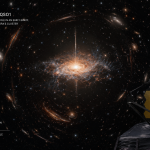
Using its highly sensitive infrared instruments, Webb observed a distant region where at least six young galaxies appear to be merging into a single massive system. The light captured by the telescope began its journey billions of years ago, meaning astronomers are seeing these galaxies as they existed when the universe was still relatively young.
For scientists, this is far more than a striking image. It offers a rare opportunity to witness one of the key processes that shaped the modern universe.
Galaxies are not isolated islands drifting through space forever. Over billions of years, gravity pulls neighboring galaxies toward one another. As they interact, clouds of gas collide, new generations of stars are born, and their structures gradually change. Eventually, several galaxies can merge into one much larger system.
Astronomers have long believed this process is responsible for creating the giant elliptical galaxies found at the centers of many galaxy clusters. Webb's latest observations provide another important piece of evidence supporting that idea.
Researchers studying the system also found signs of a rapidly growing supermassive black hole near its center. As galaxies merge, enormous amounts of gas can be funneled inward, feeding the central black hole and allowing it to grow much faster than it otherwise could. Understanding this relationship between galaxy mergers and black hole growth is one of the biggest goals of modern astronomy, and Webb is providing data that simply wasn't available before its launch.
Two Discoveries, One Story
Although one discovery comes from gravitational-wave observatories on Earth and the other from a space telescope nearly 1.5 million kilometers away, they are connected by the same fundamental force: gravity.
In the black hole merger, gravity acted with incredible intensity over just a few seconds, producing ripples that traveled across billions of light-years before reaching Earth.
In the galaxy merger, gravity is working much more slowly. Over hundreds of millions—and eventually billions—of years, it will reshape six separate galaxies into one enormous cosmic structure.
Together, these discoveries remind us that gravity works on every scale in the universe. It governs the motion of planets, the lives of stars, the collisions of black holes, and the growth of galaxies themselves.
Just a decade ago, astronomers relied almost entirely on light to study the cosmos. Today, they can combine observations from powerful telescopes with gravitational-wave detections, giving them an entirely new way to investigate events that were once invisible.
This growing field, often called multi-messenger astronomy, allows scientists to build a more complete picture of the universe by studying the same cosmic processes through different kinds of signals.
Looking Ahead
These discoveries are unlikely to be the last major headlines of the year.
The James Webb Space Telescope continues to observe some of the earliest galaxies ever formed, while the LIGO, Virgo, and KAGRA collaborations are preparing for future observing runs with improved sensitivity. Every improvement increases the chances of detecting rarer and more distant events, helping researchers answer long-standing questions about black holes, galaxy evolution, and the history of the universe.
Future projects such as the Laser Interferometer Space Antenna (LISA), planned by the European Space Agency with NASA participation, are expected to detect gravitational waves that current ground-based observatories cannot measure. Combined with next-generation telescopes, these missions promise an even deeper understanding of the cosmos.
For now, this week's announcements stand as another reminder that astronomy is advancing at an extraordinary pace. Each new observation not only answers old questions but also raises new ones, ensuring that the universe remains as mysterious as it is fascinating.
As scientists continue to explore the cosmos with increasingly sophisticated instruments, discoveries like these bring us one step closer to understanding how the universe formed, evolved, and continues to change today.