








Science, Psychology, and Religious Perspectives on Shared Dream Experiences
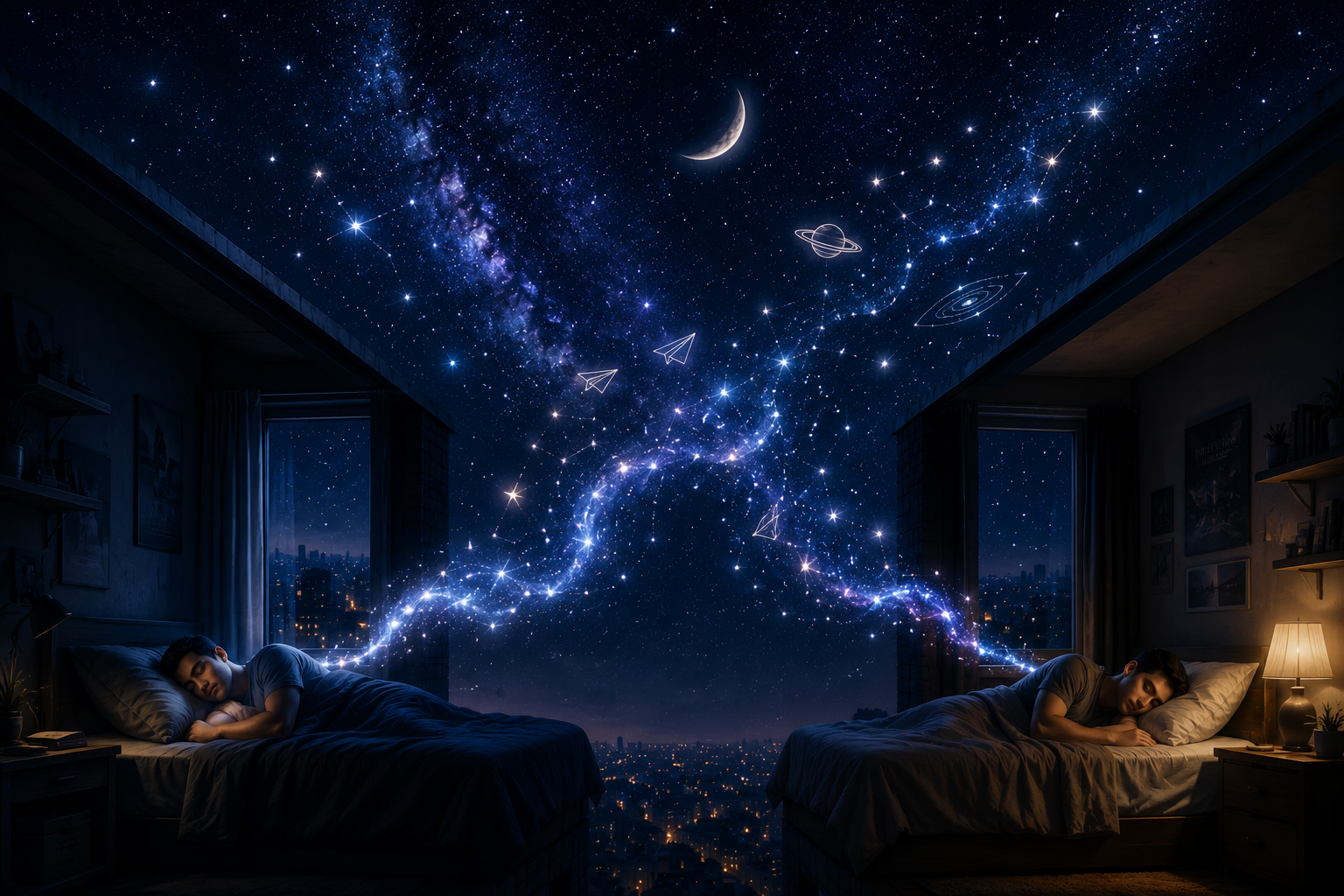
Dreams have always fascinated humanity. Almost everyone has experienced a dream that felt unusually real — sometimes emotional enough to stay in the mind for years. But among all dream-related mysteries, one question appears again and again across cultures and generations:
Can two people actually communicate with each other inside dreams?
Some people believe they have shared dreams with loved ones. Others describe dreaming about someone moments before receiving a call or message from them. There are also stories of twins, couples, or close friends claiming they experienced the same dream during the same night.
Naturally, experiences like these make people wonder whether dreams are more than imagination.
Personally, this topic became interesting to me after noticing how many people online describe dream experiences that feel deeply personal and strangely connected to reality. At first, many of these stories sound convincing. But once science, psychology, and religion are explored carefully, the picture becomes much more complex.
This article examines the idea of dream communication through:
- neuroscience,
- psychology,
- sleep studies,
- historical beliefs,
- and religious perspectives,
while remaining balanced, respectful, and evidence-based.
The goal is not to mock belief or blindly accept extraordinary claims, but to understand what modern knowledge actually says about dreams.
🧠 What Are Dreams?
Dreams are mental experiences that happen during sleep. They can involve:
- conversations,
- emotions,
- memories,
- sounds,
- imaginary places,
- or people from real life.
Sometimes dreams feel random and chaotic. Other times they feel so realistic that people wake up emotionally affected by them.
Modern neuroscience explains dreams mainly through brain activity during:
🌌 REM Sleep (Rapid Eye Movement)
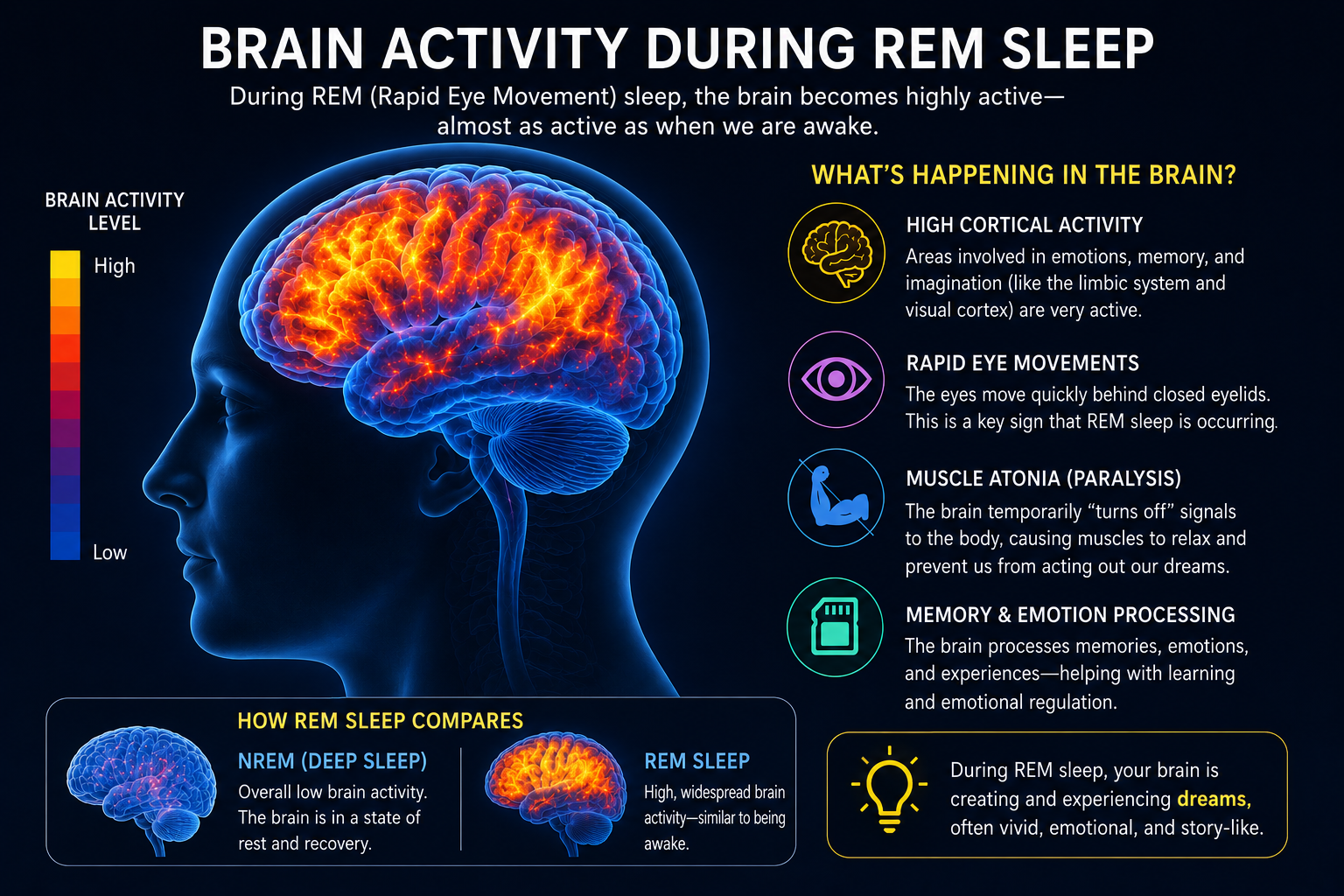
During REM sleep:
- the brain becomes highly active,
- emotional centers increase activity,
- memory processing occurs,
- and vivid dream narratives often appear.
Interestingly, the logical parts of the brain become less active during this phase. That is one reason impossible dream situations can still feel believable while we are sleeping.
A person might dream about:
- flying,
- talking to someone far away,
- revisiting childhood memories,
- or experiencing situations that never happened.
Yet during the dream, everything feels normal.
🧬 How the Brain Creates Dreams
Scientists believe dreams are produced internally by the brain rather than received externally from other people.
During sleep, the brain processes:
- emotions,
- recent experiences,
- fears,
- memories,
- and subconscious thoughts.
Sleep researcher J. Allan Hobson described dreams as the brain attempting to create meaning from internal neural signals during sleep.
In simple words:
the brain acts like a storyteller while we sleep.
For example:
- stress may produce anxious dreams,
- grief may create dreams about lost loved ones,
- excitement may influence positive dream scenarios,
- and emotional attachment often causes recurring dreams about specific people.
This is important because many “shared dream” experiences can often be explained through emotional and psychological connections rather than supernatural communication.
🌙 Why Do Dreams Feel So Real?
🌙 Why Do Dreams Feel So Real?
One of the most confusing parts about dreams is emotional intensity.
Sometimes a dream conversation feels more emotional than a real one. A dream reunion can feel genuine. A nightmare can leave fear lasting for hours after waking up.
This happens because the emotional centers of the brain remain very active during REM sleep.
At the same time:
- rational analysis weakens,
- critical thinking decreases,
- and imagination becomes stronger.
As a result:
- dreams feel immersive,
- emotional,
- and sometimes spiritually meaningful.
This emotional realism is one major reason many people believe dream communication could be possible.
🧪 Is Shared Dreaming Scientifically Proven?
The short answer is:
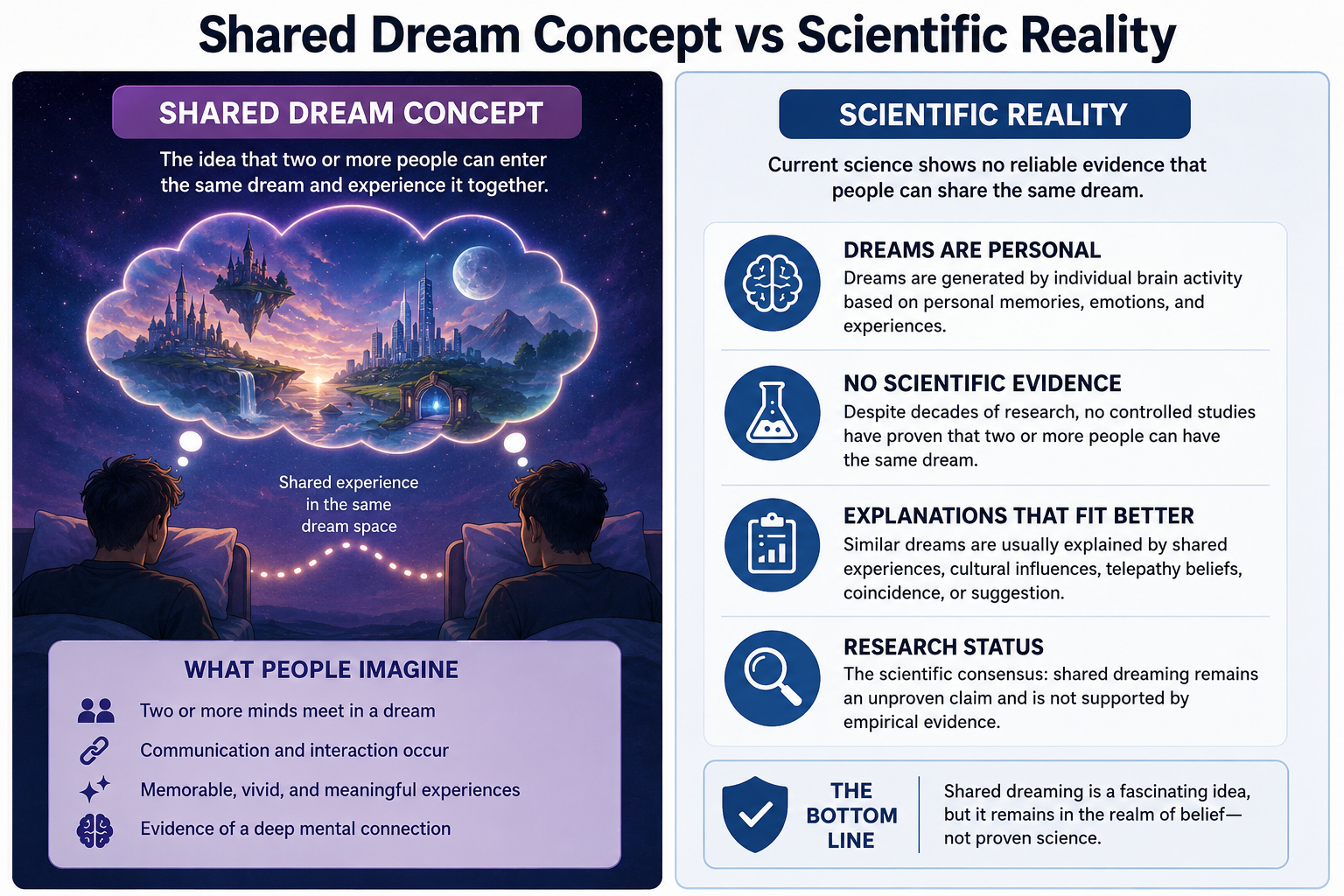
No — not according to current scientific evidence.
The concept of two people consciously meeting inside dreams is often called:
- shared dreaming,
- mutual dreaming,
- or dream telepathy.
Despite thousands of stories and internet discussions, no experiment has consistently proven that:
- two people can intentionally enter the same dream,
- exchange information during sleep,
- or communicate mind-to-mind through dreams.
Science requires:
- repeatable experiments,
- measurable evidence,
- and independent verification.
So far, shared dreaming has not passed those standards.
🧠 Why People Believe Shared Dreams Happen
Even though science has not verified dream communication, many people sincerely believe they experienced it.
Psychology offers several explanations.
💭 Emotional Bonds and Similar Dreams
People who are emotionally close often think about each other frequently.
This includes:
- romantic partners,
- family members,
- close friends,
- and twins.
Because of emotional closeness, their minds may focus on similar concerns, memories, or fears.
For example:
if two siblings are both worried about a family issue, both may independently dream about the same event.
That similarity can feel supernatural even though it may simply reflect shared emotional focus.
🧩 Coincidences Feel Powerful
Human beings naturally notice meaningful coincidences.
Imagine this situation:
You dream about an old friend, then the next day they contact you unexpectedly.
That experience feels extraordinary.
But psychologically, people often forget the hundreds of dreams that did not match reality and strongly remember the rare coincidence that did.
This is called:
Confirmation Bias
The brain gives more attention to events that appear meaningful.
🌌 Carl Jung and the Collective Unconscious
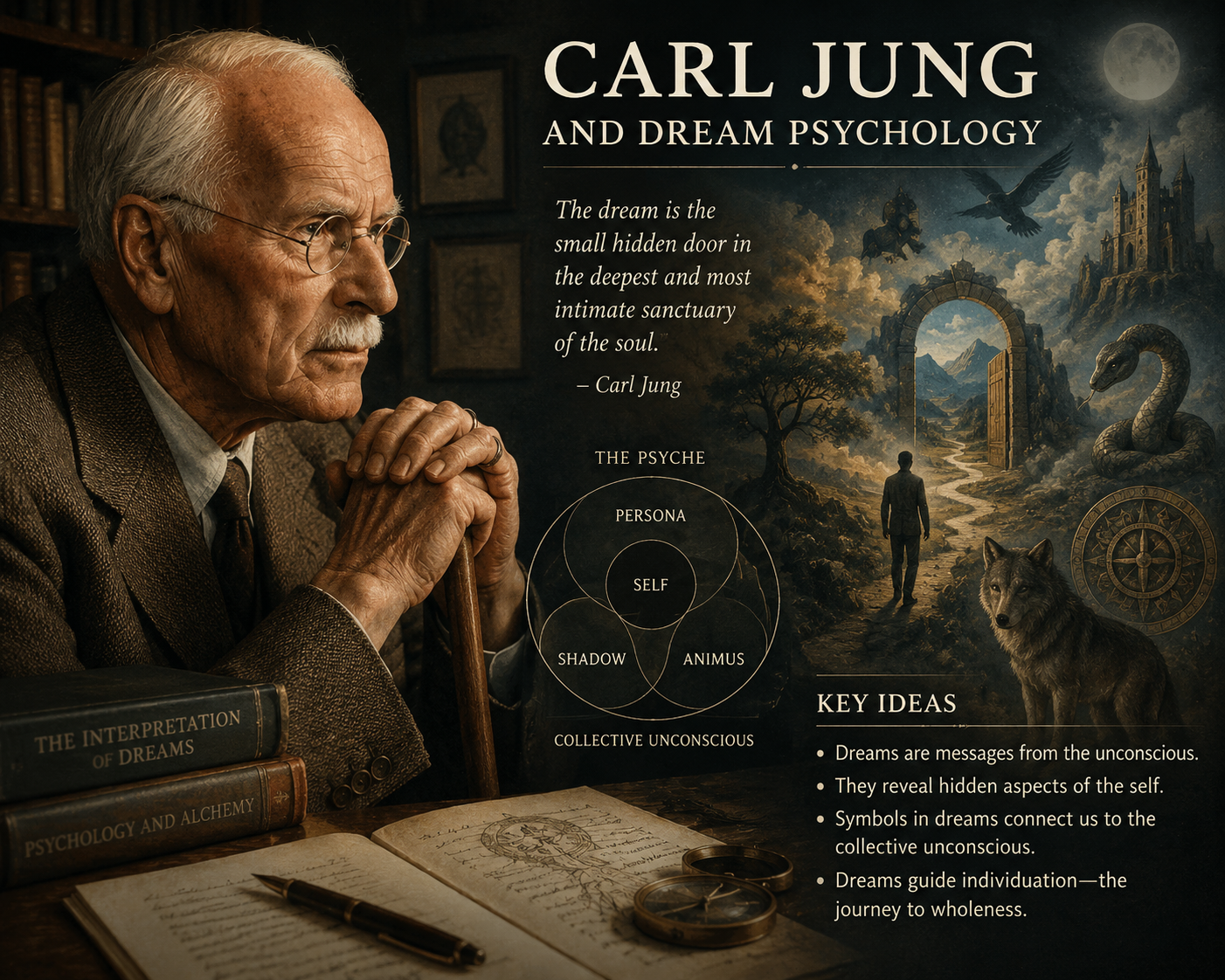
Swiss psychologist Carl Jung proposed an influential theory known as:
The Collective Unconscious
He believed humans share deep symbolic patterns called archetypes.
Examples include:
- the hero,
- the wise guide,
- the shadow,
- and universal emotional symbols.
According to Jung, many people experience similar dream themes because human psychology contains shared symbolic structures.
However, Jung’s theory was philosophical and psychological — not proof of literal dream communication between minds.
Still, his ideas strongly influenced modern discussions about dreams and consciousness.
🔮 Dream Telepathy Experiments
In the 20th century, some researchers attempted to study dream telepathy scientifically.
Sleep laboratory experiments involved:
- monitoring sleeping participants,
- observing REM sleep,
- and attempting to “send” images or thoughts to dreamers.
A few studies reported unusual coincidences, but major problems appeared:
- inconsistent results,
- small sample sizes,
- possible bias,
- and failure to replicate findings reliably.
Because of these issues:
mainstream neuroscience does not accept dream telepathy as proven science.
Today, the topic remains controversial rather than established fact.
😴 Lucid Dreaming and Dream Awareness
Another reason people believe dream communication is possible comes from:
Lucid Dreaming
A lucid dream happens when a person becomes aware they are dreaming while still inside the dream.
Some lucid dreamers can:
- influence dream environments,
- control movement,
- or consciously interact with dream characters.
Because lucid dreams feel incredibly realistic, some people attempt:
- synchronized dream experiments,
- meditation before sleep,
- or intentional dream meetings.
But no reliable evidence has shown that lucid dreamers are truly entering another person’s mind.
The experience still appears to be internally generated by the brain.
⚠️ Sleep Paralysis and “Presence” Experiences
Some people report frightening nighttime experiences involving:
- shadow figures,
- voices,
- pressure sensations,
- or the feeling that another being is nearby.
These experiences are often linked to:
Sleep Paralysis
Sleep paralysis occurs when:
- the brain partially wakes,
- but the body temporarily remains in a sleep state.
This condition can produce vivid hallucinations that feel absolutely real.
Across cultures, people historically interpreted these experiences differently:
- spirits,
- supernatural encounters,
- or dream visitors.
Modern neuroscience, however, explains them as sleep-related neurological phenomena.
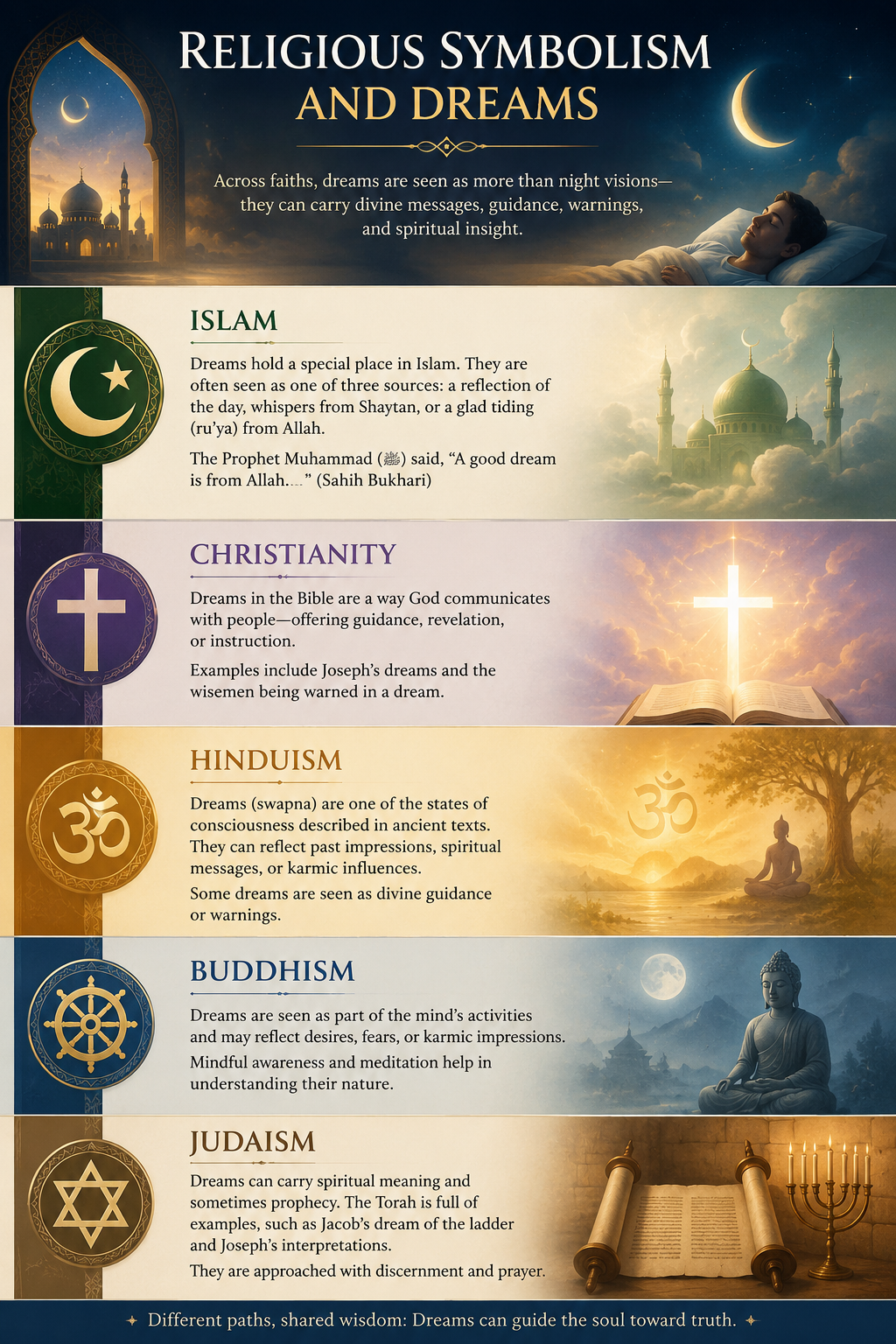
🕌 Islamic Perspective on Dreams
Islam recognizes dreams as meaningful experiences but also encourages balance and caution.
Dreams are discussed in Islamic tradition, and many scholars classify them into three categories:
🌙 1. Good or Truthful Dreams (Ru’ya)
These may:
- inspire comfort,
- encourage goodness,
- or contain symbolic meaning.
Good dreams are viewed positively in Islam.
🌙 2. Dreams from Personal Thoughts (Nafs)
These dreams come from:
- daily stress,
- emotions,
- memories,
- fears,
- or personal concerns.
Most ordinary dreams fall into this category.
🌙 3. Disturbing Dreams
Some dreams may create:
- fear,
- anxiety,
- or confusion.
Islamic teachings generally advise people not to obsess over frightening dreams.
Important Islamic Understanding
Mainstream Islamic scholarship does not teach that humans possess supernatural dream powers allowing unrestricted communication between minds.
Islam encourages:
- humility,
- avoiding superstition,
- and not making absolute claims from dreams.
Dreams are not considered reliable sources of:
- hidden knowledge,
- future certainty,
- or religious authority.
This balanced approach helps prevent exaggeration and fear-based interpretations.
✝️ Christian Perspective on Dreams
Christian traditions contain many references to symbolic dreams and visions.
In the Bible:
- dreams sometimes appear as warnings,
- guidance,
- or symbolic experiences.
However, most modern Christian scholars treat dreams carefully and avoid treating them as guaranteed supernatural communication.
Many Christian theologians emphasize discernment and wisdom when interpreting dreams.
🕉️ Hindu Perspective on Dreams
Hindu philosophy explores different states of consciousness:
- waking,
- dreaming,
- and deep sleep.
Some traditions view dreams as:
- symbolic reflections,
- karmic impressions,
- or spiritual experiences.
Certain philosophical schools discuss interconnected consciousness, but these ideas remain spiritual interpretations rather than scientific evidence.
☸️ Buddhist Perspective on Dreams
Buddhism often describes dreams as mental constructions created by consciousness.
Dreams may reflect:
- attachment,
- desire,
- fear,
- or inner mental activity.
Advanced meditation traditions sometimes explore:
- dream awareness,
- mindfulness during sleep,
- and lucid dreaming.
Still, dreams are generally viewed as products of the mind rather than literal external communication.
🏛️ Ancient Beliefs About Shared Dreams
Long before modern science existed, ancient civilizations viewed dreams as deeply important.
Cultures including:
- Egyptians,
- Greeks,
- Persians,
- Chinese traditions,
- and Indigenous communities
often believed dreams contained:
- warnings,
- wisdom,
- or symbolic insight.
Ancient Greek dream temples even encouraged people to sleep in sacred places hoping for guidance through dreams.
These historical beliefs show how universal dream fascination has always been.
📱 Why Shared Dream Stories Spread Online
The internet has greatly increased public interest in dream communication.
Social media platforms contain countless stories about:
- soulmate dreams,
- twin telepathy,
- dream reunions,
- and mysterious nighttime experiences.
Why do these stories become popular so quickly?
Because dreams are:
- emotional,
- mysterious,
- and deeply personal.
People naturally search for meaning in experiences that feel unusual.
But emotional stories alone are not scientific proof.
🧠 The Brain Rarely Invents Completely New Faces
One fascinating neuroscience finding is that the brain usually builds dream faces from stored memories.
Even strangers appearing in dreams may actually be:
- faces briefly seen in public,
- forgotten memories,
- or reconstructed combinations of real people.
This helps explain why dreams involving familiar people feel convincing and emotionally powerful.
The human brain is remarkably skilled at creating believable experiences during sleep.
🌌 Could Future Science Discover More?
Consciousness remains one of the greatest mysteries in neuroscience.
Scientists continue researching:
- sleep,
- awareness,
- memory,
- and brain activity.
It is possible future discoveries will deepen understanding of dreams and consciousness.
However, responsible science depends on evidence rather than assumption.
At present:
there is still no verified proof that two people can literally communicate inside dreams.
⚖️ Separating Personal Belief from Scientific Evidence
A dream can feel emotionally meaningful without being scientifically supernatural.
This distinction matters.
Someone may sincerely believe:
- they connected with another person in a dream,
- sensed emotional closeness,
- or experienced symbolic guidance.
That personal experience can still hold emotional value.
But science requires measurable evidence before confirming extraordinary claims.
Balancing open-mindedness with critical thinking is important when discussing dream phenomena.
🌠 Final Thoughts
Dreams continue to fascinate humanity because they exist somewhere between:
- emotion,
- imagination,
- memory,
- spirituality,
- and mystery.
Even today, modern neuroscience cannot fully explain every aspect of dreaming.
What we do know is this:
- ✔ Dreams are real mental experiences
- ✔ Emotional connections strongly influence dreams
- ✔ Many cultures and religions recognize symbolic dream importance
- ✔ Shared dream stories are common across history
But also:
- ❌ No verified scientific evidence proves direct dream communication between people
- ❌ Dream telepathy remains unconfirmed
- ❌ Emotional coincidence alone is not proof of supernatural contact
Perhaps that mystery is part of why dreams remain so unforgettable.
They remind us that the human mind is still one of the most complex things in existence.
📚 References & Sources
- National Sleep Foundation
- American Academy of Sleep Medicine
- REM Sleep Research Studies
- Dream Psychology Research
- Carl Jung’s writings on the collective unconscious
- Neuroscience studies on memory and dreaming
- Religious scholarly interpretations regarding dreams
❓ Frequently Asked Questions (FAQ)
Can two people share the same dream?
There is currently no scientific proof that two people can literally enter the same dream environment.
Why do I keep dreaming about the same person?
Usually because of emotional attachment, memory focus, stress, or subconscious thoughts involving that person.
Is dream telepathy real?
Dream telepathy has not been scientifically proven despite decades of discussion and experiments.
Does Islam believe dreams can have meaning?
Yes. Islam recognizes meaningful dreams but encourages careful interpretation and avoidance of superstition.
What is lucid dreaming?
Lucid dreaming occurs when someone becomes aware they are dreaming and may partially control the dream experience.