





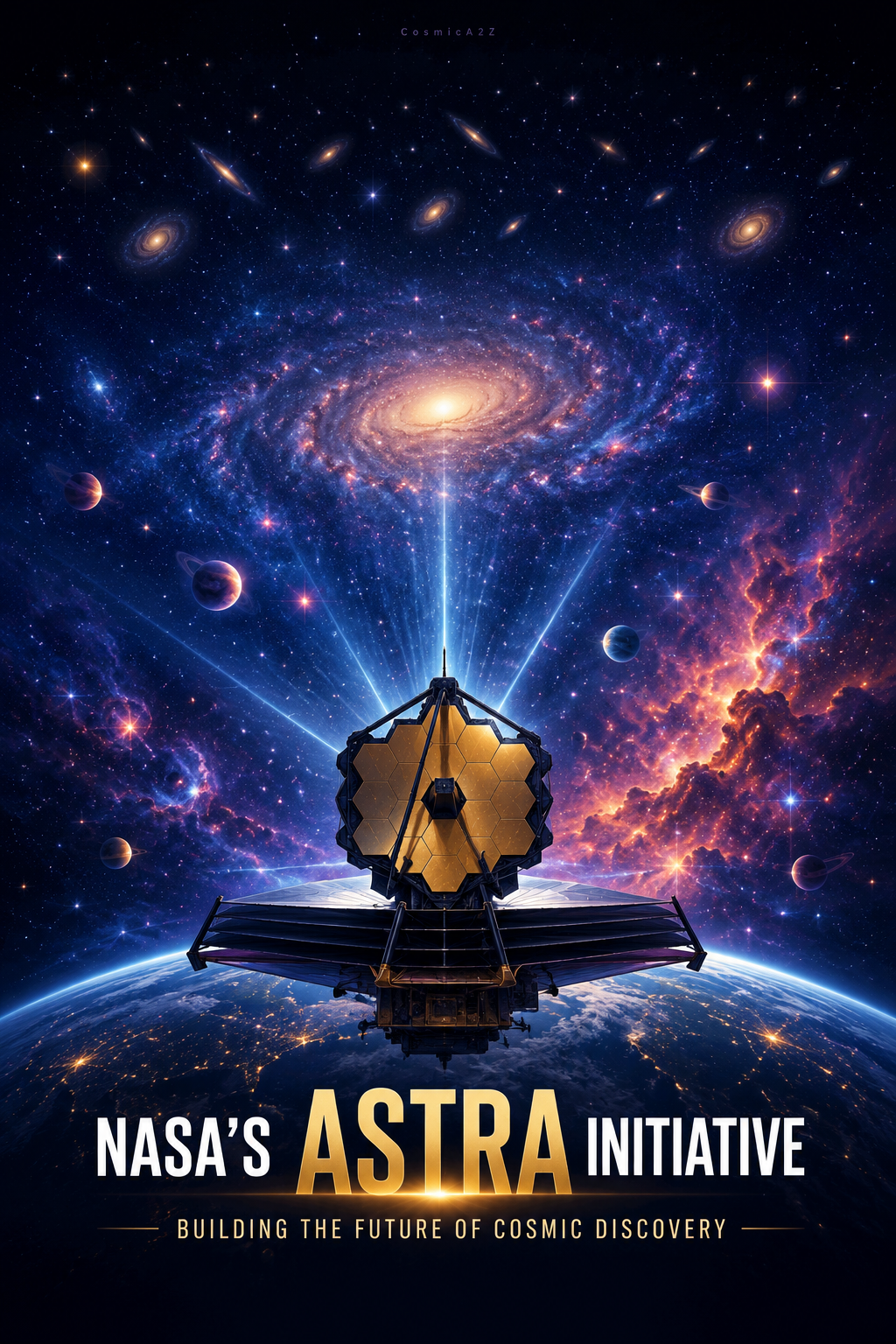
On June 10, 2026, NASA's Cosmic Origins Community Webinar introduced a major new effort that could shape the future of astronomy for decades: the ASTRA Initiative, short for Astrophysics Strategic Technology & Research Accelerator.
At first glance, ASTRA may sound like just another NASA program announcement. It is not a new telescope, a spacecraft launch, or a single mission with a fixed destination. Instead, it is a long-term framework designed to ensure that the next generation of astrophysics missions has the technology, planning, and scientific foundation needed to succeed.
In many ways, ASTRA is about preparing today for discoveries that may not happen until the 2040s. While current observatories continue exploring the universe, NASA and the broader scientific community are already looking ahead to the questions that future telescopes might answer.
Why NASA Created ASTRA
Modern space telescopes are among the most complex scientific instruments ever built. Missions such as the Hubble Space Telescope and the James Webb Space Telescope required years of planning, engineering, testing, and international cooperation before they could begin their scientific work.
One lesson learned from these missions is that groundbreaking discoveries often depend on technologies that need decades of development. Waiting until a mission is approved before beginning that development can create delays, increase costs, and introduce technical risks.
The ASTRA Initiative aims to solve that problem.
Rather than focusing on a single observatory, ASTRA creates a structured pathway for developing technologies, testing mission concepts, and building scientific consensus long before a spacecraft reaches the launch pad.
The goal is simple: when the next generation of flagship missions is ready to move forward, the necessary tools and technologies should already be mature enough to support them.
The Core Components of ASTRA
The initiative focuses on several key areas.
Mission Concept Studies
Scientists and engineers are encouraged to explore innovative ideas for future observatories. These studies examine what kinds of missions could answer the most important unanswered questions in astronomy.
Some concepts may involve giant space telescopes capable of observing galaxies formed shortly after the Big Bang. Others may focus on studying the birth of stars, the evolution of planetary systems, or the atmospheres of distant exoplanets.
These studies do not guarantee that a mission will be built. Instead, they help identify promising scientific opportunities and determine what technologies would be required.
Technology Development
Many of the instruments needed for future astronomy missions do not yet exist in their final form.
Advanced detectors, ultra-precise mirrors, high-contrast imaging systems, and space-based interferometry techniques may all play a role in future observatories. Developing such technologies can take years or even decades.
ASTRA supports the maturation of these technologies so that they can eventually be integrated into future missions with lower risk and greater reliability.
Community Participation
Astronomy has always been a global effort. Researchers from universities, research institutes, and space agencies around the world contribute ideas that shape the future of the field.
One of ASTRA's strengths is its emphasis on community engagement. Scientists are invited to participate in workshops, studies, and discussions that help identify the most compelling scientific priorities.
This collaborative approach helps ensure that future missions reflect the interests and expertise of the broader astrophysics community rather than a small group of decision-makers.
Reducing Future Risks
Large scientific missions often face budget challenges and technical hurdles. By identifying potential problems early, NASA can reduce uncertainty and improve mission planning.
Developing critical technologies ahead of time can help prevent costly redesigns later in the process. This proactive strategy could make future missions more efficient and financially sustainable.
Building on the Legacy of Great Observatories
To understand the significance of ASTRA, it helps to look at the history of modern astronomy.
The Hubble Space Telescope, launched in 1990, transformed our understanding of the universe. Its images revealed previously unseen details of galaxies, nebulae, and distant cosmic structures. Hubble also helped astronomers refine measurements of the universe's age and expansion.
More than three decades later, the James Webb Space Telescope extended humanity's view even deeper into space and time. Webb's infrared instruments allow astronomers to study some of the earliest galaxies ever observed and investigate the atmospheres of distant worlds.
The Nancy Grace Roman Space Telescope, expected to launch later this decade, will provide wide-field observations that help scientists investigate dark energy, dark matter, and exoplanets on a scale never before possible.
ASTRA represents the next step in this progression. Rather than replacing these observatories, it helps lay the groundwork for the missions that may follow them.
The Big Questions Future Missions Could Address
Astronomy is driven by questions that remain unanswered despite decades of research.
- How did the first galaxies form after the Big Bang?
- What processes control the birth and death of stars?
- How common are potentially habitable planets throughout the Milky Way?
- Can we directly detect signs of life beyond Earth?
- What role do dark matter and dark energy play in shaping the universe?
Future mission concepts supported through ASTRA could help researchers tackle these questions with unprecedented precision.
Some proposed technologies may allow astronomers to observe faint objects that are currently beyond the reach of existing telescopes. Others could improve our ability to analyze distant planetary atmospheres and search for chemical signatures associated with biological activity.
Challenges on the Road Ahead
Despite its promise, the ASTRA Initiative faces significant challenges.
Funding remains one of the largest obstacles. Flagship astrophysics missions often require investments measured in billions of dollars. Maintaining long-term political and financial support is essential.
Technology readiness is another concern. Some of the capabilities envisioned for future observatories are still in early stages of development and may require years of research before they become practical.
International collaboration will also play a critical role. Major space science projects increasingly rely on partnerships among agencies, research institutions, and private-sector organizations across multiple countries.
Finally, public engagement remains important. Scientific exploration often competes with other priorities for funding and attention. Communicating the value of these missions to the public helps build support for long-term investments in discovery.
Why ASTRA Matters Beyond Science
The importance of ASTRA extends beyond engineering and research.
For thousands of years, people have looked at the night sky and wondered where the universe came from and what lies beyond the visible horizon. Every generation has developed new tools to explore those questions.
The telescopes of the future may reveal details about cosmic history that are currently hidden from view. They may discover worlds unlike any known today. They may help explain how galaxies assembled and how the conditions necessary for life emerged.
In that sense, ASTRA is not merely a technology program. It is part of humanity's ongoing effort to understand its place in the cosmos.
Watch Related Video
Looking Toward the Future
The June 10, 2026 Cosmic Origins Webinar marked an important moment in the planning of future astrophysics missions. While ASTRA does not represent a single spacecraft or observatory, it provides something equally valuable: a roadmap.
By investing in technology development, mission studies, and scientific collaboration today, NASA is helping ensure that future generations of astronomers have the tools needed to explore the deepest mysteries of the universe.
Whether those future observatories reveal the earliest galaxies, uncover new planetary systems, or answer questions that scientists have not yet imagined, the foundations are being laid now.
The ASTRA Initiative is a reminder that the greatest discoveries of tomorrow often begin with careful planning today.
Sources
- NASA Science Mission Directorate
- NASA Astrophysics Division
- NASA Cosmic Origins Program
- Astro2020 Decadal Survey
- SPIE Astronomical Telescopes + Instrumentation Conference
- NASA Cosmic Origins Community Webinar (June 10, 2026)