

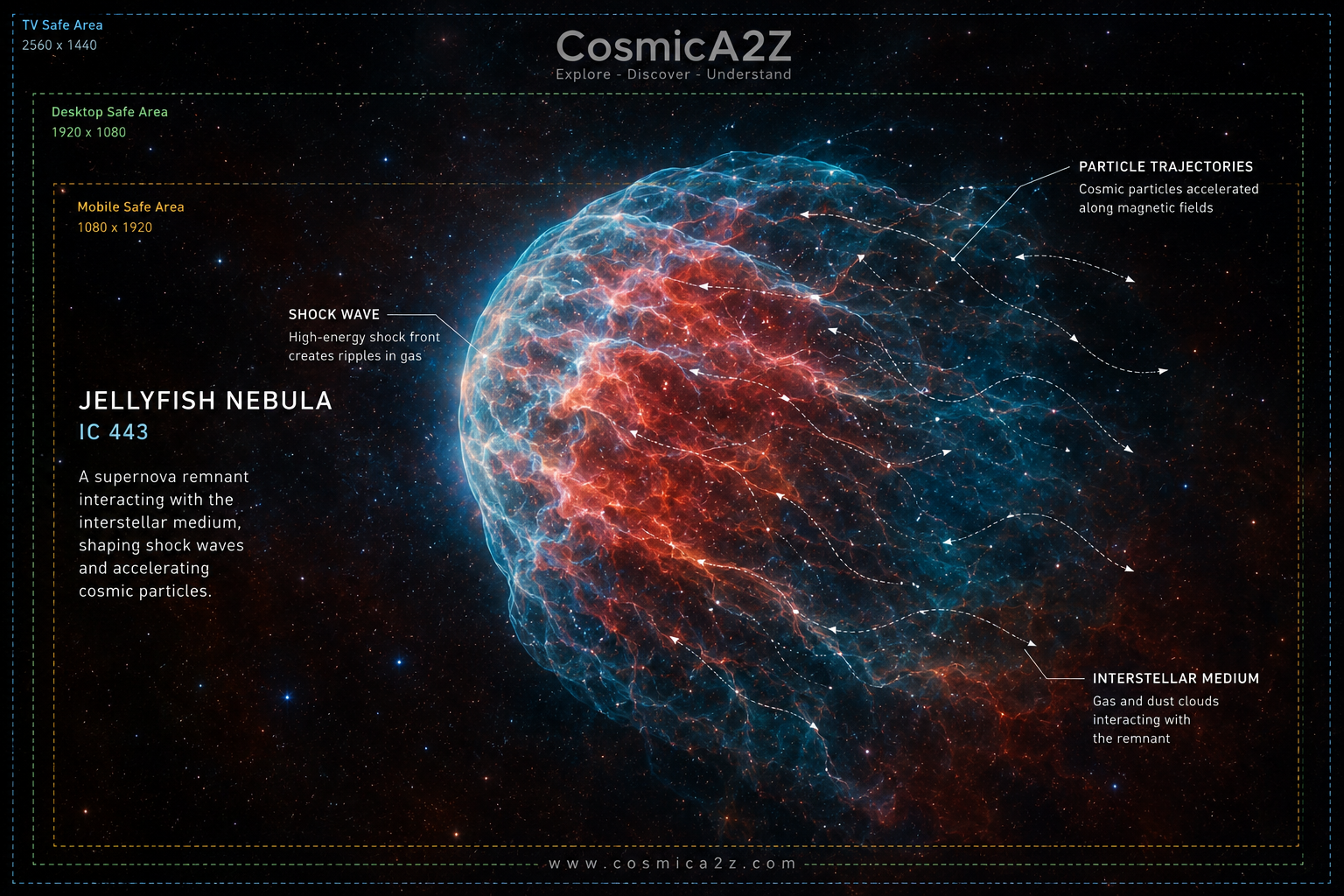
Introduction
Cosmic Update – June 4, 2026
For more than a hundred years, scientists have searched for the source of cosmic rays — those invisible, high-energy particles that constantly bombard Earth from space. Tonight, that mystery glows in the form of a giant cosmic jellyfish.
The Story Begins: A Cosmic Detective Tale
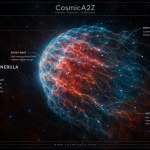
Imagine standing under a clear night sky in Narayanganj, Bangladesh. Above Gemini, a faint nebula stretches like a glowing jellyfish — its tendrils drifting through the darkness. This is IC 443, the Jellyfish Nebula, the remains of a massive star that exploded thousands of years ago.
For decades, astronomers suspected that supernova remnants like IC 443 might be the engines behind cosmic rays. But until now, the evidence was incomplete.
The Breakthrough Discovery
In early 2026, researchers at the Large High Altitude Air Shower Observatory (LHAASO) in China detected gamma rays from IC 443 reaching sub-PeV energies — nearly a quadrillion electron volts. That’s an energy level so extreme it rivals the most powerful particle accelerators on Earth.
These gamma rays are produced when shock waves from the supernova collide with dense molecular clouds, creating neutral pions that decay into gamma radiation. This process confirms that IC 443 is accelerating protons and atomic nuclei — the very particles that make up cosmic rays.
"We’ve finally caught a supernova remnant in the act of accelerating cosmic rays," said one LHAASO researcher in a NASA-linked press briefing.
How It Works: Nature’s Particle Engine
When a star explodes, it sends shock waves racing through space at thousands of kilometers per second. These waves sweep up gas and dust, compressing magnetic fields and energizing particles trapped within.
The result is a natural particle accelerator — a cosmic version of CERN’s Large Hadron Collider.
Real-world comparison:
- The LHC accelerates protons to about 7 TeV (trillion eV).
- The Jellyfish Nebula pushes particles to nearly 1 PeV (quadrillion eV) — over 100 times more powerful.
That’s why scientists call supernova remnants “PeVatrons” — celestial machines capable of producing the highest-energy particles known.
Why It Matters for Earth
Cosmic rays constantly strike our planet, influencing everything from atmospheric chemistry to satellite electronics. Understanding their origin helps scientists predict radiation exposure for astronauts and improve shielding for spacecraft.
It also deepens our understanding of how energy moves through the galaxy — connecting stellar death to cosmic life.
Case study:
During solar minimums, cosmic ray intensity near Earth increases. NASA’s ACE and SOHO missions have recorded spikes that correlate with supernova-driven particle flows. IC 443’s discovery gives context to those patterns, showing how distant explosions contribute to local space weather.
Unique Insights and Analysis
Supernova vs. Pulsar Debate
For years, scientists debated whether cosmic rays came from pulsars (spinning neutron stars) or supernova remnants. The Jellyfish Nebula’s gamma-ray signature now tilts the balance toward supernovae.
However, pulsars may still play a secondary role — acting as “re-accelerators” that boost particles already energized by explosions.
Opinion: The Universe as a Laboratory
This discovery reminds us that the cosmos itself is a vast laboratory. Every nebula, every shock wave, is an experiment in physics — one that runs for millennia.
Unlike human-made colliders, these natural accelerators operate continuously, shaping the radiation environment of entire galaxies.
Future Missions and What’s Next
NASA’s upcoming Roman Space Telescope and ESA’s Athena X-ray Observatory will study remnants like IC 443 in unprecedented detail.
- Roman Telescope: Will map cosmic structures and detect faint remnants across the Milky Way.
- Athena: Will analyze X-ray emissions from shock fronts, revealing how energy transfers between particles and magnetic fields.
Together, these missions could identify dozens of new PeVatrons — confirming that the Jellyfish Nebula is not alone.
Multimedia Ideas for Article Enhancement
| Section | Suggested Visual | Purpose |
|---|---|---|
| Story Hook | Jellyfish Nebula wide view | Establish emotional connection and curiosity |
| Discovery | Gamma ray emission diagram | Explain pion-decay mechanism visually |
| Mechanism | Shock wave interaction illustration | Show how particles accelerate |
| Earth Impact | Cosmic ray path to Earth infographic | Relate discovery to human context |
| Future Missions | Roman and Athena telescope comparison | Preview upcoming research tools |
Depth: Questions Readers Actually Search For
1. What are cosmic rays made of?
Mostly protons (≈ 90 %), helium nuclei (≈ 9 %), and heavier elements (≈ 1 %).
2. Can cosmic rays affect humans?
Indirectly — they influence radiation levels in space and can damage electronics, but Earth’s atmosphere protects us from most effects.
3. Why is IC 443 called the Jellyfish Nebula?
Its filaments resemble jellyfish tentacles, glowing in red and orange hydrogen emissions captured by telescopes like Chandra and Spitzer.
4. How old is the Jellyfish Nebula?
Estimated at 30,000 years, based on expansion rate and shock velocity measurements.
5. Could other nebulae be cosmic ray sources?
Yes — Tycho, Cassiopeia A, and Vela Jr. are strong candidates for similar acceleration processes.
Conclusion: The Universe’s Hidden Engines
The Jellyfish Nebula’s discovery is more than a scientific milestone — it’s a reminder that the universe is alive with motion and mystery. Every explosion leaves behind a legacy of energy that travels across space, eventually touching our world.
For over a century, humanity looked for the origin of cosmic rays. Now, thanks to IC 443, we can finally say: the answer glows in the tendrils of a cosmic jellyfish.
Sources
- NASA Science Mission Directorate — Cosmic Structure SIG Seminar, June 2026
- ESA Athena Mission Brief — High-Energy Astrophysics Division, May 2026
- ScienceDaily — “Supernova Remnants as PeVatrons,” May 2026
- LHAASO Collaboration — Astrophysical Journal Letters, 2026