

Astronomy often advances through unexpected discoveries.
Scientists begin with one theory, point their telescopes toward the sky, and occasionally find something entirely different—something that forces them to rethink what they thought they understood about the cosmos.
That is exactly what happened with a mysterious galaxy located around 11 billion light-years from Earth, informally nicknamed “Shadow Blaster.”
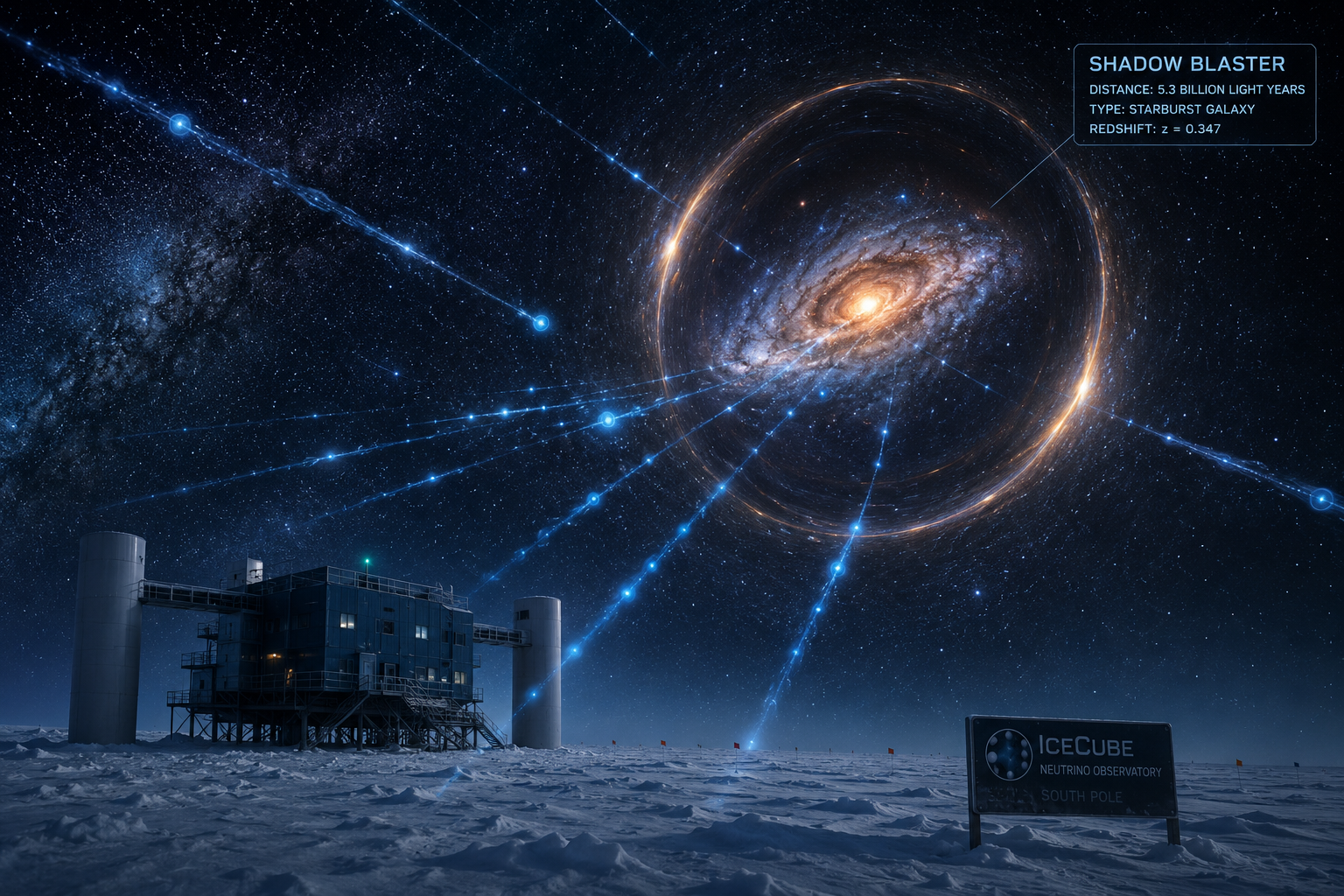
Researchers initially suspected that the immense energy coming from this object was powered by a supermassive black hole. Such black holes are known for accelerating particles to extraordinary energies and producing powerful jets visible across vast cosmic distances.
But after carefully examining the galaxy, astronomers discovered something far more intriguing.
Instead of an active black hole dominating the system, they found evidence of an incredibly intense burst of star formation. Even more remarkable, this environment appears capable of producing some of the universe’s most mysterious travelers: high-energy neutrinos, often called ghost particles.
What Exactly Are Neutrinos?
Every second, trillions of neutrinos pass through your body.
And you never notice.
These particles are among the strangest known to science. They possess almost no mass, carry no electric charge, and interact so weakly with matter that they can travel through entire planets, stars, and vast regions of space without being stopped.
Because they rarely collide with anything, neutrinos are incredibly difficult to detect. Yet they carry valuable information about violent processes occurring throughout the universe.
Scientists have been detecting neutrinos for decades, but identifying where the most energetic ones come from has remained one of astrophysics’ biggest mysteries.
The Signal That Started the Search
Back in 2021, the IceCube Neutrino Observatory, buried deep beneath the Antarctic ice, detected a particularly energetic neutrino known as IC 210922A.
When such a rare event is detected, observatories around the world spring into action.
Astronomers scanned the region of the sky from which the particle appeared to originate. X-ray telescopes, optical observatories, and gamma-ray instruments searched for obvious suspects, especially active supermassive black holes.
But nothing convincing emerged.
The source remained hidden.
Then researchers turned their attention to a distant object later nicknamed “Shadow Blaster.”
What they found changed the story entirely.
A Galaxy Unlike Ordinary Galaxies
Shadow Blaster is extraordinary.
The galaxy shines with roughly trillions of times the infrared luminosity of our Sun, making it one of the brightest star-forming galaxies known.
Its center contains enormous quantities of gas and dust packed into a surprisingly compact region. New stars are forming there at a tremendous rate.
Rather than hosting an actively feeding supermassive black hole, the galaxy appears to be undergoing an extreme “starburst” phase—a period when stars are being born far faster than in ordinary galaxies.
This discovery surprised astronomers because active black holes have traditionally been considered the most likely sources of extremely energetic particles. Yet the evidence emerging from Shadow Blaster suggested that nature might have another mechanism capable of accelerating particles to astonishing energies.
How Star Factories Become Particle Accelerators
At first glance, star formation and high-energy particles might seem unrelated.
But the connection is surprisingly powerful.
Massive stars live short lives and often end as violent supernova explosions. These explosions generate cosmic rays—high-energy particles traveling near the speed of light.
Inside an environment as dense and chaotic as Shadow Blaster, these particles repeatedly collide with gas and dust.
Those collisions can create neutrinos.
For years, theoretical studies suggested that starburst galaxies might contribute to the cosmic neutrino background. However, obtaining direct observational evidence proved extremely difficult.
Shadow Blaster may finally provide that missing link.
If the interpretation is correct, it means some of the universe’s most mysterious particles could originate not from supermassive black holes, but from regions where stars are being born at extraordinary rates.
Nature Helped Scientists With a Cosmic Magnifying Glass
Studying an object 11 billion light-years away is no easy task.
Fortunately, gravity provided a helping hand.
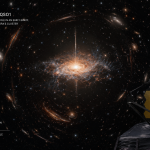
Between Earth and Shadow Blaster sits another galaxy whose immense gravity bends and magnifies the light coming from behind it.
This phenomenon, called gravitational lensing, acts like a giant natural telescope.
Without this cosmic magnifying glass, Shadow Blaster would have been far harder to study.
The lensing effect allowed astronomers to investigate the galaxy’s structure in unprecedented detail and reveal the dense star-forming core hidden within clouds of dust.
Gravitational lensing has become one of astronomy’s most valuable tools because it enables scientists to examine extremely distant objects that would otherwise remain invisible.
In this case, nature itself provided the magnification needed to uncover one of the most intriguing potential neutrino sources ever discovered.
Why This Discovery Matters
Scientists have long believed that active black holes were the primary producers of high-energy neutrinos.
But Shadow Blaster suggests another possibility.
Perhaps some of these particles originate not from black hole jets, but from compact star-forming galaxies scattered throughout the early universe.
According to researchers, galaxies similar to Shadow Blaster may account for a significant portion of the diffuse high-energy neutrino background detected by the IceCube Observatory.
If confirmed, this would represent a major shift in our understanding of where these ghost particles come from.
Instead of a single class of cosmic object dominating neutrino production, multiple astrophysical environments may be contributing to the invisible particle rain constantly flowing through space.
Such a realization would reshape models used by astrophysicists and influence future observations carried out by neutrino observatories around the world.
Looking Back in Time
Because Shadow Blaster lies about 11 billion light-years away, astronomers are seeing it as it existed when the universe was much younger.
Around that era, sometimes called “cosmic noon,” galaxies throughout the universe were forming stars at astonishing rates.
The cosmos itself was far more active than it is today.
Galaxy interactions were common, enormous reservoirs of gas fueled stellar birth, and violent processes shaped the structures we now observe in the modern universe.
Studying objects like Shadow Blaster provides researchers with an opportunity to investigate those ancient conditions.
These distant galaxies act almost like time capsules, preserving clues about how galaxies evolved over billions of years and how matter organized itself into the structures we observe today.
Every photon and every neutrino arriving from such objects carries information from an era long before the Solar System even existed.
Multi-Messenger Astronomy Is Opening a New Era
For centuries, astronomy relied almost entirely on light. Scientists used visible wavelengths and, later, radio waves, infrared radiation, X-rays, and gamma rays to study the universe.
But modern astronomy has entered a completely new age.
Researchers are now exploring the cosmos using multiple forms of information simultaneously. This approach, known as multi-messenger astronomy, combines traditional electromagnetic observations with neutrinos, cosmic rays, and gravitational waves.
Instead of relying only on what telescopes can see, scientists are learning to study the universe through entirely different messengers.
Neutrinos are especially valuable because they can escape environments that ordinary light cannot penetrate.
Dense clouds of gas and dust often block visible radiation, hiding violent cosmic events from conventional telescopes. Ghost particles, however, pass through these barriers with ease, carrying information directly from their birthplace.
As technology improves and detectors become increasingly sensitive, astronomers may uncover many more hidden sources similar to Shadow Blaster.
The future of astronomy may involve combining information from every messenger available, allowing scientists to build a much more complete picture of the universe.
The Mystery Is Far From Solved
Researchers emphasize that the connection between the neutrino event IC 210922A and Shadow Blaster still requires additional confirmation.
Science rarely delivers certainty overnight.
Discoveries are built through years of observations, repeated measurements, and independent verification by researchers across the world.
Yet even as a candidate source, Shadow Blaster represents one of the strongest pieces of evidence suggesting that extreme star-forming galaxies can produce high-energy neutrinos.
Sometimes the universe surprises scientists by refusing to follow expectations.
Astronomers expected a monster black hole.
Instead, they found an ancient galaxy overflowing with stellar birth—a cosmic factory capable of launching invisible particles across billions of light-years.
And if one hidden galaxy can challenge decades of assumptions, there may be countless others waiting to rewrite humanity’s understanding of the cosmos.
Watch the Discovery Explained
Want a quick visual overview of this remarkable discovery? Watch our YouTube Short below and continue exploring the mysteries of the universe with Cosmic A2Z.
Frequently Asked Questions
What is the Shadow Blaster galaxy?
Shadow Blaster is the nickname given to an extremely bright and distant starburst galaxy located around 11 billion light-years away. Scientists believe intense star formation inside this galaxy may be producing high-energy neutrinos.
What are neutrinos?
Neutrinos are tiny subatomic particles with almost no mass and no electric charge. They interact very weakly with matter and can travel through planets, stars, and galaxies almost undisturbed.
Why is this discovery important?
The discovery suggests that starburst galaxies may be major sources of high-energy neutrinos, challenging previous assumptions that active supermassive black holes were the primary producers.
What is the IceCube Neutrino Observatory?
The IceCube Neutrino Observatory is a giant scientific detector buried beneath Antarctica’s ice. It is designed to detect neutrinos arriving from distant cosmic sources.
Sources
- Nature Astronomy — Research concerning compact dusty starburst galaxies and high-energy neutrino production.
- IceCube Neutrino Observatory Collaboration.
- Gemini North Observatory observations.
- Atacama Large Millimeter/submillimeter Array (ALMA).
- Courthouse News — Coverage of astronomers tracing a ghost particle to a distant star-forming galaxy.
- Astrophysical Journal and theoretical studies regarding starburst galaxies and neutrino backgrounds.