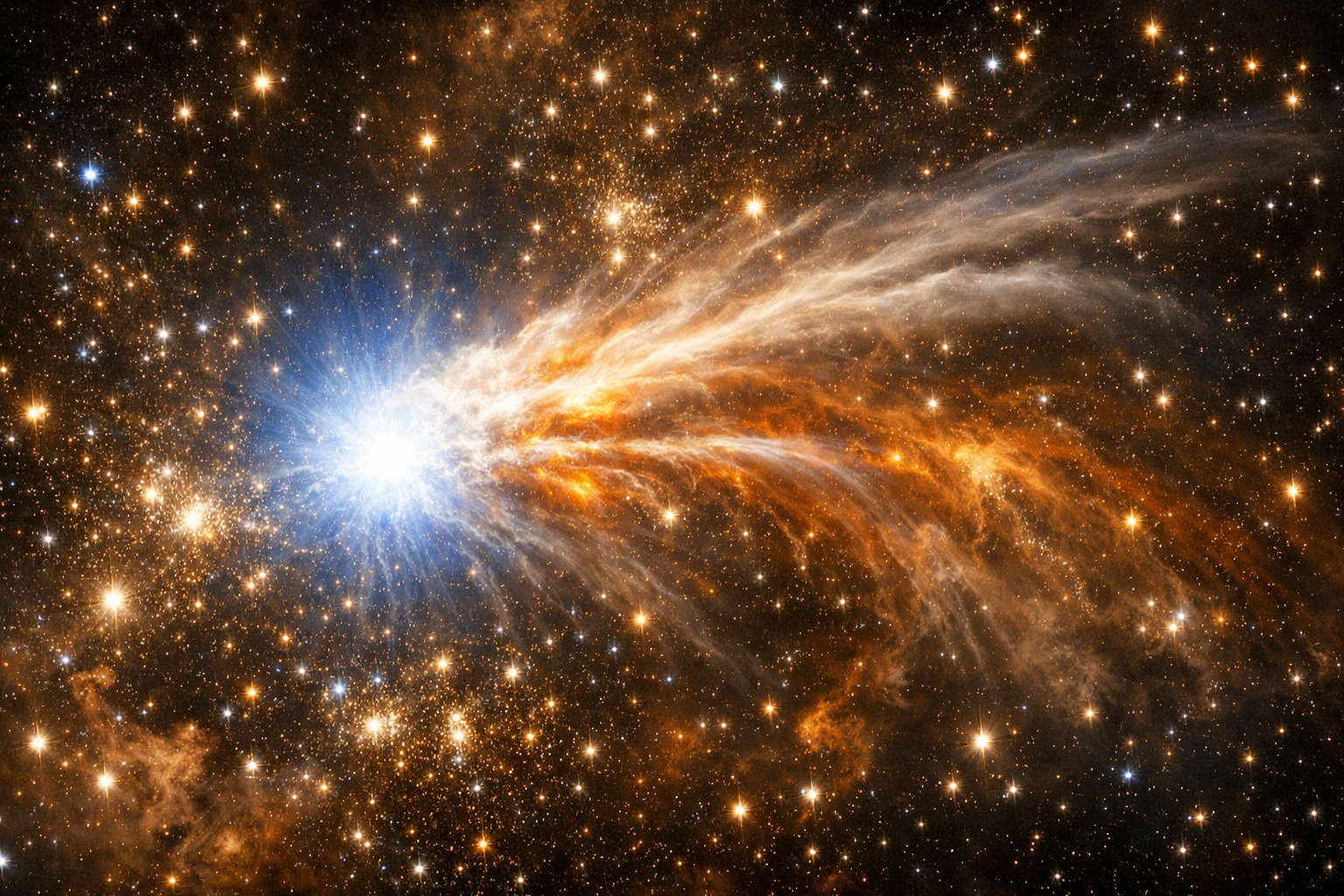
LBV 1806-20 in a violent stellar wind phase inside Sagittarius cluster
---
LBV 1806-20 — The Galactic Titan That Burns Brighter Than Creation
Introduction: A Star Beyond Imagination
LBV 1806-20 is not just another luminous blue variable — it’s a cosmic leviathan, a star so powerful that it challenges the very limits of stellar physics. Located roughly 30,000 light-years away in the constellation Sagittarius, this celestial monster radiates nearly five million times the brightness of our Sun. Its unstable atmosphere roars with supersonic stellar winds, and its surrounding cluster is a battlefield of massive stars competing for survival.
Astronomers first identified LBV 1806-20 in the early 2000s through infrared observations, since visible light cannot penetrate the dense dust clouds of the W31 star-forming region. What they found was astonishing — a star (or possibly a binary pair) so luminous that it redefined what we thought possible for stellar formation.
---
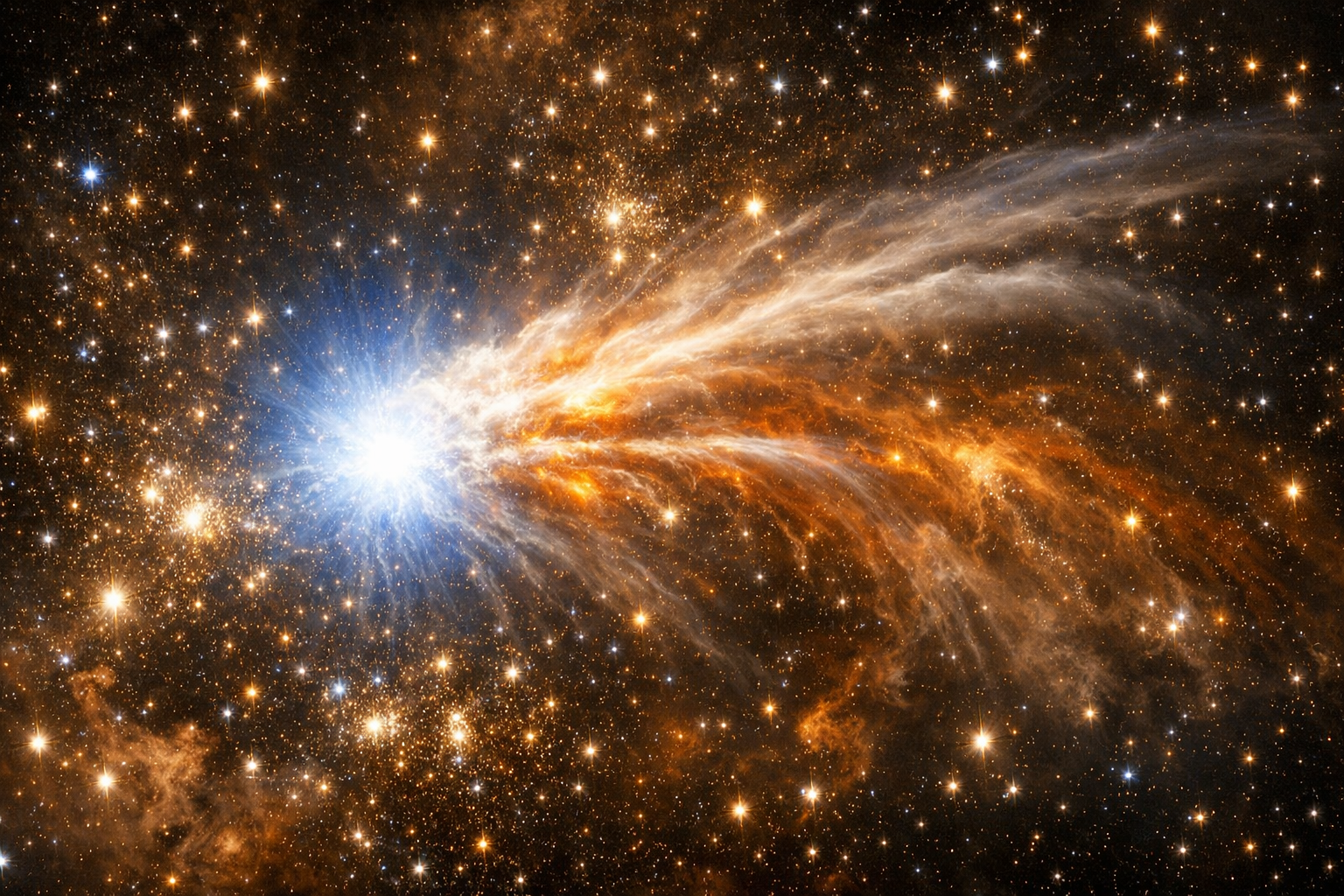
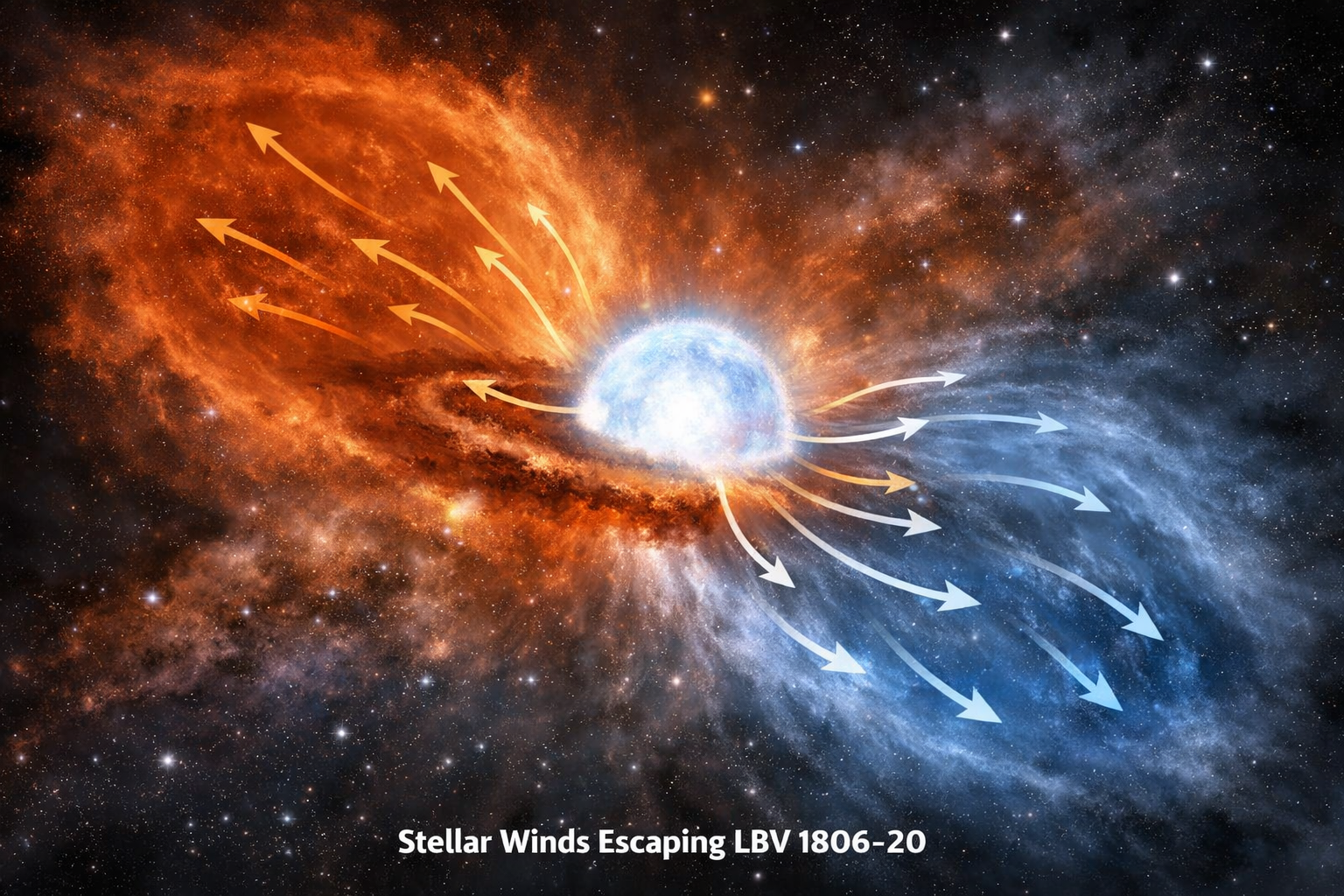
Stellar winds violently escaping LBV 1806-20
The Storm of Stellar Winds
LBV 1806-20’s outer layers are in constant turmoil. Its stellar winds eject material at speeds exceeding 1,000 km/s, creating vast shells of gas and dust that glow in infrared wavelengths. These winds are not gentle breezes — they are cosmic hurricanes, stripping the star of mass and reshaping the surrounding nebula.
Spectroscopic studies show P Cygni profiles in hydrogen and helium lines, a telltale sign of violent outflow. The star’s mass-loss rate is estimated at 10⁻⁴ solar masses per year, meaning it sheds the equivalent of Earth’s mass every few hours. This relentless shedding is part of the LBV life cycle — a prelude to the inevitable supernova or hypernova that awaits.
---
Scientific Analysis and Sources
According to research published in The Astrophysical Journal and Monthly Notices of the Royal Astronomical Society, LBV 1806-20 is likely a binary system, composed of two massive stars orbiting within a shared envelope. This configuration explains its extreme luminosity without violating the theoretical upper mass limit of 150 solar masses.
Infrared data from NASA’s Spitzer Space Telescope and ESO’s Very Large Telescope reveal that the surrounding Cluster 1806-20 hosts several Wolf–Rayet stars and the magnetar SGR 1806-20 — one of the most magnetic objects ever discovered. The proximity of these exotic bodies suggests that LBV 1806-20 may soon undergo a core-collapse supernova, possibly leaving behind another magnetar or even a stellar-mass black hole.
---
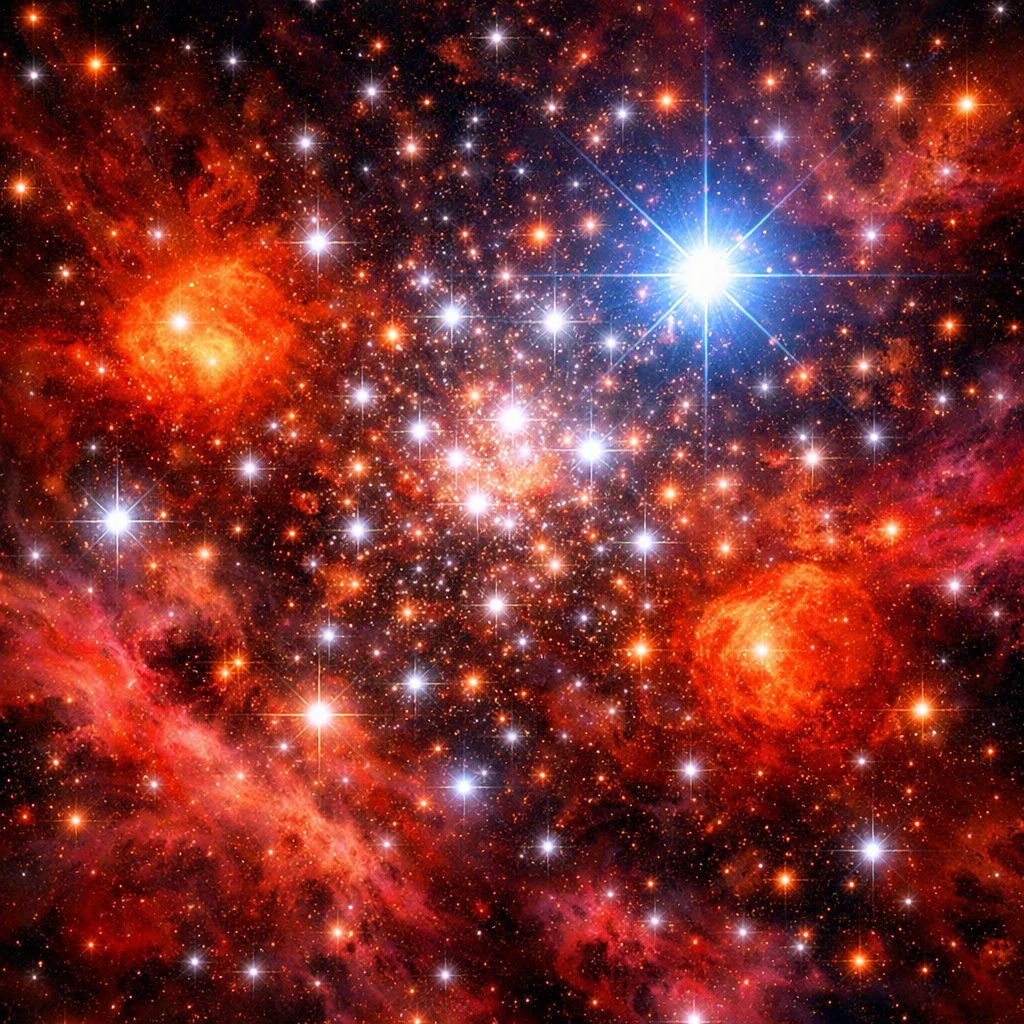
Dense infrared star cluster surrounding LBV 1806-20
The Cluster of Giants
LBV 1806-20 resides in a stellar nursery teeming with giants. The Cluster 1806-20 is a dense region of massive stars, each tens of times heavier than the Sun. Their combined radiation pressure sculpts the surrounding interstellar medium into glowing filaments and shock fronts.
Infrared imagery shows a crowded field of blue-white stars, some already transitioning into Wolf–Rayet phases, others still burning hydrogen in their cores. The cluster’s age — roughly 3 to 5 million years — means many of its members are nearing the end of their lives. LBV 1806-20 stands as the most luminous among them, a beacon of instability and power.
---
The Coming Cataclysm
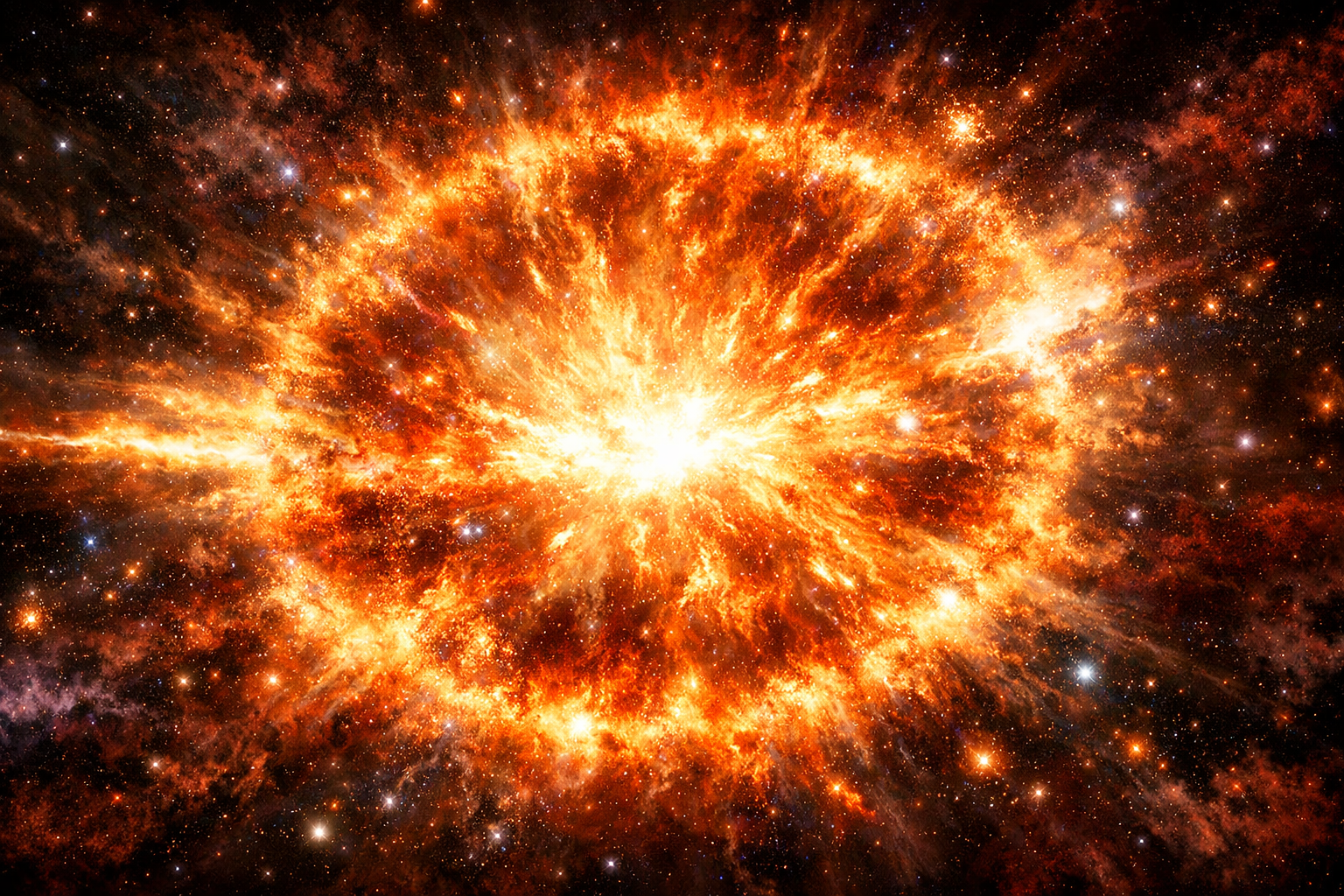
When LBV 1806-20 finally collapses, the explosion will be catastrophic. Models predict a hypernova, releasing more energy than any ordinary supernova. The blast could briefly outshine the entire Milky Way, sending shockwaves through the surrounding cluster and triggering new waves of star formation.
Such an event would also produce gamma-ray bursts, among the most energetic phenomena known. If directed toward Earth, these bursts could be detectable even across tens of thousands of light-years — a cosmic echo of the star’s final scream.
---
Possible hypernova explosion scenario of LBV 1806-20
Why LBV 1806-20 Matters
LBV 1806-20 is a cornerstone for understanding massive-star evolution, binary interactions, and supernova mechanics. Its study helps refine models of radiation pressure, mass loss, and stellar feedback in galactic ecosystems.
For science communicators and astronomy enthusiasts, LBV 1806-20 offers a perfect narrative blend of beauty and destruction — a star that embodies the cycle of creation and collapse.
---
SEO-Optimized Keywords
LBV 1806-20 is one of the most extreme and scientifically important examples of a luminous blue variable star in modern astrophysics. It is frequently studied in the context of massive star evolution, hypernova progenitors, stellar wind dynamics, and infrared astronomy. This celestial object in the Sagittarius star-forming region is a key reference point for understanding how the most massive stars in the universe behave, evolve, and eventually die in catastrophic supernova or hypernova events. Its significance in astronomy makes it a high-value keyword topic for space science content, astrophysics research, and educational astronomy resources.
---
Final Takeaway
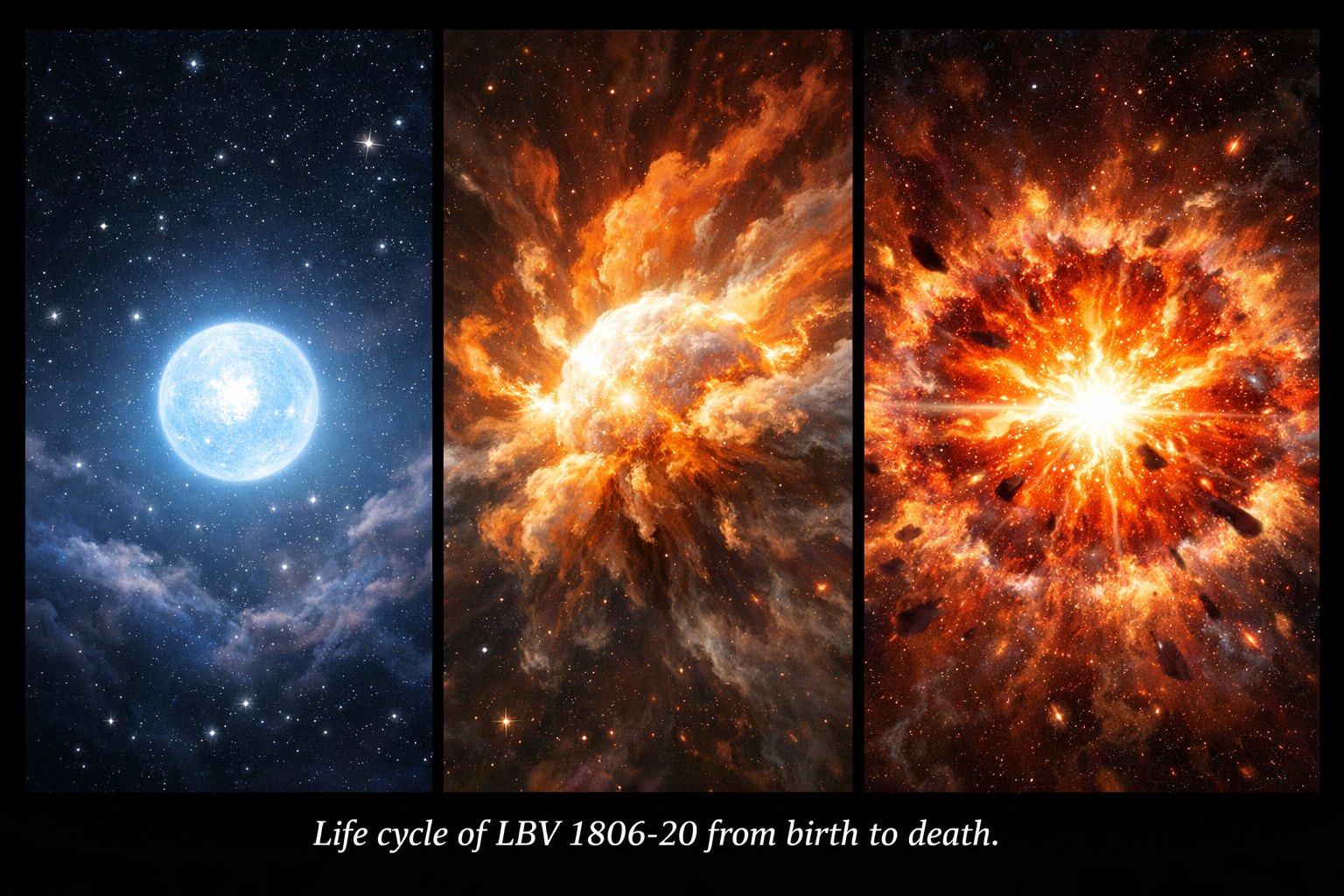
LBV 1806-20 is a galactic titan, a star whose brilliance and instability remind us that even the universe’s most powerful creations are fleeting. Its story — from formation to inevitable explosion — is a cosmic symphony of light, motion, and transformation.
When it finally dies, LBV 1806-20 will not fade quietly. It will ignite the heavens, leaving behind a legacy of energy and matter that will seed new stars for millions of years to come.
---
Complete life cycle of LBV 1806-20