








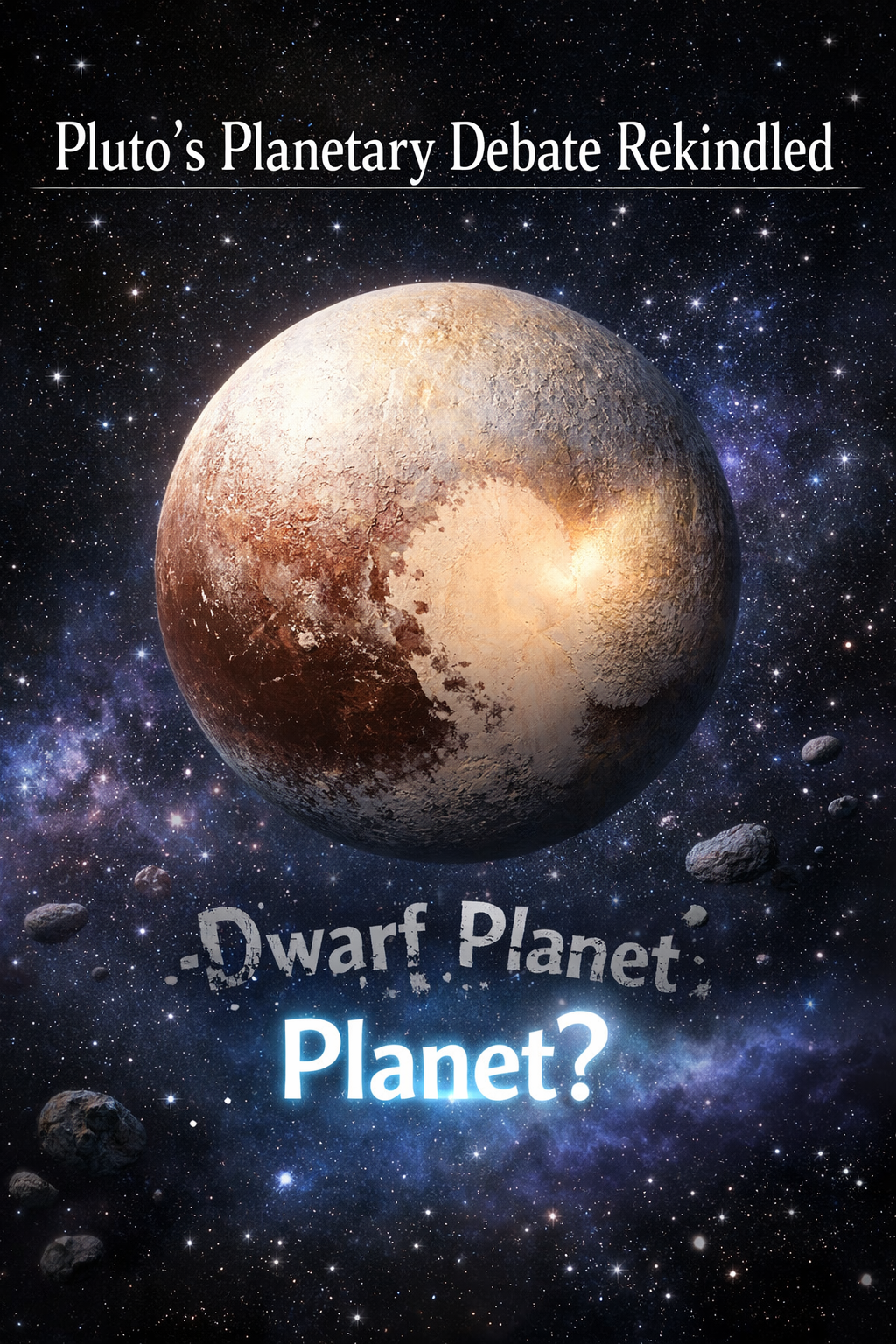
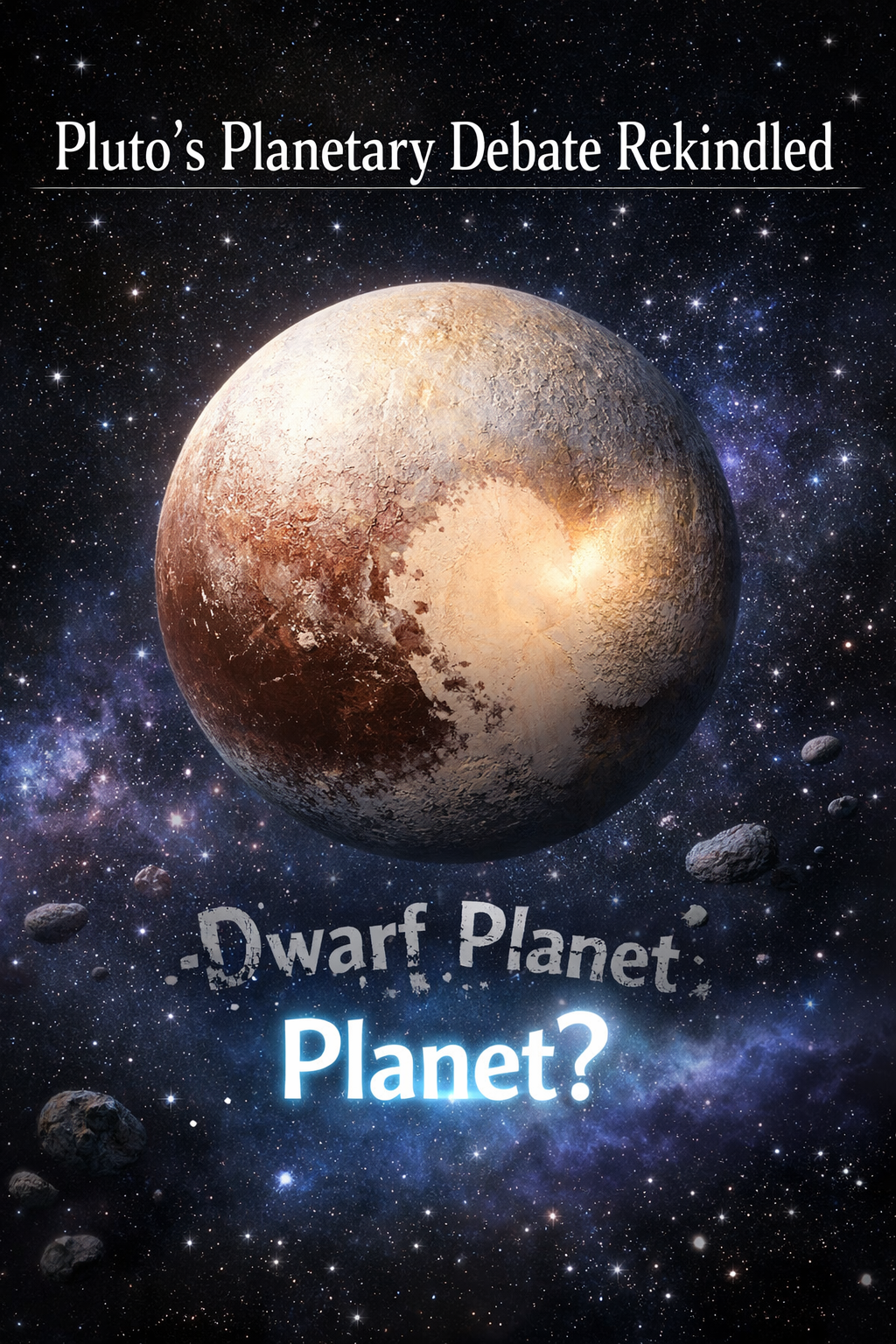
Pluto’s Planetary Debate Rekindled
Introduction
Cosmic Update – May 12, 2026
Nearly twenty years after Pluto was stripped of its planetary crown, the debate has returned to center stage. On April 27, 2026, Jared Isaacman told Congress he is “in the camp of make Pluto a planet again.” His remarks reignited one of astronomy’s most emotional and scientifically complex controversies.
Pluto’s Journey: From Discovery to Demotion
Pluto was discovered in 1930 by Clyde Tombaugh at Lowell Observatory. For decades, it was celebrated as the ninth planet of our Solar System, appearing in textbooks, classrooms, and popular culture worldwide.
But in 2006, the International Astronomical Union redefined what constitutes a planet. The new criteria required a celestial body to:
- Orbit the Sun
- Be nearly round in shape
- Clear its orbital neighborhood
Pluto met the first two requirements but failed the third, since it resides in the Kuiper Belt among countless icy objects. The IAU’s Resolution B5 reclassified Pluto as a dwarf planet, sparking disappointment and debate across the world.
Why Pluto Still Matters
Despite its demotion, Pluto remains one of the most scientifically fascinating worlds in the Solar System:
- Geology: Towering icy mountains, nitrogen glaciers, and evidence of tectonic activity
- Atmosphere: A thin but dynamic atmosphere with seasonal variation
- Moons: Five known moons, including Charon, forming a near-binary system with Pluto
- Tombaugh Regio: The iconic heart-shaped region revealed by NASA’s New Horizons mission in 2015
These discoveries transformed Pluto from a distant icy dot into a complex and active world, challenging assumptions about what deserves planetary status.
NASA’s Renewed Push
Isaacman’s April 2026 testimony reportedly came in response to a senator’s question rather than from prepared remarks. He emphasized that NASA scientists are preparing papers to intensify discussion within the astronomical community.
Part of the motivation is symbolic: honoring Clyde Tombaugh and reconsidering whether the IAU’s orbital-clearing rule is too restrictive.
This is the first time in years that senior NASA leadership has openly signaled support for revisiting Pluto’s classification, giving the debate renewed momentum.
The Scientific Divide
The astronomy community remains deeply divided:
Pro-Pluto Scientists: Researchers such as Alan Stern and Bill McKinnon argue that a planet should be defined by geophysical complexity — geology, atmosphere, and internal processes — rather than orbital dominance.
Skeptics: Scientists including Mike Brown and some IAU representatives warn that redefining Pluto could lead to hundreds of Kuiper Belt objects qualifying as planets.
Middle Ground: Some researchers suggest creating new classifications such as “geophysical planets,” balancing scientific precision with cultural understanding.
The disagreement reflects a deeper philosophical question: should science prioritize strict classification systems or intuitive public understanding?
Cultural Resonance
Pluto’s 2006 demotion became more than a scientific decision — it became a cultural event.
Public Sentiment: Many people still feel Pluto was unfairly stripped of its status
Education: Schools and textbooks adapted, but nostalgia for the “nine planets” remains strong
Symbolism: Pluto represents exploration at the Solar System’s frontier, inspiring generations with the mystery of distant worlds
The debate continues because Pluto is tied not only to astronomy, but also to identity, memory, and humanity’s fascination with discovery.
Implications of Reclassification
If Pluto were restored as a planet, the consequences would ripple across science and education:
Scientific: Dozens of trans-Neptunian objects might also qualify as planets
Educational: Planet counts, textbooks, and curricula would need revision
Cultural: Pluto’s restoration would satisfy public sentiment and honor Tombaugh’s legacy
Institutional: NASA’s advocacy could pressure the IAU to revisit its 2006 decision, though any formal change would require international agreement
The issue ultimately affects how humanity defines worlds across the universe.
Looking Ahead
The International Astronomical Union has not formally responded to Isaacman’s remarks, and no official proposal currently exists. Still, NASA’s renewed involvement could reopen discussions that many believed were settled.
Whether Pluto regains full planetary status or remains classified as a dwarf planet, the debate demonstrates how scientific definitions evolve alongside new discoveries.
Conclusion
As of May 12, 2026, Pluto’s fate remains uncertain, but the conversation is once again alive. Backed by growing public interest and renewed attention from NASA leadership, Pluto continues to stand at the intersection of science, culture, and curiosity.
Its planetary crown may not yet be restored — but the debate ensures that Pluto remains one of the most beloved worlds in the Solar System.