


Introduction
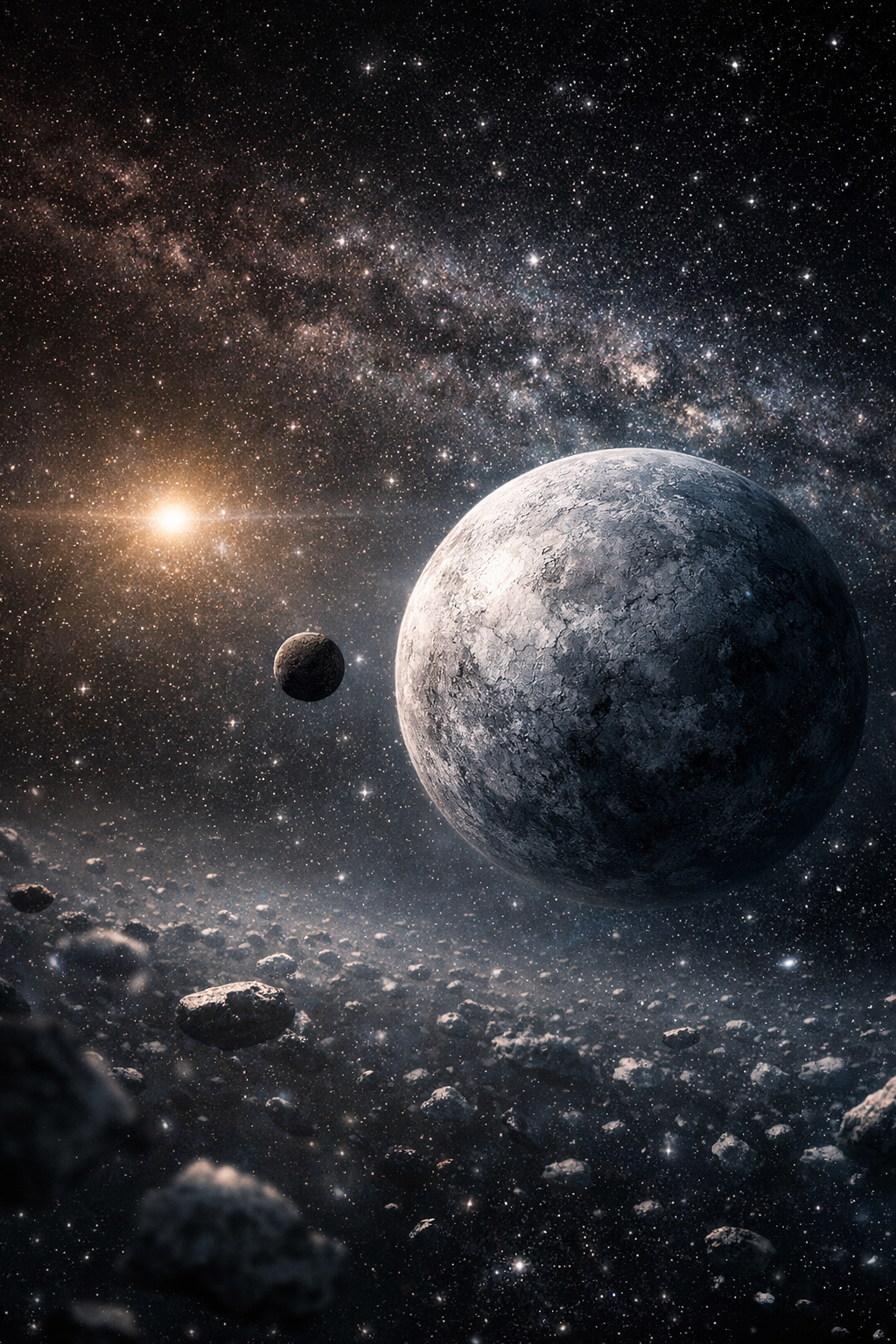
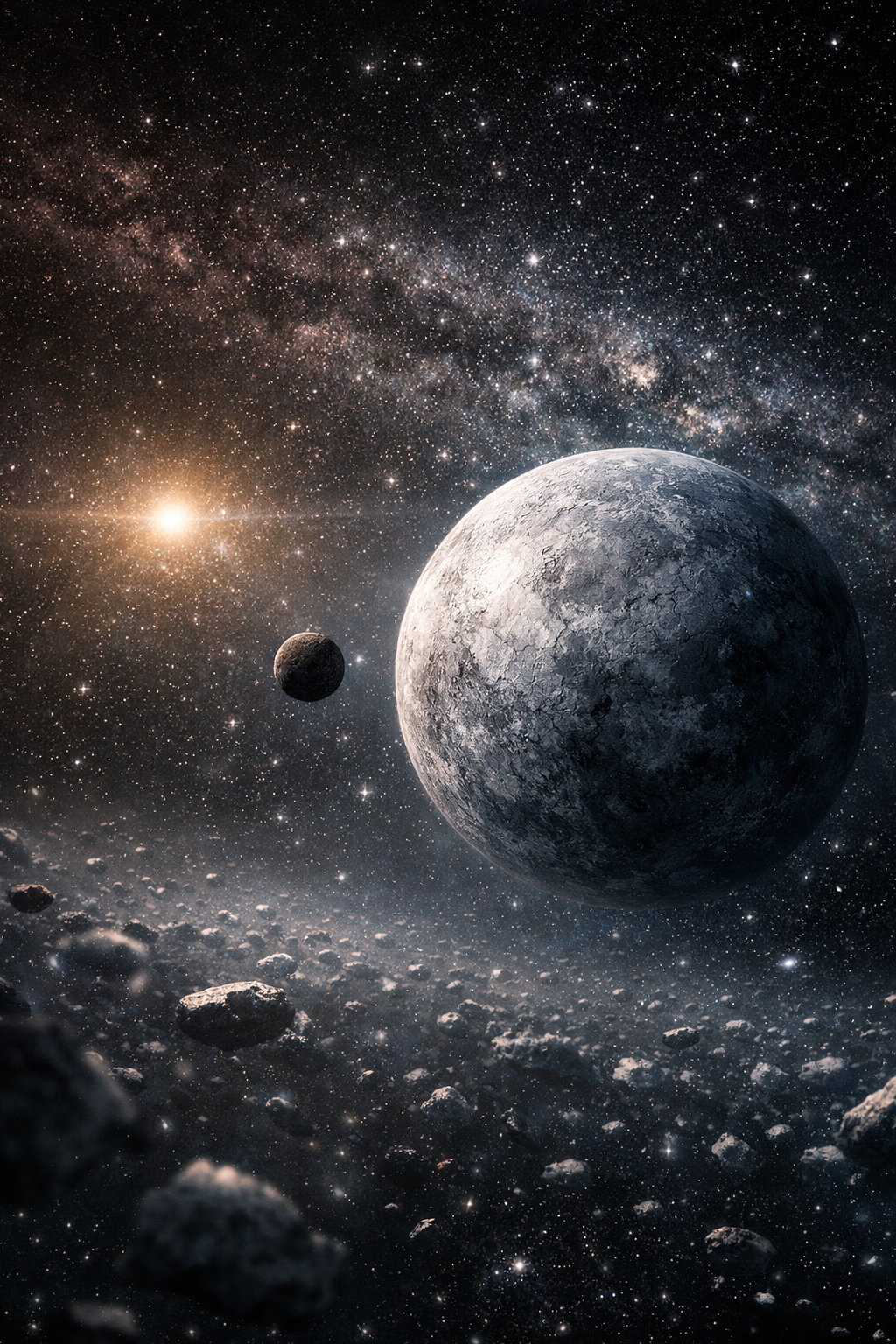
We grew up learning there were nine planets. Then, in 2006, Pluto was erased from the list, leaving only eight. But the discovery of Eris — a frozen world orbiting far beyond Neptune — reignited one of astronomy’s most heated debates: what truly counts as a planet? Eris is massive, mysterious, and accompanied by a tiny moon, Dysnomia. Its existence forces us to ask whether our Solar System should be described as eight planets, nine, or even ten.
The Discovery of Eris
Eris was first identified in 2003 and officially announced in 2005 by astronomers Mike Brown, Chad Trujillo, and David Rabinowitz. At the time, Eris appeared larger than Pluto, sparking immediate controversy. If Pluto was considered a planet, then surely Eris deserved the same title. Instead, the International Astronomical Union (IAU) responded by redefining the word “planet” — a decision that demoted Pluto and classified Eris as a dwarf planet. The name “Eris,” meaning discord in Greek mythology, perfectly captured the turmoil it caused in astronomy.
Orbit and Physical Characteristics
Eris is one of the most distant known objects in the Solar System.
- Distance from Sun: ~10 billion km (67 AU).
- Orbital period: 560 Earth years — meaning one Eris year lasts longer than five human lifetimes.
- Diameter: ~2,326 km (slightly smaller than Pluto).
- Mass: 27% greater than Pluto.
- Surface: Frozen methane and nitrogen, reflecting sunlight with an albedo of 0.96.
- Temperature: –243°C, making it one of the coldest worlds known.
- Moon: Dysnomia, a faint companion that helps astronomers measure Eris’s mass.
Its day length is surprisingly familiar — about 26 hours, close to Earth’s 24. Yet sunlight there is so weak that the Sun appears only as a bright star in the sky.
The Planet Definition Debate
The IAU’s 2006 definition of a planet requires three conditions:
- It must orbit the Sun.
- It must be spherical due to gravity.
- It must clear its orbital neighborhood.
Eris meets the first two but fails the third, just like Pluto. Critics argue this rule unfairly excludes distant worlds that naturally share space with other icy bodies. Some astronomers propose alternative definitions, such as ranking planets by gravitational dominance or simply including all spherical bodies above a certain size. If such criteria were adopted, Eris would almost certainly qualify as the tenth planet.
Scientific and Cultural Impact
Eris’s discovery reshaped astronomy in several ways:
- It expanded the known population of trans-Neptunian objects (TNOs).
- It inspired missions like New Horizons, which explored Pluto and continues to study the Kuiper Belt.
- It forced scientists to reconsider how planetary systems are classified, especially as thousands of exoplanets are discovered around other stars.
- It reignited public fascination with planetary identity. Many people still feel nostalgic for Pluto and curious about Eris, sparking debates in classrooms, documentaries, and social media.
Eris vs Pluto: A Cosmic Comparison
| Feature | Eris | Pluto |
|---|---|---|
| Diameter | 2,326 km | 2,376 km |
| Mass | 1.64 × 10²² kg | 1.31 × 10²² kg |
| Orbit Period | 560 years | 248 years |
| Distance from Sun | 10.1 billion km | 5.9 billion km |
| Moons | 1 (Dysnomia) | 5 |
This comparison shows why Eris is such a disruptive discovery. It is smaller in size but heavier than Pluto, proving that the Kuiper Belt contains worlds of surprising diversity.
The Future of Planetary Classification
As telescopes like the James Webb Space Telescope (JWST) capture clearer data on Eris and Dysnomia, astronomers are reconsidering the rigid “eight-planet” model. With thousands of TNOs discovered, the Solar System may eventually be described as a hierarchy of worlds rather than a fixed list. Some scientists argue that clinging to the number eight oversimplifies reality, while others believe expanding the list would overwhelm education.
Conclusion
Eris challenges us to rethink the Solar System. Whether we call it a planet or a dwarf planet, it expands our imagination of what lies beyond Neptune. Perhaps the Solar System isn’t shrinking — it’s expanding in understanding. Eris reminds us that discovery never ends, and that the debate over “how many planets we have” is less about numbers and more about curiosity.