







Introduction
For thousands of years, humanity has looked toward the night sky and wondered whether other worlds exist beyond our own. Among the billions of stars scattered across the Milky Way, one system has captured the imagination of astronomers more than any other: Alpha Centauri. Located just over 4.3 light-years from Earth, it is the closest stellar system to our Sun and the most realistic destination for future interstellar exploration.
Unlike distant stars that remain little more than points of light, Alpha Centauri represents a nearby cosmic laboratory where scientists can study star formation, planetary systems, and potentially even alien life. Recent discoveries of exoplanets orbiting Proxima Centauri have transformed Alpha Centauri from a bright object in the southern sky into one of the most important targets in modern astronomy.
As technology advances and humanity dreams of traveling beyond the Solar System, Alpha Centauri stands as the first true frontier of interstellar exploration.
The Alpha Centauri System: A Family of Three Stars
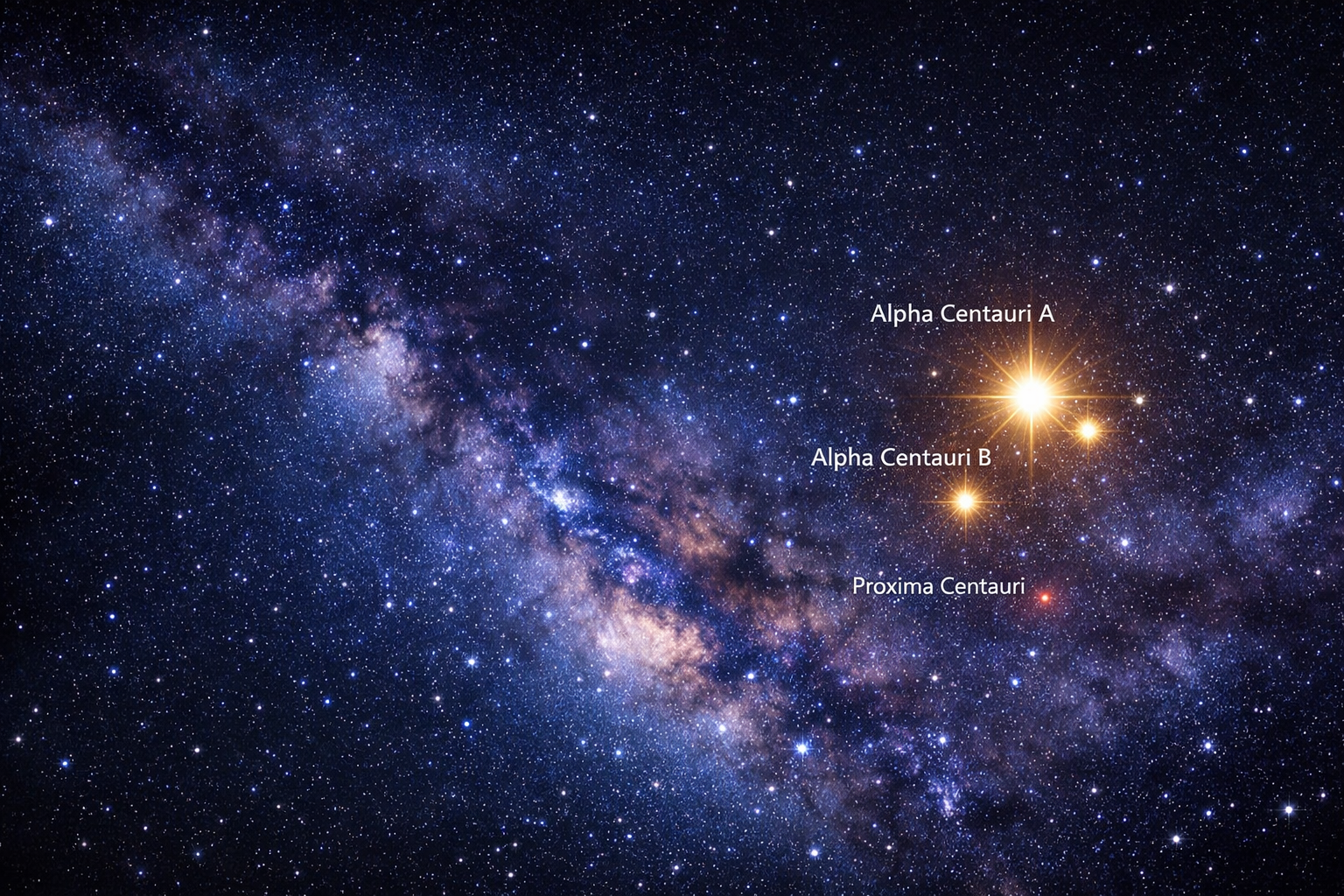
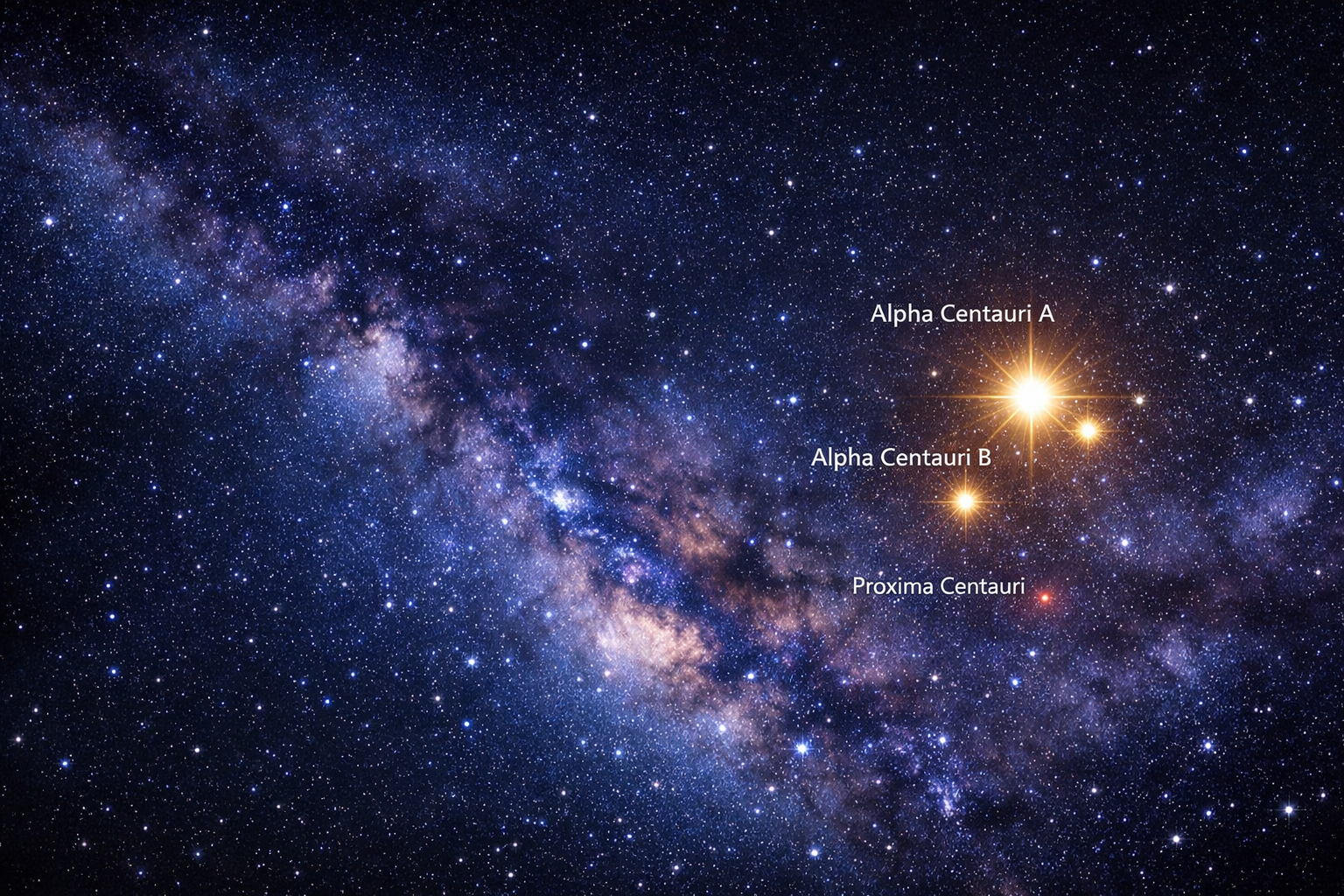
The Alpha Centauri system is not a single star, but a gravitationally bound family of three stars:
Alpha Centauri A (Rigil Kentaurus)
Alpha Centauri B (Toliman)
Proxima Centauri (Alpha Centauri C)
Together, these stars form a complex triple-star system unlike our own Solar System.
Alpha Centauri A — The Sun’s Closest Stellar Twin
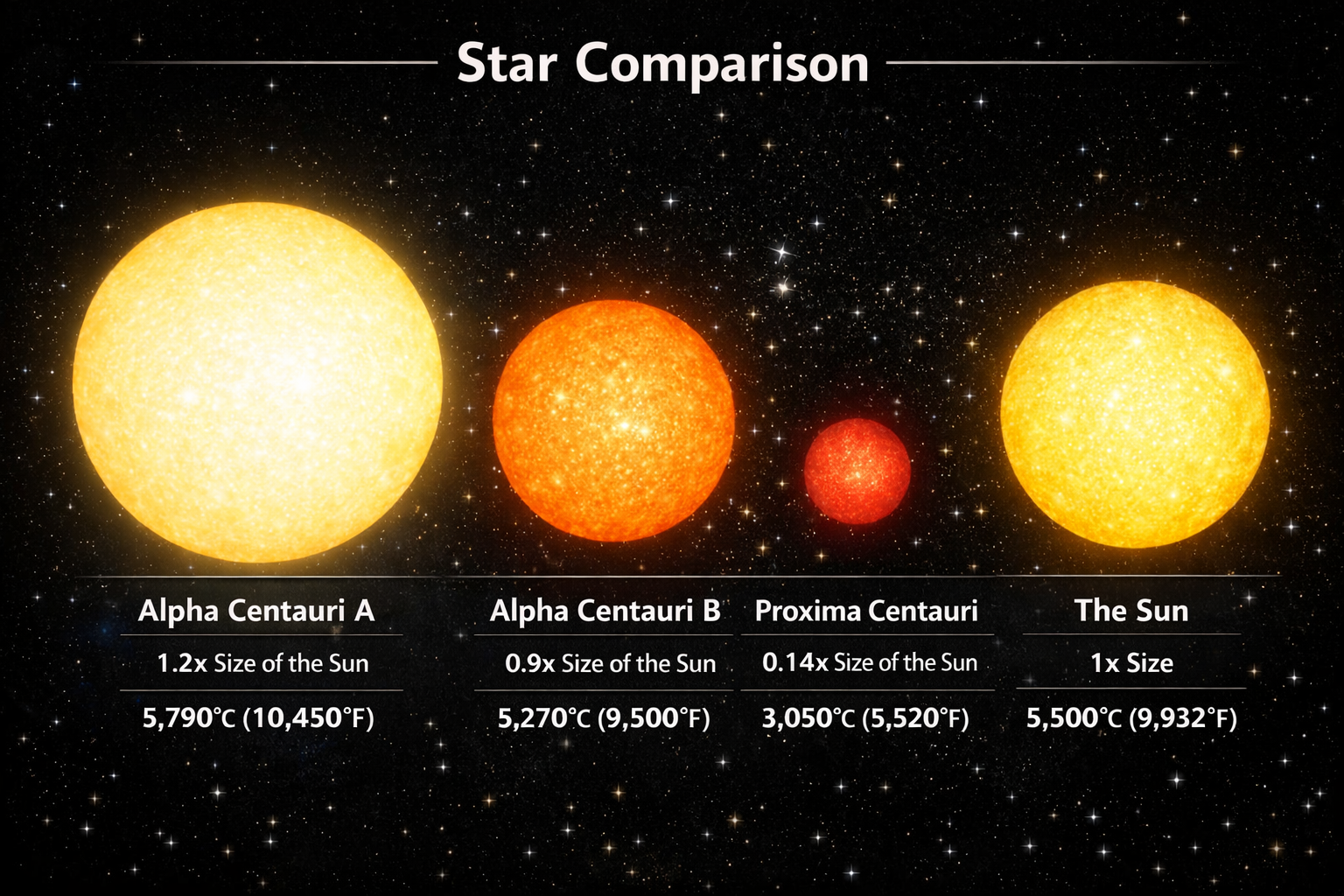
Alpha Centauri A is a G-type main-sequence star, almost identical to our Sun in temperature, size, and luminosity. In fact, astronomers often describe it as the closest “solar twin” known to humanity.
However, Alpha Centauri A is slightly larger and more luminous than the Sun:
Mass: ~1.1 times the Sun
Radius: ~1.2 times the Sun
Luminosity: ~1.5 times brighter
Because of these similarities, scientists believe planets orbiting Alpha Centauri A could potentially support Earth-like conditions if stable worlds exist there.
Alpha Centauri B — The Orange Companion
Alpha Centauri B is smaller, cooler, and dimmer than Alpha Centauri A. It belongs to the K-type orange dwarf category and emits a warm orange glow.
Characteristics include:
Mass: ~0.9 times the Sun
Cooler surface temperature
Longer lifespan than the Sun
Many astronomers consider K-type stars especially interesting because they are stable for extremely long periods, potentially giving life more time to evolve on surrounding planets.
Proxima Centauri — The Closest Star to Earth
The third member of the system, Proxima Centauri, is the nearest known star to Earth after the Sun. It lies approximately 4.24 light-years away.
Unlike the bright Alpha Centauri A and B stars, Proxima is a tiny red dwarf:
Only ~12% the Sun’s mass
Extremely faint and invisible to the naked eye
Surface temperature around 3,000°C
Despite its small size, Proxima has become one of the most scientifically important stars ever discovered because it hosts multiple exoplanets.
A Remarkable Binary Dance
Alpha Centauri A and B orbit each other in a binary system, completing one orbit every 79.9 years. Their distance changes dramatically during this orbit:
At closest approach: similar to Saturn’s distance from the Sun
At farthest separation: greater than Pluto’s orbit
Meanwhile, Proxima Centauri orbits the binary pair at an enormous distance of roughly 13,000 astronomical units. One complete orbit around the pair may take more than half a million years.
This makes the Alpha Centauri system both stable and dynamically fascinating.
Visibility in the Night Sky
Alpha Centauri is located in the southern constellation Centaurus. It is visible mainly from the Southern Hemisphere and regions south of roughly 40° north latitude.
To observers on Earth:
Alpha Centauri A and B appear as one bright star
It is the third brightest stellar object in the night sky
Only Sirius and Canopus appear brighter
For centuries, sailors used Alpha Centauri as a navigational reference while traveling across southern oceans.
The Discovery of Planets Around Proxima Centauri

Proxima b — The Nearest Potentially Habitable World
In 2016, astronomers announced the discovery of Proxima b, an Earth-sized rocky planet located within the star’s habitable zone.
Key characteristics:
Minimum mass: ~1.3 Earth masses
Orbital period: 11.2 days
Receives energy comparable to Earth’s sunlight
Because it orbits within the habitable zone, liquid water could theoretically exist on its surface.
The discovery immediately became one of the most important milestones in modern astronomy because Proxima b is the closest potentially habitable exoplanet ever found.

Proxima c — The Cold Super-Earth
Scientists later discovered Proxima c, a much larger super-Earth orbiting farther from the star.
Unlike Proxima b:
It likely has extremely cold temperatures
May possess a thick icy atmosphere
Could resemble a frozen Neptune-like world
Although probably uninhabitable, Proxima c provides important insight into planetary formation around red dwarfs.
Proxima d — One of the Lightest Known Exoplanets
A third planet, Proxima d, was later confirmed using ultra-precise radial velocity measurements.
It is remarkable because:
Its mass is only about one-quarter to one-third of Earth’s
It completes an orbit in just over 5 days
It is among the lightest exoplanets ever detected
Detecting such a tiny world demonstrates how advanced modern astronomical instruments have become.
How Scientists Detect These Worlds
The planets around Proxima Centauri were primarily discovered using the radial velocity method.
As planets orbit a star, their gravity causes the star to wobble slightly. Sensitive instruments detect these tiny motions by measuring shifts in starlight.
Major instruments involved include:
HARPS
ESPRESSO
NIRPS
These spectrographs are capable of detecting movements smaller than walking speed, allowing astronomers to identify incredibly small planets.
Could Life Exist There?
One of the biggest questions in astronomy is whether life could survive around red dwarf stars like Proxima Centauri.
Reasons for Hope
Proxima b lies in the habitable zone
Rocky planets exist in the system
Water may potentially exist
Major Challenges
However, Proxima Centauri is a violent flare star. It frequently emits:
Powerful X-ray bursts
Ultraviolet radiation
Stellar winds
These flares could strip atmospheres from nearby planets and expose surfaces to deadly radiation.
Even if life exists there, it may be very different from life on Earth.
Distance Scale
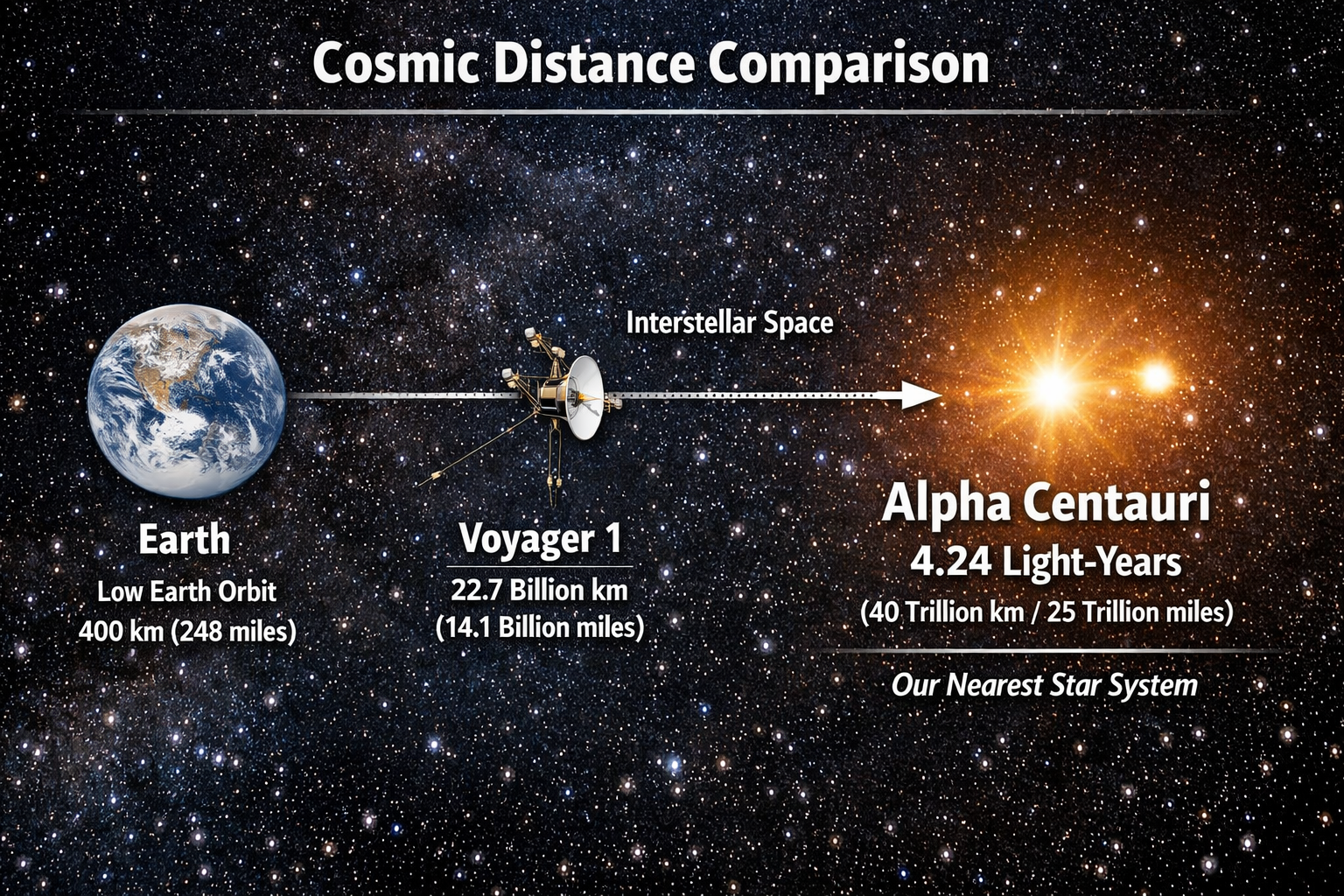
4.3 light-years away
Comparison with Our Solar System
| Star | Type | Relative Mass | Key Feature |
|---|---|---|---|
| Alpha Centauri A | G2V | 1.1× Sun | Closest solar twin |
| Alpha Centauri B | K1V | 0.9× Sun | Stable orange dwarf |
| Proxima Centauri | M5.5V | 0.12× Sun | Hosts multiple exoplanets |
| Sun | G2V | 1.0 | Supports life on Earth |
This comparison highlights why Alpha Centauri is scientifically valuable: it contains stars similar to the Sun while also hosting planets around a red dwarf.
Future Interstellar Missions

Humanity has never traveled beyond the Solar System, but Alpha Centauri may become the first destination.
Breakthrough Starshot
One of the most ambitious concepts is Breakthrough Starshot, a project proposing tiny laser-powered spacecraft accelerated to a significant fraction of light speed.
If successful:
Travel time could be reduced to 20–30 years
Probes could photograph Proxima b directly
Scientists could analyze atmospheres for biosignatures
Although still experimental, such technology could revolutionize space exploration forever.
Why Alpha Centauri Matters to Humanity
Alpha Centauri represents far more than a nearby star system.
It symbolizes:
The possibility of discovering alien life
Humanity’s future beyond the Solar System
The beginning of interstellar exploration
For the first time in history, we know that planets exist around the stars nearest to us. What once belonged only to science fiction is now part of real scientific investigation.
Conclusion
Alpha Centauri is humanity’s nearest cosmic neighbor and one of the most fascinating regions in the galaxy. From the Sun-like stars Alpha Centauri A and B to the planet-hosting red dwarf Proxima Centauri, the system offers an extraordinary opportunity to study worlds beyond our Solar System.
The discovery of Proxima b and other nearby exoplanets has transformed Alpha Centauri into a beacon of scientific hope. Though enormous distances still separate us from the stars, future technologies may one day allow humanity to explore this neighboring system directly.
In many ways, Alpha Centauri is not just another star system — it is the first stepping stone on humanity’s journey into the wider universe.