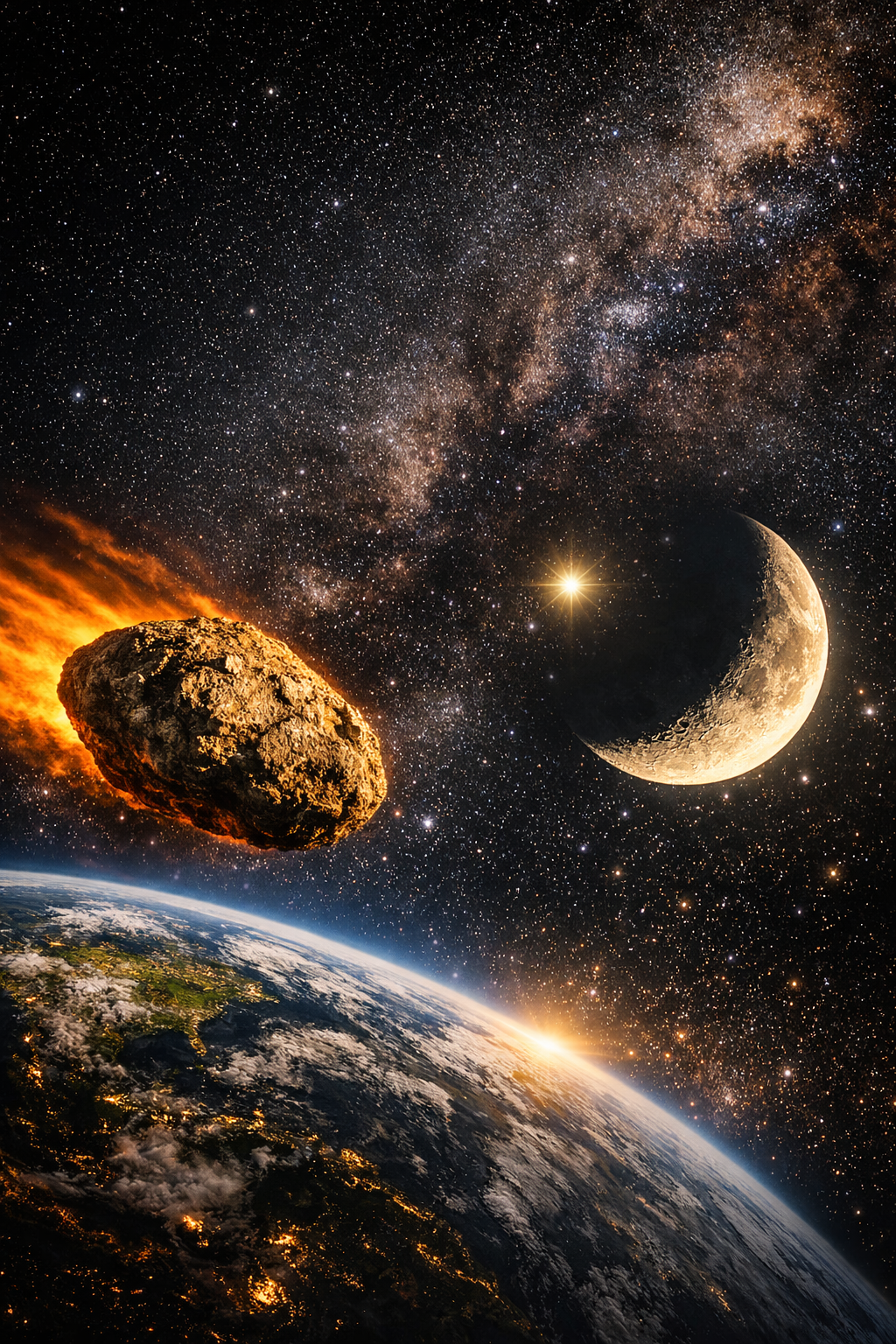
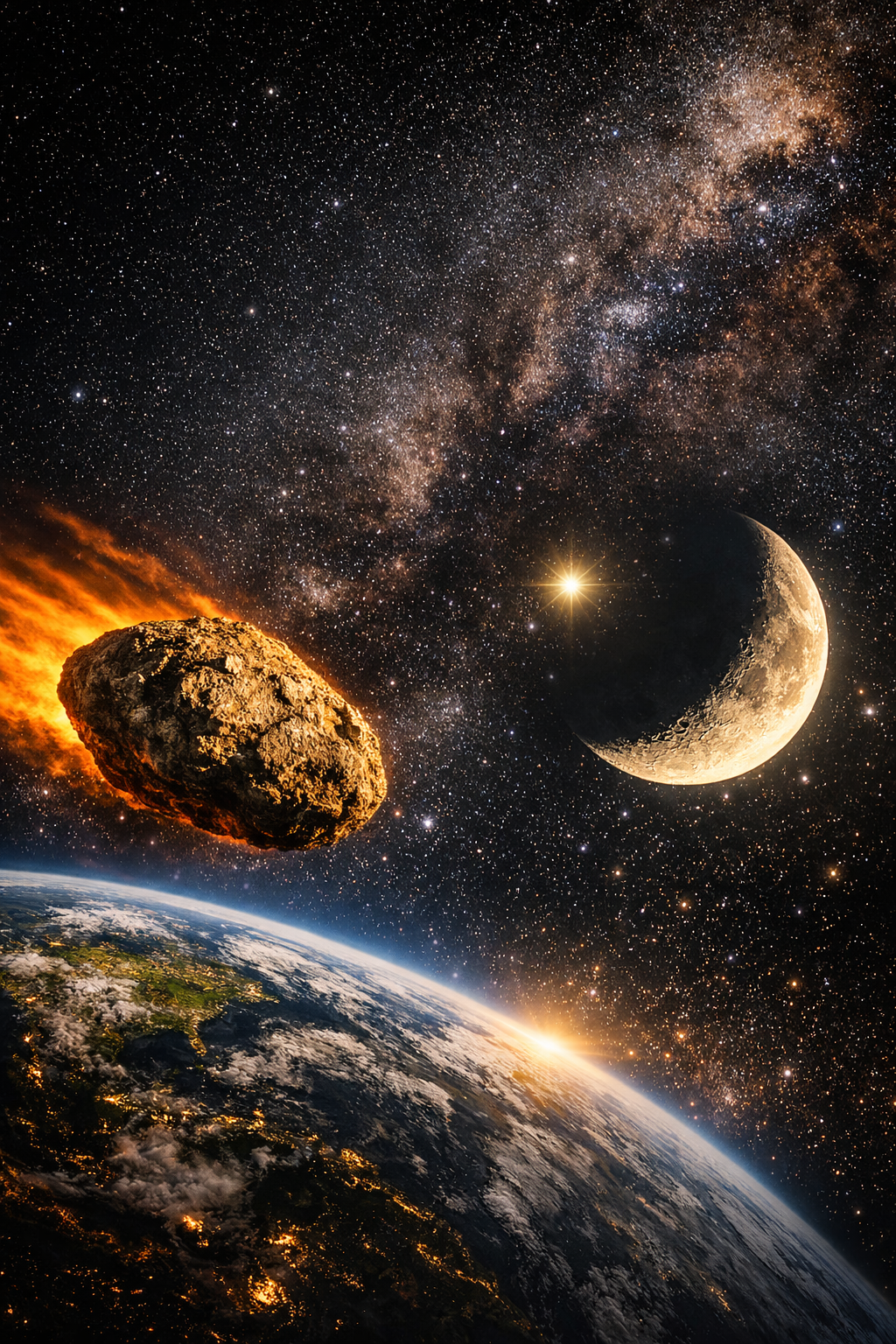
🌌 A Rare Cosmic Double Event — May 18, 2026
On the evening of May 18, 2026, skywatchers around the world were treated to an extraordinary celestial pairing: a brilliant Venus–Moon conjunction glowing in the western sky while, unseen to the naked eye, a near-Earth asteroid raced past our planet at a distance closer than many artificial satellites.
The event combined two very different faces of astronomy. One inspired wonder and beauty — a shining crescent Moon beside dazzling Venus. The other reminded humanity that Earth exists within an active and constantly changing cosmic environment filled with fast-moving asteroids and hidden celestial hazards.
Together, these events transformed an ordinary night into a remarkable cosmic showcase — one blending beauty, science, and planetary awareness.
🌙 Venus and the Crescent Moon Illuminate the Evening Sky
Shortly after sunset, observers noticed a razor-thin crescent Moon hanging low in the western sky beside Venus, the brightest planet visible from Earth. The conjunction occurred as the Moon passed less than 3 degrees north of Venus within the constellation Taurus.
To the naked eye, the pair appeared breathtakingly close. Venus shone intensely at magnitude –4, while the crescent Moon glowed at approximately magnitude –10. Though the Moon is vastly larger and reflects far more sunlight overall, Venus often appears sharper and more brilliant because its light is concentrated into a tiny point rather than spread across a wide surface.
This creates a fascinating optical illusion in human vision. Our eyes interpret concentrated brightness differently from diffuse brightness, making Venus seem almost jewel-like beside the Moon’s softer glow. It is a perfect example of how astronomy often reveals the difference between perception and physical reality.
For many viewers, the conjunction resembled a natural work of cosmic art. Photographers captured stunning images of the pair above city skylines, deserts, mountains, and oceans. Amateur astronomers using binoculars and telescopes were even able to observe Venus displaying its partial phase — similar to a miniature Moon — caused by its position relative to Earth and the Sun.
The conjunction reached peak visibility around 21:50 EDT (01:50 UTC on May 19), though excellent viewing conditions continued for roughly two and a half hours after sunset across much of the world.
✨ Why Venus Appears So Bright
Venus is often called the “Evening Star” or “Morning Star,” though it is actually a planet. Its incredible brightness comes from two major factors:
-
Highly Reflective Clouds
Venus is covered by thick clouds composed mainly of sulfuric acid droplets. These clouds reflect around 70% of incoming sunlight, making Venus the most reflective major planet in the Solar System. -
Relative Proximity to Earth
Venus orbits closer to Earth than most planets, allowing it to appear exceptionally luminous in our sky.
Because of these characteristics, Venus can sometimes cast faint shadows under dark skies and is occasionally visible even during daylight hours.
The Moon, meanwhile, was only a thin crescent during the conjunction. Most of its surface remained dark except for faint “Earthshine,” a phenomenon caused by sunlight reflecting from Earth onto the Moon’s night side. This subtle glow has fascinated astronomers and poets for centuries.
🚀 Asteroid 2026 JH2 Makes a Close Approach
While millions admired the conjunction, astronomers were carefully tracking another major event unfolding in near-Earth space.
Asteroid 2026 JH2, discovered only days earlier by the Mount Lemmon Survey in Arizona, passed Earth at an astonishingly close distance of approximately 91,135 kilometers (56,628 miles). That is roughly one-quarter of the average Earth–Moon distance and closer than the orbits of some satellites.
Scientists estimate the asteroid measured between 15 and 35 meters wide — roughly the size of a small building. Though far too small to threaten global civilization, an object of this size could still produce significant regional damage if it entered Earth’s atmosphere over a populated area.
Fortunately, astronomers confirmed that 2026 JH2 posed absolutely no collision risk.
The asteroid belongs to the Apollo class of Near-Earth Objects (NEOs), a group of asteroids whose orbits cross Earth’s path around the Sun. Apollo asteroids are among the most closely monitored celestial bodies because of their potential to make near approaches to our planet.
🛰️ Planetary Defense in Action
Events like the flyby of 2026 JH2 are critically important for planetary defense efforts.
Organizations such as NASA’s Planetary Defense Coordination Office and international observatories continuously scan the skies for undiscovered objects that could threaten Earth in the future. Every close flyby provides valuable opportunities to test tracking systems, improve orbital calculations, and refine emergency response strategies.
Modern asteroid detection networks use powerful telescopes, automated imaging systems, and advanced computer algorithms capable of identifying faint moving objects against dense star fields. Once discovered, astronomers rapidly calculate an asteroid’s orbit to determine whether any impact risk exists.
In the case of 2026 JH2, follow-up observations quickly confirmed a safe trajectory. Still, the event highlighted an important reality: many small asteroids are discovered only days or weeks before close approaches because they are extremely difficult to detect.
This ongoing challenge drives global investment in next-generation survey systems designed to find hazardous objects earlier and more efficiently.
🌍 Earth’s Dynamic Cosmic Neighborhood
Asteroid flybys are far more common than many people realize. Small near-Earth asteroids pass between Earth and the Moon several times each year, though most go unnoticed by the public.
Earth travels through a crowded cosmic environment shaped by billions of years of Solar System evolution. Countless rocky fragments remain from the formation of planets over 4.5 billion years ago. These remnants continue orbiting the Sun, occasionally crossing paths with Earth.
Most burn harmlessly in the atmosphere as meteors. Larger objects are rarer, but history shows they can have enormous consequences. The extinction of the dinosaurs 66 million years ago was caused by a massive asteroid impact, reminding scientists why planetary defense remains essential.
Unlike ancient civilizations, however, humanity now possesses the scientific knowledge and technology needed to detect, track, and potentially deflect dangerous asteroids in the future.
🌠 Humanity’s Ancient Connection to the Sky
Long before modern astronomy, celestial events like Venus–Moon conjunctions inspired myths, calendars, navigation systems, and religious traditions across civilizations worldwide.
Ancient Mesopotamians associated Venus with divine power and fertility. The Maya tracked Venus with extraordinary precision, incorporating its movements into ceremonial calendars. In many cultures, conjunctions involving the Moon and bright planets were interpreted as omens or messages from the heavens.
Today, science has replaced superstition with understanding — yet the emotional power of the night sky remains unchanged.
Whether viewed through advanced telescopes or with the naked eye, celestial events continue to connect humanity to something larger than itself.
📝 Conclusion
The cosmic events of May 18, 2026, revealed two sides of modern astronomy at once: wonder and vigilance.
The graceful conjunction of Venus and the crescent Moon reminded people across the globe of the beauty visible in the night sky, while the close flyby of asteroid 2026 JH2 demonstrated the importance of scientific monitoring and planetary defense.
Together, they served as a powerful reminder that Earth is not isolated, but part of a vast and active cosmic system filled with motion, danger, beauty, and discovery.
Every conjunction, meteor, and asteroid flyby deepens humanity’s understanding of the universe — and our place within it.