
Halley’s Comet Returns Through Fire: The Eta Aquarids Meteor Shower 2026
---
🌌 Introduction
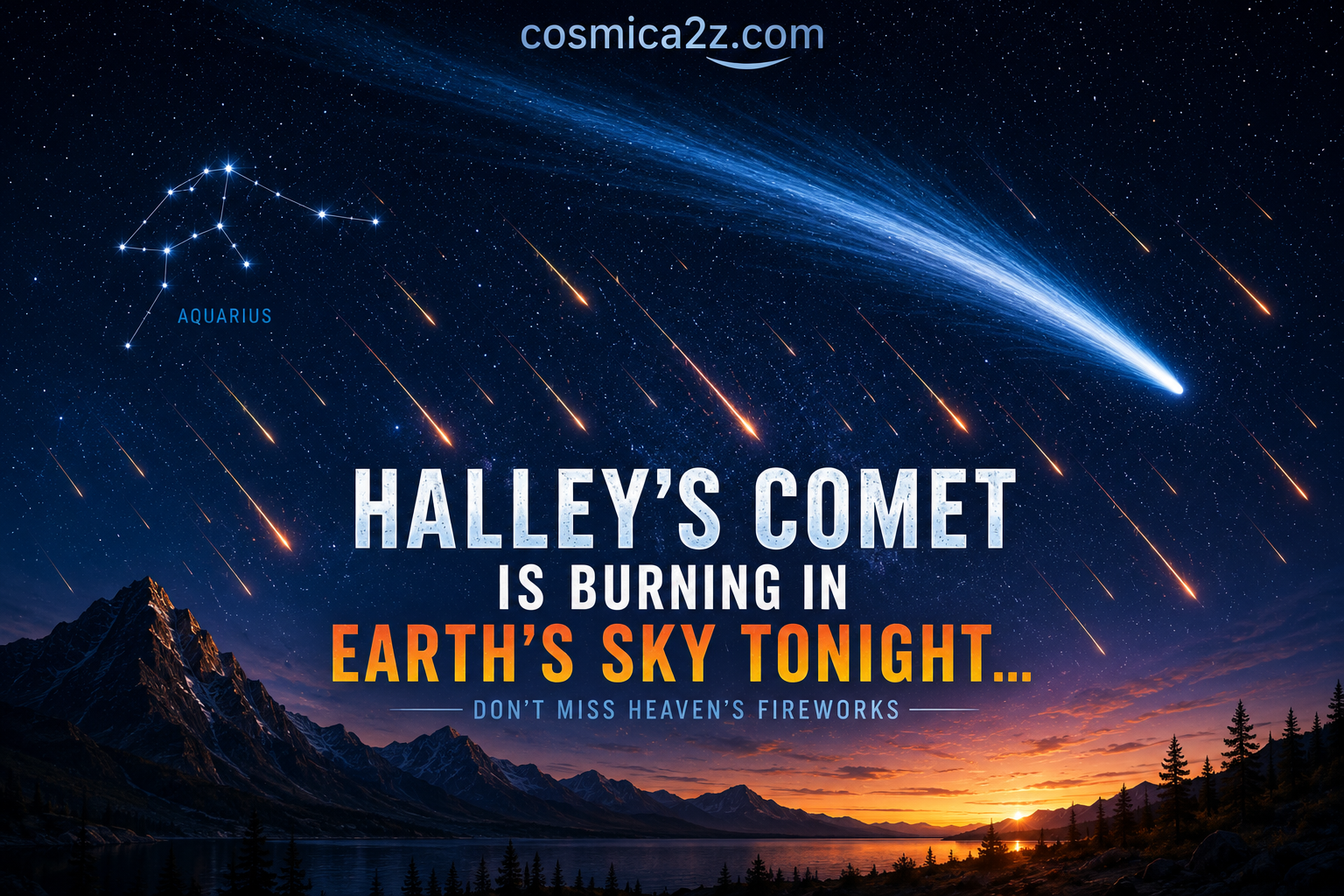
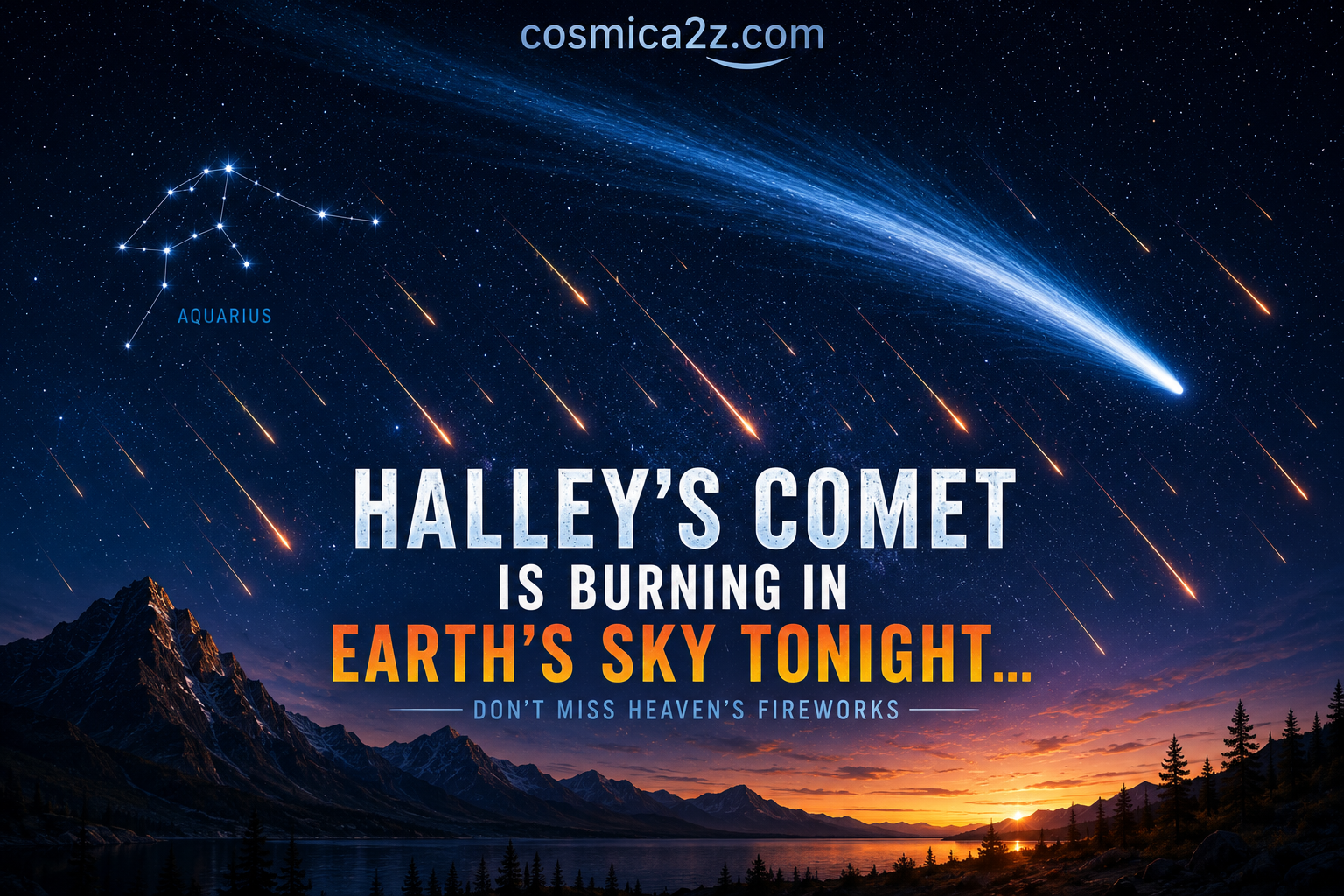
Cosmic Update – May 6, 2026: The sky is alive with fragments of Halley’s Comet as Earth passes through its ancient debris trail. The Eta Aquarids meteor shower is now peaking, producing fast and brilliant streaks of light across the pre-dawn darkness. These meteors are not random — they are cosmic remnants of one of the most famous comets in human history, racing into our atmosphere at nearly 66 km/s.
This celestial event transforms the night sky into a moving historical archive. Every streak of light is a particle released from Halley’s Comet centuries ago, now burning away in Earth’s upper atmosphere. It is a reminder that the Solar System is not static — it is a constantly evolving system of motion, dust, and energy.
---
🔭 The Science Behind the Eta Aquarids
Halley’s Comet (1P/Halley) completes an orbit around the Sun roughly every 76 years. Each time it approaches the inner Solar System, solar radiation causes its icy surface to sublimate, releasing dust, ice, and gas into space. Over time, this material spreads along the comet’s orbital path, forming a meteoroid stream.
Earth intersects this stream twice annually, producing two major meteor showers: the Eta Aquarids in May and the Orionids in October.
Key scientific features include:
- Velocity: ~66 km/s, among the fastest meteor showers known.
- Radiant Point: Near Eta Aquarii in the constellation Aquarius.
- Burning Altitude: 80–100 km above Earth’s surface.
- Composition: Silicates, carbon compounds, sodium, and magnesium.
The extreme speed of these particles creates long-lasting luminous trails known as persistent trains, which can remain visible for several seconds after the meteor itself disappears.
---
🌍 Where and When to Watch
The Eta Aquarids are a global event, but viewing conditions vary depending on location. The Southern Hemisphere experiences the strongest display due to the higher elevation of Aquarius in the sky.
| Region | Best Time | Meteors/Hour | Direction |
|---|---|---|---|
| India | 2 AM – 5 AM IST | 20–40 | East before sunrise |
| Europe | 2 AM – 5 AM local | 10–30 | Eastern horizon |
| USA | 2 AM – 5 AM local | 10–30 | East-southeast |
| Southern Hemisphere | 1 AM – 4 AM local | 40–60 | High in Aquarius |
For the best experience, move away from artificial lights, allow your eyes to adapt for at least 20–30 minutes, and avoid looking directly at bright screens before observation.
---
🌠 A Legacy That Never Fades
Halley’s Comet last reached perihelion in 1986 and will return again in 2061, yet its influence remains constant through meteor showers like the Eta Aquarids. These events demonstrate how cometary debris continues to interact with Earth long after the comet itself has moved away.
Each meteor represents a fragment that may have been released hundreds or even thousands of years ago. As these particles drift through space, they slowly evolve under gravitational influences from planets such as Jupiter and Saturn, shaping the intensity of the meteor shower we observe today.
---
🧭 Scientific Importance
The Eta Aquarids are not only visually stunning but also scientifically valuable. When meteoroids burn in Earth’s atmosphere, they produce spectral emissions that allow scientists to analyze their composition remotely.
Researchers use radar and optical systems to track meteor activity, helping to map the density and structure of Halley’s debris stream. These observations contribute to our understanding of comet evolution, orbital mechanics, and interplanetary dust dynamics.
---
📸 Capturing the Meteor Shower
Astrophotographers consider the Eta Aquarids one of the most rewarding meteor showers due to their speed and brightness. To capture them effectively:
- Use a wide-angle lens (14–24mm recommended).
- Set exposure between 10–20 seconds.
- Use ISO 800–1600 depending on sky brightness.
- Frame the eastern sky with a natural foreground.
- Take continuous exposures to increase chances of capture.
Even smartphones in night mode can capture faint meteor streaks when stabilized properly on a tripod.
---
🎬 Watch Cosmic Update
---
🌌 The Human Connection
Halley’s Comet has been recorded in human history for over two millennia. Ancient civilizations documented its appearance, and modern science continues to study its remnants. The Eta Aquarids serve as a recurring reminder that humanity exists within a dynamic and interconnected cosmic environment.
Every observer looking at the same sky participates in a shared global experience — a moment where science, history, and wonder intersect.
---
🪐 Future of Halley’s Comet
When Halley returns in 2061, it will once again become one of the most observed celestial objects in the night sky. Until then, its presence continues through meteor showers, ensuring that its legacy remains active in Earth’s sky every year.
---
🌠 Final Reflection
Each Eta Aquarid meteor is a message from deep time — a fragment of ancient cosmic material briefly illuminating our world before vanishing. These fleeting streaks remind us that the universe is constantly in motion, shaped by cycles of creation and destruction.
Looking at the meteor shower is not just an act of observation, but participation in a story that spans centuries of cosmic evolution.
---
📌 SEO Highlights
Keywords: Eta Aquarids 2026, Halley’s Comet meteor shower, meteor shower May 2026, Aquarius constellation meteors, shooting stars 2026, cosmic update, best time meteor shower 2026.
---
🔗 Sources
NASA Solar System Exploration, Space.com, Time and Date, Sky & Telescope, EarthSky, Star Walk Space App, Zee News, AOL Science Desk.
---
# Hashtags
#EtaAquarids #HalleyComet #MeteorShower2026 #Astronomy #SpaceNews #ShootingStars #CosmicUpdate #NightSky #NASA #Universe