

Introduction
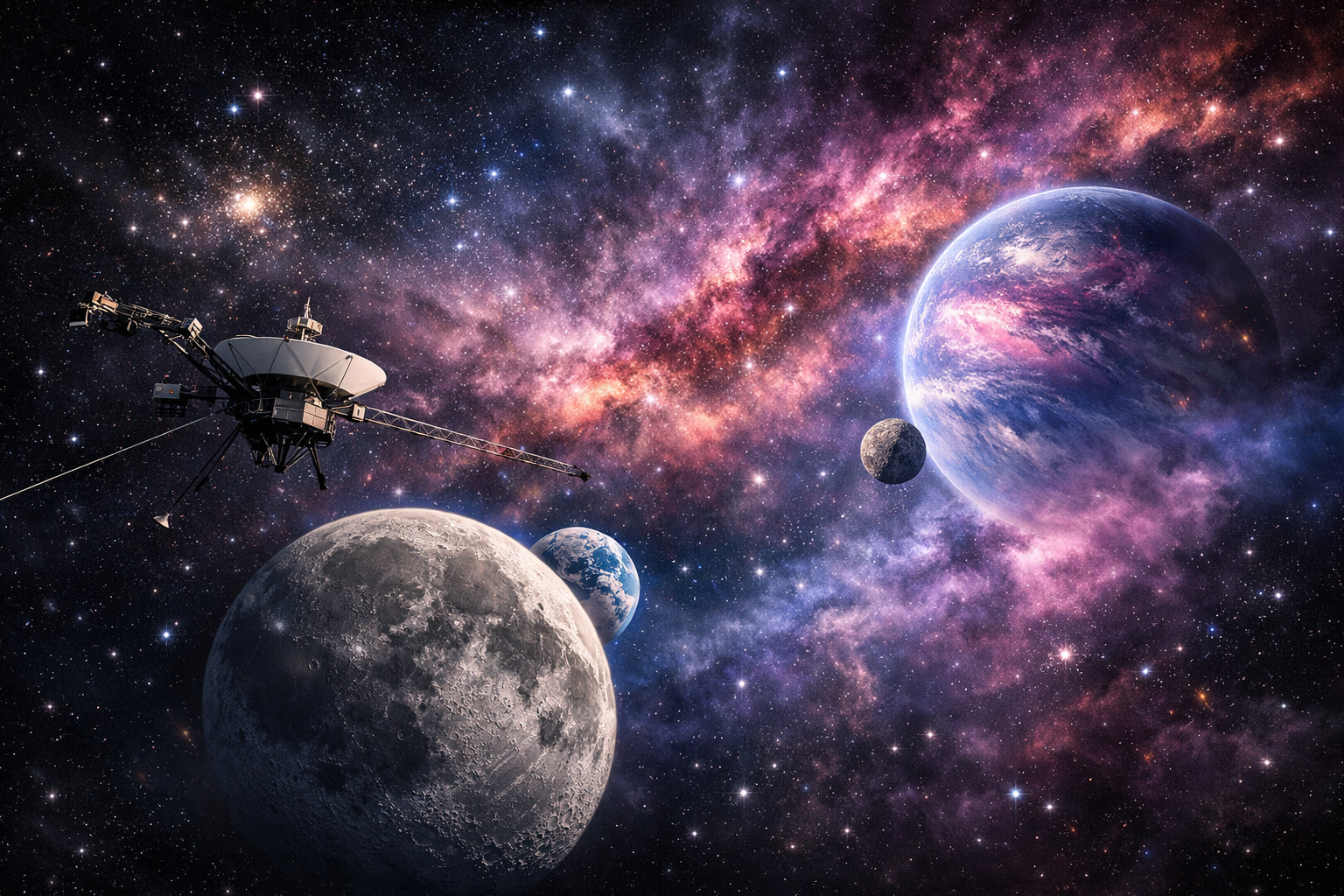
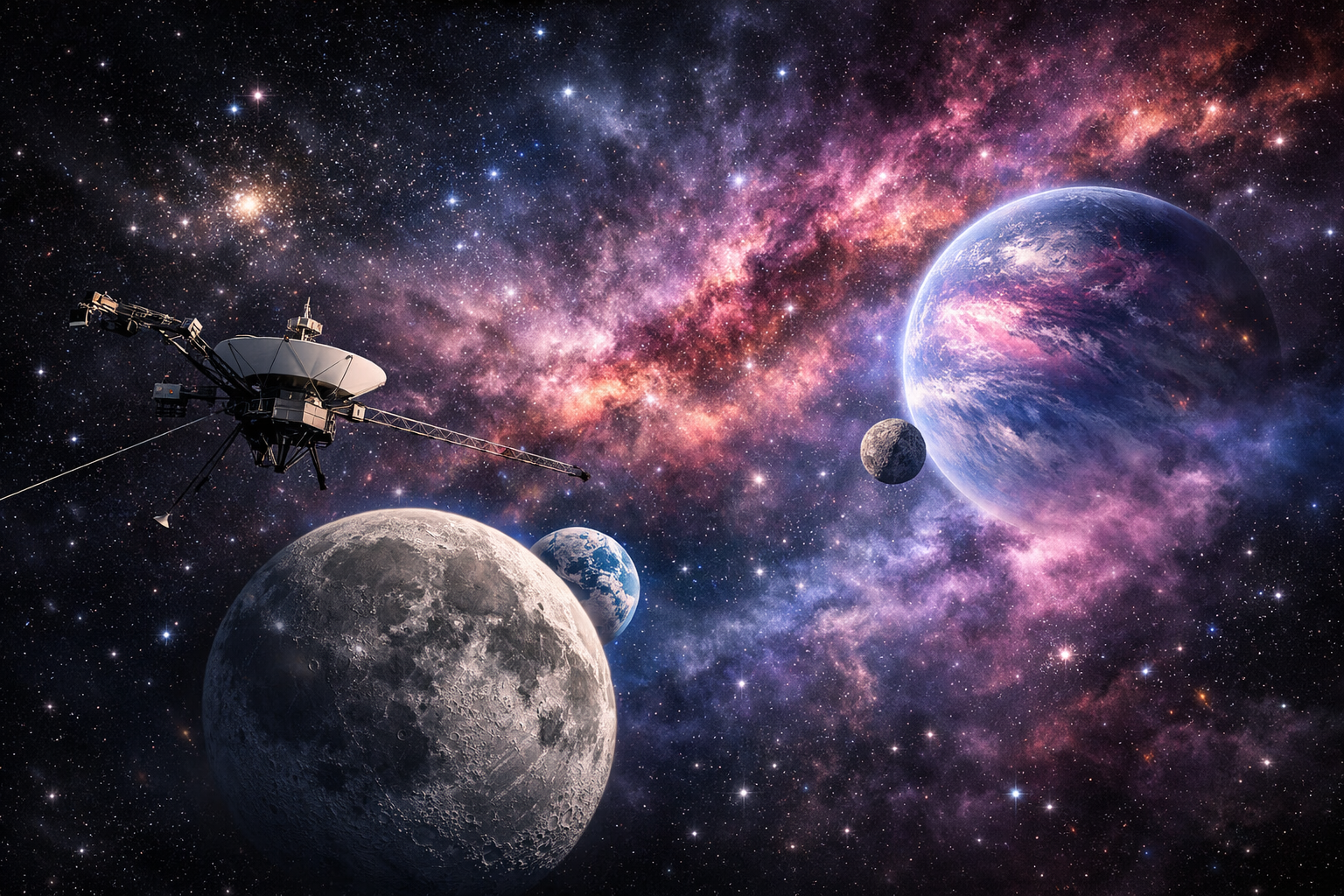
On May 4, 2026, three extraordinary cosmic events unfolded that together reshape how we see humanity’s role in the universe. From the lonely endurance of Voyager 1 at the edge of interstellar space, to the renewed promise of Artemis II preparing for lunar return, to the awakening of a new telescope in Chile searching for Earth-like worlds — these milestones form a narrative of persistence, renewal, and vision.
These events are not isolated achievements. They represent different phases of the same human journey: remembering where we came from, strengthening our present capabilities, and expanding toward unknown futures. Each mission reflects a different layer of curiosity — survival of technology, return of human presence beyond Earth, and search for life beyond our solar system.
Together, they show that space exploration is no longer just about reaching new distances. It is about understanding our identity in a vast universe that is constantly expanding, challenging, and inspiring us.
---
Voyager 1: Humanity’s Most Distant Messenger
Launched in 1977, Voyager 1 is now more than 25 billion kilometers from Earth, making it the farthest human-made object in existence. In May 2026, NASA engineers shut down one of its instruments — not due to failure, but to conserve dwindling power and extend the spacecraft’s life.
Voyager’s journey is almost mythical. For nearly five decades, it has traveled beyond the planets, past the heliopause, into the interstellar medium. Each subsystem shutdown is bittersweet: a reminder that the spacecraft is aging, yet still whispering data from the edge of the Sun’s influence.
Even as its systems slowly power down, Voyager continues to inspire engineers and scientists. It proves that human ingenuity can survive far beyond its expected limits. Its signals, faint but persistent, still cross billions of kilometers to reach Earth, reminding us that exploration can outlive generations.
- Scientific impact: Even with fewer instruments, Voyager continues to measure cosmic rays and magnetic fields, offering rare insights into the boundary between our Solar System and interstellar space.
- Emotional resonance: Voyager carries the Golden Record — greetings, music, and sounds of Earth — a symbolic love letter to the cosmos. Its endurance reminds us that exploration is not just about data, but about leaving a trace of humanity among the stars.
- Disclaimer: Voyager’s exact operational timeline is uncertain; power management decisions are ongoing.
Source: NASA Voyager mission status reports, April–May 2026
---
Artemis II: Preparing for Humanity’s Return to the Moon
On April 1, 2026, Artemis II launched from Kennedy Space Center, marking the first crewed lunar mission since Apollo 17 in 1972. By early May, Orion’s fiery re-entry test was completed successfully, proving its heat shield and life-support systems are ready for astronauts.
Artemis is more than a mission; it is a statement of intent. Unlike Apollo, which was a race, Artemis is designed for sustainability. The program envisions a future where humans not only visit the Moon but build a lasting presence there.
The mission also represents a technological shift in space travel. Advanced navigation systems, deep-space communication networks, and improved life-support technologies make Artemis a stepping stone toward Mars missions. It is not just about returning to the Moon — it is about staying there safely and building infrastructure for future generations.
- Technical achievement: Orion endured re-entry speeds of over 25,000 km/h, validating safety for future lunar landings.
- Cultural impact: Artemis is not a one-time mission. It is designed to establish sustainable lunar exploration, laying the foundation for Mars and beyond.
- Symbolism: Artemis II bridges Apollo’s legacy with a new era. Humanity is preparing to walk on the Moon again — this time to stay.
- Disclaimer: Timelines for lunar landings depend on funding, technical readiness, and safety reviews.
Source: NASA Artemis mission tracker, April–May 2026
---
PoET Telescope: Opening Eyes to Distant Worlds
In Chile’s Atacama Desert, the Paranal Observatory Exoplanet Telescope (PoET) achieved first light in May 2026. This instrument is designed to detect Earth-like planets orbiting nearby stars.
PoET represents humanity’s vision turned outward. While Voyager looks back at Earth from interstellar space and Artemis prepares us to return to the Moon, PoET gazes forward into the galaxy, searching for worlds that might resemble our own.
This telescope is part of a new generation of observational tools capable of analyzing atmospheres of distant planets. By detecting chemical signatures such as oxygen, methane, and water vapor, it brings us closer to answering one of humanity’s most profound questions: are we alone in the universe?
- Scientific potential: PoET uses ultra-precise spectrographs to measure tiny wobbles in starlight, revealing planets as small as Earth.
- Why it matters: Exoplanet research is the frontier of cosmic discovery. Finding habitable worlds could answer humanity’s oldest question: Are we alone?
- Emotional resonance: Every telescope is another eye opened to the universe. PoET symbolizes humanity’s collective vision, searching for new homes among the stars.
- Disclaimer: Early results are preliminary; exoplanet discoveries require peer-reviewed confirmation.
Source: European Southern Observatory press release, May 2026
---
Analysis: Humanity’s Expanding Reach
Taken together, these three events form a narrative arc:
- Voyager 1 represents endurance — a messenger still alive after nearly 50 years.
- Artemis II represents renewal — humanity preparing to return to the Moon.
- PoET represents vision — the search for new worlds beyond our Solar System.
This cosmic arc shows that exploration is not linear. It is a tapestry of past missions still alive, present missions proving readiness, and future instruments opening possibilities. Voyager reminds us of persistence, Artemis of renewal, and PoET of vision. Together, they illustrate humanity’s quiet but steady expansion into the cosmos.
These missions also highlight a deeper philosophical truth: exploration is a mirror of humanity itself. As we push outward into space, we also push inward into understanding who we are, what we value, and what we hope to become.
---
Conclusion
From the edge of our Solar System… to the Moon… to distant worlds — humanity is quietly expanding its reach into the universe. These events remind us that cosmic exploration is not only about science; it is about inspiring love, unity, and resilience.
Voyager whispers from interstellar space. Artemis prepares us to walk on the Moon again. PoET opens its eyes to distant worlds. Together, they redefine humanity’s place in the cosmos.