

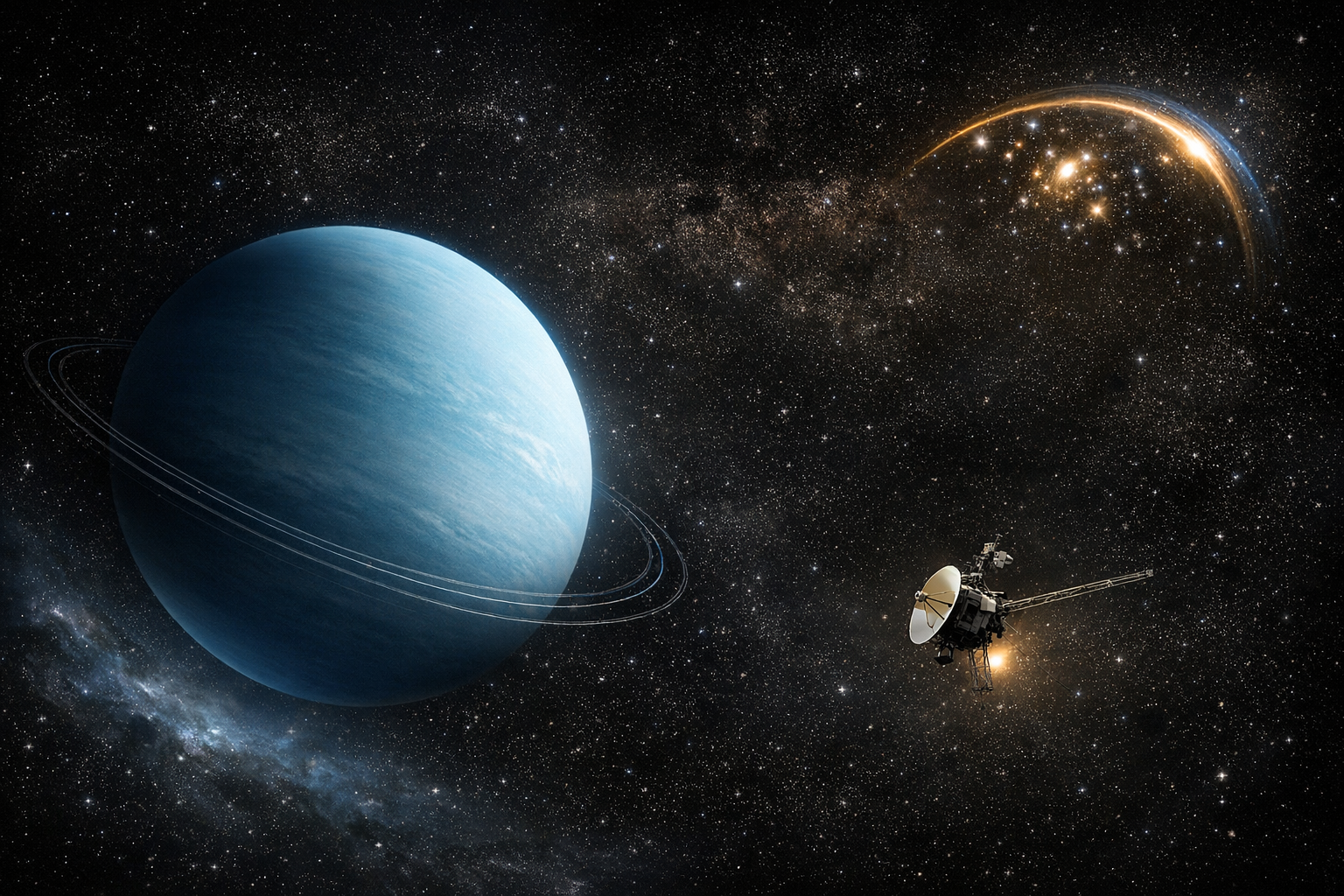
From the shifting dust rings of Uranus to the fragile endurance of Voyager 1 and a global effort led by the Euclid space telescope, this cosmic snapshot connects quiet mysteries with the largest structures in the universe.
1. Uranus’s Faint Rings Are Shifting — And No One Knows Why
Uranus has always been a quiet outlier among the giant planets. No towering storms like Jupiter, no brilliant rings like Saturn—just a pale blue world hiding its complexity.
Now, its faintest rings—Mu and Nu—are drawing attention for unexpected behavior.
What Makes These Rings Different?
Unlike the dense, icy rings of Saturn, Uranus’s outer rings are:
- Composed of microscopic dust particles
- Spread across wide, diffuse regions
- Extremely faint and difficult to observe
And yet, they are not static.
What Are Scientists Seeing?
Recent observations reveal:
- Subtle ripples and distortions
- Brightness patterns that shift off-center
- Asymmetries that evolve over time
These changes suggest the rings are being actively shaped.
What Could Be Causing This?
- Hidden moonlets acting as gravitational sculptors
- Magnetic interactions, as Uranus’s tilted magnetic field influences charged dust
- Ancient collision debris still dispersing
- Or unknown physical processes not yet modeled
Other planets provide clearer explanations:
- Saturn’s E-ring is fed by Enceladus
- Jupiter’s faint rings originate from its inner moons
But Uranus’s Mu and Nu rings appear to operate without an obvious source.
We’ve only visited Uranus once—during Voyager 2’s flyby in 1986.
These new clues hint at deeper physics still hidden in the system, strengthening the case for a future Uranus orbiter mission.
2. Voyager 1 Is Fading — But Refuses to Go Silent
Far beyond the planets, beyond the heliosphere, Voyager 1 continues its journey through interstellar space.
More than 24 billion kilometers from Earth, it is now operating on carefully rationed power.
To extend its life, NASA is making difficult decisions:
- Powering down non-essential instruments
- Preserving communication systems
- Maintaining only the most critical scientific measurements
A Mission Running on Time
Voyager 1’s power source—a radioisotope generator—loses energy each year.
Every instrument shutdown buys time, but reduces capability.
Why It Still Matters
Even in its reduced state, Voyager 1 continues to measure:
- Cosmic rays
- Interstellar plasma
- Magnetic fields beyond the Sun’s influence
No other spacecraft has reached this environment.
A Quiet, Human Story
Voyager 1 is:
- The farthest human-made object
- A carrier of Earth’s Golden Record
- A functioning relic of 1970s engineering
Each powered-down instrument is a compromise between science and survival.
It no longer speaks loudly.
But it still speaks.
3. A Telescope That Turns the Universe Into a Shared Discovery
While Voyager drifts outward, Euclid is mapping the deep structure of the universe.
Its goal is ambitious: to understand how dark matter and dark energy shape cosmic evolution.
Now, it’s inviting the world to participate.
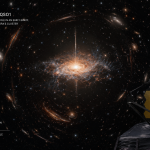
What Are Gravitational Lensing Arcs?
- Distorted, stretched images of distant galaxies
- Caused by massive objects bending spacetime
- Visible evidence of unseen mass
This phenomenon allows scientists to detect dark matter indirectly.
Why Human Eyes Matter
Euclid is collecting vast amounts of data:
- Billions of galaxies
- Large regions of the sky
- Subtle and complex distortions
Automated systems help—but they often miss faint, irregular arcs.
Human perception remains surprisingly powerful.
A Global Effort
- Anyone can examine real telescope images
- Volunteers help identify lensing arcs
- Each contribution feeds directly into research
Why It Matters
- Map the distribution of dark matter
- Test theories of gravity
- Understand galaxy formation
- Refine models of cosmic expansion
A Universe Still Unfolding
These stories span extremes:
- Dust grains circling a distant ice giant
- A spacecraft fading but still transmitting
- A telescope mapping billions of galaxies
Different scales.
Different mysteries.
Yet all connected by a single force: curiosity.
Uranus challenges what we think we understand about planetary systems.
Voyager 1 reminds us how far exploration can reach—and how long it can endure.
Euclid transforms the study of the universe into something shared.
The cosmos is not just something we observe.
It is something we are still learning how to read.
And with every new signal, distortion, and discovery—
it becomes a little less silent.