

Introduction
Black holes are among the most mysterious objects in the universe. They trap everything that crosses their event horizon, including light, making them invisible except through their gravitational effects. But what if the universe had an opposite — a region of spacetime that violently expels matter and light instead of swallowing it? This is the idea of a white hole, a purely theoretical construct in Einstein’s general relativity.
Although no white holes have ever been observed, they remain a fascinating concept in cosmology. They challenge our understanding of time, space, and the origin of the universe. Some physicists even speculate that the Big Bang itself could be interpreted as a one-time white hole eruption. In this article, we’ll explore the theory, the mathematics, the challenges, and the cosmic wonder behind white holes.
🔭 What Is a White Hole?
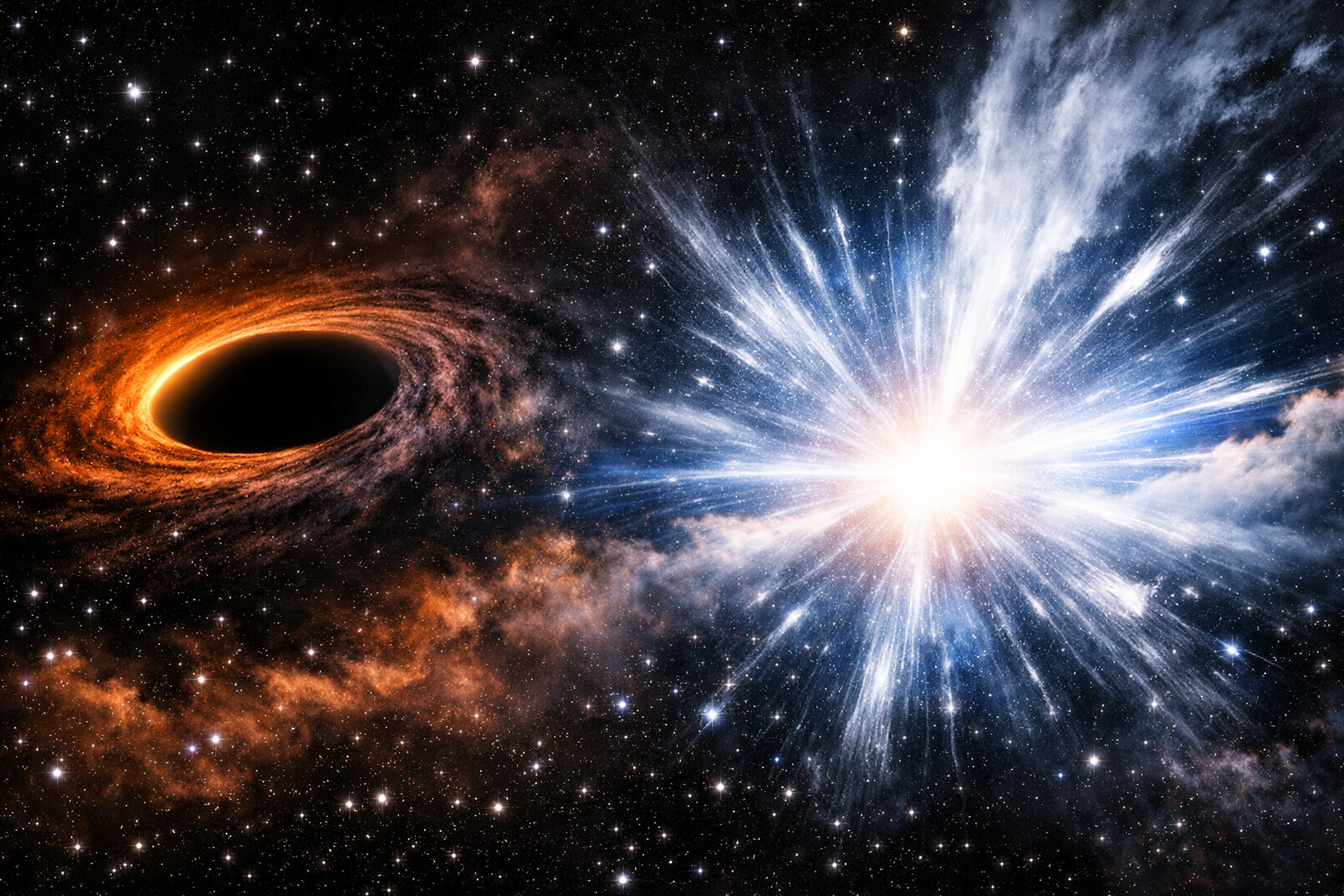
A white hole is a hypothetical region of spacetime where matter and energy can escape, but nothing can enter. In simple terms, it is the time-reversed solution of a black hole.
- Black hole: A gravitational trap where nothing escapes.
- White hole: A cosmic fountain where nothing enters.
The concept arises from the Schwarzschild solution to Einstein’s equations of general relativity. When physicists extend the equations backward in time, they find that a mirror image of a black hole is mathematically possible. This mirror image is the white hole.
⚖️ White Holes vs. Black Holes
| Feature | Black Hole | White Hole |
|---|---|---|
| Matter flow | Matter falls in, never escapes | Matter bursts out, nothing enters |
| Event horizon | Boundary of no return | Boundary of no entry |
| Observational evidence | Strong (X-ray emissions, gravitational waves, star motion) | None |
| Stability | Long-lived, formed from collapsing stars | Theoretically unstable, short-lived |
| Role in cosmology | Proven astrophysical objects | Purely mathematical constructs |
🌌 Theoretical Foundations
Einstein–Rosen Bridges
White holes often appear in wormhole models. In theory, a wormhole could connect a black hole (entry point) with a white hole (exit point). This is sometimes called an Einstein–Rosen bridge. However, such wormholes are unstable and would collapse too quickly for travel.
Quantum Gravity
In quantum gravity research, white holes are sometimes discussed as possible outcomes of black hole evaporation. Some models suggest that when a black hole evaporates via Hawking radiation, it could leave behind a white hole remnant. This remains highly speculative.
Big Bang Connection
One of the most intriguing ideas is that the Big Bang itself could be interpreted as a white hole. In this view, the universe erupted from a singularity, expelling matter and energy outward in all directions. While this analogy is poetic, most cosmologists caution that the Big Bang is better explained by inflationary models rather than a white hole.
🚫 Why Haven’t We Found One?
- No observational evidence: Unlike black holes, which are detected through gravitational effects on nearby stars and gas, white holes have never been observed.
- Formation problem: There is no known astrophysical process that naturally creates a white hole. Black holes form from collapsing stars, but white holes lack a similar mechanism.
- Instability: Theoretical models suggest that if a white hole existed, it would collapse quickly, making it unlikely to persist long enough to be detected.
📚 Scientific Sources and Analysis
- General relativity: The Schwarzschild solution mathematically allows white holes, but only as time-reversed black holes.
- Carlo Rovelli (2014): Proposed that quantum gravity could stabilize white holes as remnants of evaporated black holes.
- Stephen Hawking: His work on black hole evaporation indirectly inspired speculation about white hole remnants.
- Cosmology debates: Some fringe theories link white holes to cyclic universe models, but mainstream cosmology favors inflationary theory.
🌠 White Holes in Popular Culture
White holes often appear in science fiction as gateways, cosmic fountains, or exotic energy sources. While fictional, these portrayals help spark public interest in real physics. For cosmic lovers, they represent the beauty of imagination meeting science.
🌌 Conclusion
White holes remain mathematical curiosities — fascinating, but unproven. They inspire cosmic wonder and challenge our understanding of time, space, and the universe’s origin. For cosmic lovers, they represent the beauty of science: ideas that may never be seen, but still expand our imagination.
The universe is full of mysteries waiting to be explored. Whether white holes exist or not, they remind us that physics is not just about equations — it’s about wonder, curiosity, and the human drive to understand the cosmos.