
Introduction
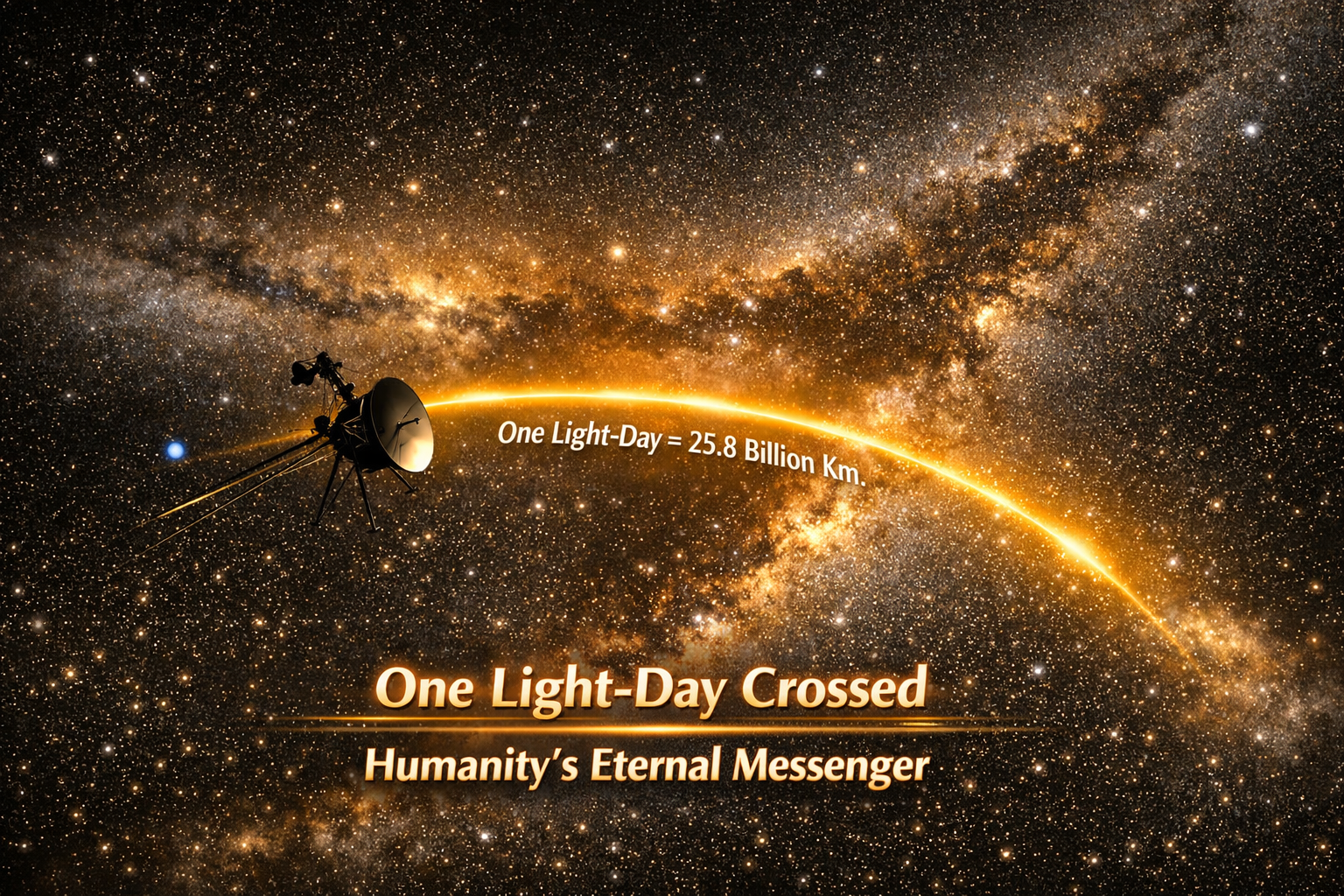
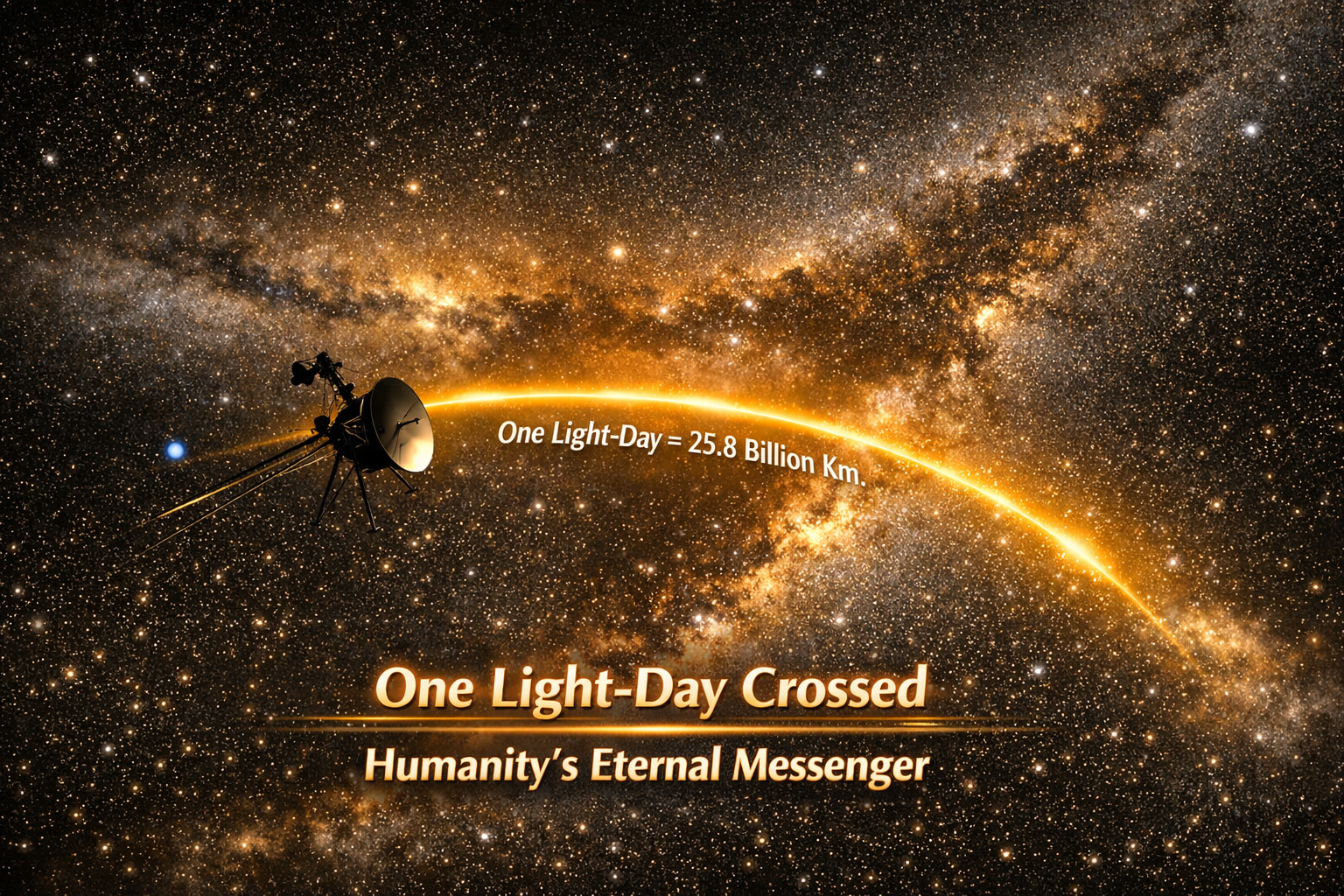
In April 2026, humanity quietly reached a milestone that will echo for centuries: Voyager 1, the farthest spacecraft ever launched, crossed the distance of one light-day — about 25.8 billion kilometers (16 billion miles) from Earth. This achievement may sound small compared to the vastness of the cosmos, but it represents a profound step in our journey beyond the Sun’s protective bubble. Voyager 1 is no longer just a spacecraft; it is a messenger carrying Earth’s voice into interstellar space, a symbol of endurance, curiosity, and the eternal reach of human imagination.
The Launch and Early Triumphs
Voyager 1 was launched on September 5, 1977, from Cape Canaveral, Florida, as part of NASA’s ambitious Voyager program. Its twin, Voyager 2, departed a few weeks earlier. The mission was designed to take advantage of a rare planetary alignment that occurs once every 176 years, allowing a spacecraft to slingshot from one giant planet to another using gravity assists.
Voyager 1’s early triumphs included:
- Jupiter flyby (1979): Captured breathtaking images of the Great Red Spot and discovered volcanic activity on Io.
- Saturn flyby (1980): Revealed intricate details of Saturn’s rings and sent back data on Titan’s thick atmosphere.
These encounters transformed planetary science, giving humanity its first close-up look at worlds that had previously been distant points of light.
Crossing the Heliopause
After completing its planetary mission, Voyager 1 continued outward. In August 2012, it crossed the heliopause — the boundary where the solar wind from our Sun meets the interstellar medium. This made Voyager 1 the first human-made object to enter interstellar space.
Scientists confirmed the crossing by detecting changes in plasma density and cosmic ray intensity. Inside the heliosphere, solar particles dominate; outside, the density of interstellar plasma is far greater. Voyager’s instruments recorded this shift, proving it had left the Sun’s realm forever.
The One Light-Day Milestone
By April 2026, Voyager 1 had traveled about 25.8 billion kilometers from Earth. This distance equals one light-day — the span light covers in 24 hours.
- Light-day distance: ~25.9 billion km.
- Voyager’s current distance: ~25.8 billion km.
- Signal delay: ~23.9 hours for radio waves to reach Earth.
This milestone is symbolic. While one light-day is tiny compared to the 4.24 light-years to Proxima Centauri, it marks the first time a human creation has reached such a scale. Voyager’s journey is now measured not in planetary flybys, but in cosmic units of light itself.
Cosmic Scale Ahead
The one light-day milestone highlights the enormity of space:
- Nearest star (Proxima Centauri): 4.24 light-years (~40 trillion km). At Voyager’s speed (~61,200 km/h), this journey would take ~70,000 years.
- Andromeda Galaxy: 2.5 million light-years away. Even at light speed, this would take millions of years; Voyager will drift for billions without ever arriving.
Voyager’s path is endless. It will never reach another star within its operational lifetime, but it will continue wandering the Milky Way long after Earth itself has changed beyond recognition.
Power and Longevity
Voyager 1 runs on radioisotope thermoelectric generators (RTGs), which convert heat from decaying plutonium into electricity. At launch, it had ~470 watts of power; today, less than 4 watts remain. NASA engineers have carefully shut down instruments to conserve energy, prioritizing those that provide the most valuable data.
By the early 2030s, Voyager may no longer send usable signals. Yet the spacecraft itself will endure, silently drifting through interstellar space for billions of years.
The Golden Record: Humanity’s Message
One of Voyager’s most iconic features is the Golden Record — a phonograph disk containing sounds, images, and greetings from Earth. Curated by Carl Sagan and his team, it includes:
- Greetings in 55 languages.
- Sounds of nature: waves, wind, birds, whales.
- Music from Bach, Beethoven, and Chuck Berry.
- Images of human life, DNA, and Earth’s landscapes.
The Golden Record is humanity’s time capsule, a message to any civilization that might encounter Voyager in the distant future.
Cultural and Scientific Legacy
Voyager 1 is more than a spacecraft; it is a cultural icon. It has inspired countless books, films, and artworks. Its journey reminds us of both our smallness and our greatness: small in the face of cosmic distances, yet great in our ability to imagine and create.
Scientists continue to analyze Voyager’s data to understand cosmic rays, plasma waves, and the structure of interstellar space. Even as its instruments fade, the knowledge it has provided will shape astrophysics for decades.
Conclusion
Voyager 1’s crossing of the one light-day milestone in April 2026 is a profound reminder of humanity’s reach. Though it will take tens of thousands of years to approach the nearest star, Voyager already represents our eternal presence in interstellar space. Its journey is not about destinations, but about endurance — a spacecraft sustaining Earth’s voice forever in the dark.
Sources for Depth & Credibility
- NASA Voyager Mission Updates (NASA.gov)
- Jet Propulsion Laboratory (JPL) Voyager Data Archive
- Scientific American articles on heliopause crossing
- ESA Cosmic Distance Scale resources